
Car Specification Check by Number Plate and Registration Number
Check any UK vehicle's exact technical parameters, factory-fitted equipment, and build details with CarVeto's car specification check.
It uses a registration number and VIN to retrieve the data assigned by the Original Equipment Manufacturer (OEM) during production.
A vehicle's specifications determine its performance capabilities, emissions output, running costs, and legal road classifications.
Factory parameters in this reg check include engine configuration, brake horsepower (BHP), WLTP fuel economy, CO2 emissions, minimum kerb weight, and the exact drivetrain layout.
CarVeto's data systems cross-reference Driver and Vehicle Licensing Agency (DVLA) records with official manufacturer databases.
This process automatically retrieves the 17-character Vehicle Identification Number (VIN) to unlock the original OE build sheet, optional factory extras, and OEM-advised service schedules.
Factory-built data in a CarVeto’s vehicle lookup by reg differs from basic V5C logbook information.
A logbook provides registered keeper details, and a vehicle spec check gives the full manufacturer-assigned build record.
CarVeto's specification check is ideal for UK car buyers searching for a vehicle check, DVLA reg checker, vehicle model check, or vehicle VIN decoder.
Our vehicle specification reports also help users looking to perform a car model check or check engine size by providing accurate manufacturer-assigned vehicle data.
This guide explains what a full vehicle specification report includes, how it differs from a full vehicle history check, and why both are important when buying a used car.
✅ 6.4 Million Plus Checks Completed
CarVeto has completed over 6.4 million vehicle checks for UK car buyers and trade professionals.
🛡️£10,000 Finance Data Guarantee
CarVeto provides a car specification check, backed by a £10,000 finance data guarantee.
🗄️Official DVLA and DVSA Data
We source car specification data directly from official DVLA and DVSA records to give vehicle buyers verified vehicle information on every check.
📋 50+ Point Independent Vehicle Report
Our independent vehicle specification report provides over 50+ data points retrieved from OEM records and official UK databases.
🚘 Factory Build and Trim Verification
We verify the exact factory-assigned trim level, optional extras, and build specification of any UK-registered vehicle directly against manufacturer build sheets.
🕒 Delivered Within 24 Hours
We deliver a full vehicle specification report within 24 hours, with verified factory build data, before you commit to a purchase decision.
⭐ 4.8 Star Review Rating
CarVeto's car specification checks are rated 4.8 out of 5 by thousands of verified UK car buyers on Google.
What is a Car Specification Check?
A car specification check is a vehicle data verification service that identifies and validates a vehicle's original factory specification from DVLA (Driver and Vehicle Licensing Agency) and manufacturer records using its registration number or VIN (Vehicle Identification Number).
This vehicle specification check provides the exact vehicle configuration assigned at the time of production, including its model, make, engine size, fuel type, emission ratings, dimensions, drivetrain, MOT history, and tax status.
A car spec check report helps buyers make informed purchasing decisions before buying a car because it uses DVSA records (Driver and Vehicle Standards Agency) and vehicle build sheets to verify the vehicle's original specification.
Car spec check by reg and car spec check by VIN can be used by vehicle buyers to get answers to questions like towing capacity by reg, car performance check, and check my car.
What Information is Included in a Full Vehicle Specification Report?
Information included in a full vehicle specification report includes vehicle identification, engine and performance specifications, fuel economy and emissions, weight and dimensions, and towing weight specifications.
The car specification report also provides wheel and tyre specifications, wheel fitment details, factory build details, safety features, service and maintenance data, and vehicle ownership records.
CarVeto offers both free and premium vehicle specification reports to suit different buyer needs.
A free check provides basic identification data, including make, model, engine size, and year of manufacture.
CarVeto's premium report gives details like factory-fitted equipment, paint codes, exact trim levels, euro status, and fuel economy.
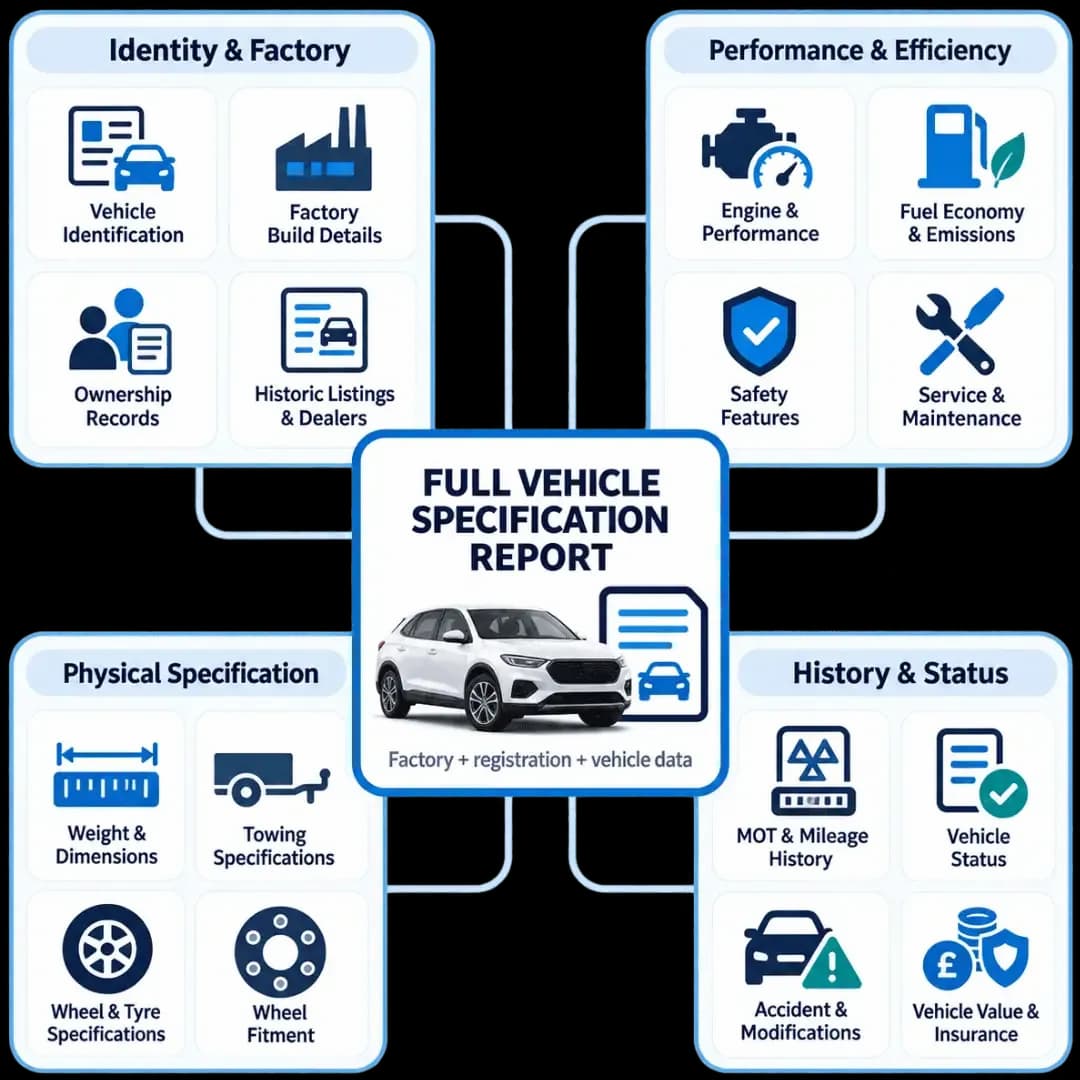
The vehicle identification section of the spec check report confirms a vehicle's exact identity using registration plate data, including its make, model, variant, year of manufacture, and VIN (Vehicle Identification Number).
These vehicle specifications are sourced from Driver and Vehicle Licensing Agency (DVLA) records and cross-checked against the manufacturer's original factory build sheets.
A vehicle’s exact model and specification data are important for a buyer because two cars sharing the same nameplate differ in engine size, trim level, and safety rating.
This creates confusion between model variants and leads buyers to make incorrect assumptions about the vehicle's true specification before purchase.
CarVeto’s Number Plate Check resolves this uncertainty by retrieving the vehicle's 17-character VIN (Vehicle Identification Number) for accurate identification of the exact model and factory-assigned specification of the vehicle.
The vehicle identification details in a vehicle specification report are given below.
- VIN Verification: A specification report validates the 17-character VIN (vehicle identification number) against manufacturer records to confirm the vehicle's authenticity and factory-assigned identity.
- Vehicle Registration: The vehicle spec report confirms the vehicle's current and historical registration status by cross-referencing the registered number plate with official records.
- Vehicle Record: The vehicle record within a spec report consolidates all DVLA-held and manufacturer-assigned information into a single verified profile.
- Model Range: The model range data in a car specification report places the vehicle within the manufacturer's broader product lineup.
- Model Sub Range: The model sub range in a vehicle specification report specifies the vehicle's exact body style and variant classification within its model family.
- Derivative: The derivative section in a specification report identifies the vehicle's precise trim level, engine configuration, and transmission type.
- Vehicle Description: The vehicle description in a vehicle spec report provides a standardised summary of the vehicle, combining the make, model, derivative, and body style.
- IDS Code: The IDS (integrated diagnostic system) code included in a car spec report provides specific vehicle configurations within a model range.
- Model Year: The model year mentioned in a vehicle specification report specifies the production cycle to which the vehicle belongs.
- Year of Manufacture: The year of manufacture written in a specification report confirms when the vehicle was physically built.
- Introduced Date: The introduced date in a spec report confirms when the specific model of a vehicle was officially launched by the manufacturer.
- Production End Date: The production end date mentioned in a vehicle spec report indicates whether the vehicle belongs to an active or discontinued production run.
- Number of Axles: The number of axles confirmed in a vehicle specification report defines the vehicle's structural configuration for classification purposes.
- Vehicle Colour: The vehicle colour recorded in a car specification report confirms the DVLA-registered colour associated with the vehicle.
- Registration Status: The registration status within a spec report confirms the vehicle's current and historical registration status.
Our comprehensive vehicle spec report gives the exact drivetrain metrics, vehicle statistics, and performance capability.
A car specification check on a 2019 Jaguar I-PACE EV400 will give exact mechanical parameters including 395 BHP (brake horsepower) power output, 513 Nm torque, 124 mph top speed, and 4.5-second 0-60 mph acceleration.
This specification report will also provide engine configuration, cylinder arrangement, and engine capacity (cc) of the 2019 Jaguar I-PACE EV400.
A vehicle’s engine and performance specifications help buyers make informed decisions by enabling performance, efficiency, and suitability comparisons across vehicles before purchase.
These specifications determine insurance group placement, fuel economy, running costs, and long-term maintenance requirements, which directly impact the total cost of ownership over months and years.
Users searching for queries like what is the engine capacity of my car, check engine code by reg, what engine size is my car, and check car engine size want to verify a vehicle's factory-assigned engine and performance specifications.
A CarVeto BHP Check uses the registration or VIN of a vehicle to provide these details to the buyers so they can verify power output and compare vehicles.
The engine and performance details in a vehicle specification report are mentioned below.
- Engine Type: A vehicle specification report identifies the engine type assigned to the vehicle at the point of manufacture.
- Engine Displacement: The engine displacement section in a specification report specifies the engine's cubic capacity (cc) and cylinder count of the vehicle based on factory data.
- Engine Size: A car specification report gives the vehicle’s engine size and engine code.
- Horsepower: A vehicle spec report provides the horsepower figure assigned directly to that specific vehicle from the manufacturer's performance records.
- Brake Horsepower (BHP): A specification report provides the exact BHP figure from factory-assigned performance specifications to define the vehicle’s official output rating.
- Torque Output: The torque output in a vehicle specification report represents the engine’s maximum rotational force, measured in Newton metres (Nm).
- Transmission Type: A spec report identifies the transmission type from factory build data of the vehicle, indicating whether it is manual or automatic.
- Drivetrain: The drivetrain configuration section in a vehicle spec report specifies whether the vehicle is front-wheel drive, rear-wheel drive, or four-wheel drive.
- Fuel Type: A specification report states the factory-assigned fuel type of the vehicle, such as petrol, diesel, hybrid, or electric.
- Top Speed: A car specification report gives the top speed in mph (miles per hour) based on OEM performance records of the vehicle.
- Acceleration (0-100 km/h): A spec report provides the 0-100 km/h acceleration figure to specify the performance capability of the vehicle.
- 0-60 Acceleration: The 0-60 mph acceleration figure allows comparison of the real-world performance of a vehicle across different engine configurations.
CarVeto’s vehicle specification report provides the exact fuel system and type (petrol, diesel, electric, or hybrid), recommended oil type, and fuel tank capacity in litres.
A difference in MPG (miles per gallon) rating between two similar vehicles affects the daily fuel expenses over months or years of ownership.
This makes fuel economy and fuel type confirmation critical for vehicle buyers to calculate monthly and annual running costs before purchase.
UK car buyers use the spec check report to get answers to common questions, like ‘how big is my fuel tank’, ‘how many litres is my car’, 'what engine size is my car’, and ‘how many cylinders in my car’.
The fuel economy and emissions details in a vehicle specification report are provided below.
- Fuel Economy: The fuel economy figure in a vehicle specification report provides the official fuel efficiency rating assigned to that specific vehicle.
- Combined MPG: The combined MPG figure in a vehicle spec report reflects the official average fuel consumption of the vehicle during urban and extra-urban driving conditions.
- Urban MPG: The urban MPG figure in a car specification report provides the vehicle’s official fuel consumption in stop-start city driving conditions.
- Extra Urban MPG: The extra urban MPG figure in a specification report specifies the vehicle’s official fuel consumption on faster, open-road driving conditions.
- Emissions Rating: The emissions rating shown in a spec report confirms the official emissions classification assigned to the vehicle by registration number.
- Euro Emission Standard: The Euro emission standard shown in a vehicle specification report identifies the level of exhaust emissions the vehicle was certified to produce.
- ULEZ Compliance: The ULEZ compliance status displayed in a car specification report indicates whether the vehicle can enter the Ultra Low Emission Zone without paying a daily charge.
- Running Cost Estimation: The running cost estimation data in a vehicle spec report gives the expected monthly and annual operating costs.
Our vehicle spec report gives the exact dimensions and weight of the car.
A car specification report on the 2019 Jaguar I-PACE will provide vehicle specifications such as gross vehicle weight of 2,670 kg, a kerb weight of 2,244 kg, a wheelbase of 2,990 mm, and a boot space capacity of 407 litres.
Exceeding the manufacturer-assigned payload restrictions risks mechanical failure, creates legal liability, and invalidates insurance coverage.
Weight and dimensions in a spec report help buyers evaluate similar vehicles before a purchase decision by highlighting differences in gross vehicle weight, payload capacity, and structural measurements.
CarVeto’s vehicle specification check provides these Car Dimensions by the registration number to help buyers make an accurate evaluation of the vehicle before purchase.
The weight and dimension data details included in a full vehicle specification report are listed below.
- Kerb Weight: A vehicle specification report confirms the kerb weight, which represents the total weight of the vehicle without passengers or cargo.
- Vehicle Weight: The vehicle weight provided in a vehicle spec report reflects the total mass of the vehicle recorded in the original factory build data.
- Gross Vehicle Weight: Gross vehicle weight in a specification report is the maximum legal operating weight of a car or LCVs (light commercial vehicles), including passengers, cargo, and fuel.
- Front Axle Weight: The front axle weight in a specification report identifies the maximum load permitted on the front axle of a vehicle.
- Rear Axle Weight: A spec report includes the rear axle weight of the vehicle, which specifies the maximum load rating permitted on the rear axle.
- Vehicle Dimensions: The vehicle dimensions in a car specification report provide the complete factory-assigned measurements of its physical size.
- Vehicle Length: A spec report provides the length of the vehicle from the front bumper to the rear.
- Vehicle Width: The vehicle width in a car specification report represents the distance across the widest point.
- Vehicle Height: The vehicle’s height measurement in a specification report is the distance from the ground to the highest fixed point.
- Wheelbase: The wheelbase in a vehicle specification report measures the distance between the centres of the front and rear axles, to check ride stability and interior space of a vehicle.
- Ground Clearance: Ground clearance in the vehicle spec report is the distance between the lowest point of the vehicle and the ground.
- Seating Capacity: The seating capacity in a spec report is the total number of factory-fitted seats assigned to that specific vehicle.
Our car spec report provides the towing capacity, nose weight, maximum wheel load, and wheel load rating assigned by the manufacturer.
These specifications determine the maximum trailer, caravan, or load weight a vehicle can safely tow or carry within its rated structural and braking limits.
Towing limits help buyers choose suitable trailers and loads while avoiding excessive weight that could compromise vehicle stability, braking performance, towing safety, and compliance with UK road laws.
Towing weight specifications in a vehicle specification report are provided below.
- Towing Capacity: The towing capacity stated in a vehicle spec report provides the maximum total weight the vehicle can tow, based on structural and braking limits.
- Max Braked Towing Weight: The max braked towing weight provided in a specification report is the maximum load the vehicle can tow when the trailer is fitted with its own independent braking system.
- Max Unbraked Towing Weight: The max unbraked towing weight in a car spec report is the maximum load the vehicle can tow when the trailer has no independent braking system.
- Nose Weight: The nose weight specified in a spec report is the maximum downward force that a trailer can apply to the vehicle's tow bar.
- Roof Load Limit: The roof load limit in a car specification report shows the maximum weight permitted on the vehicle's roof.
- Maximum Wheel Load: The maximum wheel load in a vehicle specification report is the highest permissible weight that a vehicle's single wheel can safely support under load conditions.
- Wheel Load Rating: The wheel load rating in a vehicle spec report indicates the maximum load each wheel of the vehicle can safely carry under full-load conditions.
Wheel and tyre specifications in a vehicle specification report include tyre size, load index, speed rating, wheel dimensions, rim diameter, and tyre width.
Incorrect tyres and wheel specifications affect vehicle safety, grip, and driving stability on UK roads.
A vehicle specification report gives buyers verified wheel and tyre data to confirm correct fitment and compatibility before purchase.
Wheel and tyre specifications included in a vehicle specification report are provided below.
- Original Wheel Specification: The original wheel specification in a vehicle spec report gives the factory-assigned wheel and tyre configuration for that specific vehicle.
- Pitch Circle Diameter (PCD): The Pitch Circle Diameter measurement in a specification report identifies the diameter of the circle formed by the wheel bolt centres.
- Centre Bore Diameter: The centre bore diameter specification in a car spec report details the size of the wheel's central hole that fits over the hub.
- Rim Width: The rim width measurement in a spec report provides the internal width of the wheel rim to determine compatible tyre width for safe fitment.
- Rim Offset: The rim offset value in a car specification report is the distance between the wheel's mounting face and its centre line to check wheel positioning, steering geometry, and suspension clearance.
- Load Index: The load index rating in a vehicle specification report shows the maximum weight each vehicle tyre can safely support at its rated speed.
- Speed Index: The speed index rating in a vehicle spec report indicates the maximum safe operating speed of a vehicle tyre under its rated load.
- Load Index (Front): The front load index rating in a specification report is the maximum safe load capacity of the front tyres of a vehicle, based on axle load distribution requirements.
- Load Index (Rear): The rear load index rating in a car spec report is the maximum safe load capacity of the rear tyres of the vehicle, based on axle load distribution requirements.
- Speed Index (Front): The front speed index rating in a spec report sets out the maximum safe operating speed of the vehicle's front tyres.
- Speed Index (Rear): The rear speed index rating in a car specification report sets out the maximum safe operating speed of the vehicle's rear tyres.
- TPMS Fitted Status: The TPMS (tyre pressure monitoring system) fitted status in a vehicle specification report shows whether this system is factory-installed in the vehicle.
- Run Flat Tyre Status: The run flat tyre status indicated in a vehicle spec report identifies whether the vehicle is factory-fitted with run-flat tyres that allow continued driving at reduced speed after a puncture.
- Extra Load Tyres Status: The extra load tyre status recorded in a specification report shows whether the vehicle requires extra load-rated tyres with a higher maximum load capacity than standard tyres.
Our spec check report confirms the exact specifications required for correct wheel installation on a specific vehicle.
These fitment specifications ensure the wheels are installed correctly to maintain vehicle stability, steering accuracy, and safe load distribution across the axle.
Wheel fitment details in a vehicle specification report are given below.
- Nut/Bolt Thread Type: The wheel fastener thread specification in a vehicle specification report specifies the correct thread pattern required for wheel nuts and bolts of the vehicle.
- Nut/Bolt Torque: Nut and bolt torque data in a car specification report provides the vehicle’s manufacturer-assigned tightening specification for wheel fasteners.
- Nut/Bolt Hex Size: The nut and bolt hex size data in a vehicle spec report provides the exact tool size required for wheel fastener removal and refitting during tyre changes and wheel maintenance.
- Bolt Length: Bolt length data in a specification report specifies the exact thread engagement length of the wheel bolt to determine safe and compatible wheel bolt fitment.
8. Factory Build Details
CarVeto’s vehicle specification report sources factory build details from OEM (Original Equipment Manufacturer) build sheets and manufacturer databases.
Verified factory option data in this report helps buyers confirm a vehicle's true value, support fair price negotiation, and avoid overpriced purchases.
Standard specification checks omit optional equipment, whereas a full vehicle specification report gives the complete factory-assigned build specification.
A full vehicle specification report provides interior and exterior factory options that determine aesthetics and comfort, with mechanical drivetrain data that defines performance.
The factory build data points included in a full vehicle specification report are listed below.
- Factory Build Intelligence: The factory configuration intelligence section in a vehicle specification report gives the exact trim, derivative details, and equipment packages assigned to that specific vehicle.
- Production Intelligence: The production intelligence section in a vehicle specification report provides the exact manufacturing data assigned to that specific vehicle at the point of production.
- Vehicle Augmentation Availability: The vehicle augmentation availability section in a spec check report identifies which factory-approved upgrades and additions were available for that specific model at the point of production.
- OE Build Sheet Status: The OE (original equipment) build sheet status in a vehicle spec report confirms whether the original equipment build sheet is available for that specific vehicle.
- Fitments Availability: Fitments availability data in a spec report lists which factory-approved fitments were available for the vehicle at the point of manufacture.
- Factory Configuration Intelligence: Factory configuration intelligence in a car specification report gives the exact combination of options, trim levels, and equipment packages assigned to that specific vehicle.
- Factory Equipment: Factory equipment in a vehicle specification report provides all manufacturer-fitted items, including optional additions such as cruise control and 360-degree parking cameras.
- Factory-Fitted Equipment: The factory-fitted equipment section in a specification report distinguishes each item physically installed during production from later additions or aftermarket modifications.
- Factory Equipment Category: Factory equipment category in a spec report classifies each factory-fitted item in the vehicle by type, such as safety, comfort, technology, or performance.
- Factory Equipment Status: A car specification report identifies the factory equipment status to indicate whether each vehicle feature was standard, optional, or unavailable for the specific vehicle configuration.
- Factory Feature Codes: The factory feature codes section in a vehicle spec report gives the manufacturer-assigned reference codes for each factory-fitted feature, including paint codes such as Metallic Paint.
- Factory Option Code: The factory option code in a car spec report gives the manufacturer-assigned code for each optional extra fitted to that specific vehicle.
- Optional Equipment Codes: Optional equipment codes in a vehicle specification report state the manufacturer-assigned identifiers for each optional extra available for that specific vehicle.
- Standard Equipment Codes: Standard equipment codes in a spec report give the manufacturer-assigned identifiers for each item included as standard in that specific vehicle's base specification.
- Optional Equipment Price: The optional equipment price section in a car specification report gives the original manufacturer's price of each optional extra fitted to that specific vehicle.
- OEM Option Pricing: OEM option pricing in a vehicle specification report gives the original manufacturer-assigned price for each factory option in a vehicle.
- Standard Equipment Indicator: A vehicle spec report identifies the standard equipment indicator, showing which features were included as standard when the vehicle left the factory.
- Free Equipment Indicator: The free equipment indicator in a spec report states which factory-fitted items were included in the vehicle at no additional cost to the original buyer.
- Upholstery Specification: The upholstery specification section specifies a vehicle’s factory-assigned interior trim material, such as Ebony Windsor Leather and audio packs like the Meridian Surround Sound system.
- Unique Attributes: The unique attributes section in a car specification report provides any distinguishing features of the vehicle, like bespoke paint codes and exclusive interior finishes.
CarVeto’s specification report covers the factory-fitted active and passive safety systems for a specific vehicle.
These features in the specification report define the level of occupant protection a vehicle provides to determine how effectively a vehicle reduces accident risk and minimises injury severity in a collision.
Safety features in a vehicle specification report are given below.
- Safety Rating: The safety rating in a vehicle specification report records the official crash test result assigned to that specific vehicle.
- Airbag System: Airbag system data in a car specification report provides the factory-assigned airbag count and positioning in the vehicle.
- ADAS Features: A specification report identifies the ADAS (advanced driver assistance features) fitted at the factory, including systems such as lane departure warning, autonomous emergency braking, and blind spot monitoring.
- ABS and Stability Control: ABS (anti-lock braking system) and stability control data in a car specification report specify whether anti-lock braking and electronic stability control were factory-fitted in the vehicle.
OEM (Original Equipment Manufacturer) service schedules and maintenance data in a specification report provide the exact service intervals in miles and months, average fleet repair costs, and associated labour rates for a specific vehicle.
These metrics are evaluated alongside the vehicle's exact date of registration because maintenance schedules and component wear are strictly tied to a vehicle's lifespan and accumulated mileage.
Service and maintenance data in a vehicle specification report helps buyers plan maintenance costs, predict future repair expenses, and avoid unexpected breakdowns or servicing costs before purchase.
Service and maintenance data in the vehicle specification report are listed below.
- Service Engineering Data: Service engineering data in a specification report gives the manufacturer-assigned maintenance specifications for that specific vehicle.
- Fixed Service Regime: A vehicle spec report confirms whether the fixed service regime applies, indicating manufacturer-defined maintenance intervals that remain constant regardless of driving conditions.
- OEM Service Schedule: The OEM service schedule within a vehicle specification report provides manufacturer-assigned service intervals measured in miles and months.
- Oil Capacity: The oil capacity specified in a car specification report identifies the exact volume of engine oil required for the vehicle’s engine.
- Coolant Capacity: The coolant capacity mentioned in a vehicle spec report is the total volume of coolant required by the vehicle’s cooling system.
- Gearbox Capacity: The gearbox capacity in a specification report specifies the precise volume of transmission fluid required for correct gearbox operation of the vehicle.
- Antifreeze Percentage: The antifreeze percentage in a spec report is the manufacturer-recommended coolant concentration required to protect the vehicle’s engine from freezing and overheating under operating conditions.
Our vehicle history report confirms the number of previous registered keepers and the length of each ownership period.
This helps buyers understand the vehicle's ownership history and provides valuable context about how it may have been used and maintained over time.
A high number of owners within a short period may raise questions about the vehicle's history and can affect resale value, while long-term ownership may indicate more consistent use and maintenance.
Vehicle ownership records in a vehicle specification report are listed below.
- Ownership History: The ownership history section in a specification report gives the complete registered keeper timeline.
- Previous Keeper Count: The previous keeper count in a vehicle spec report is the total number of registered keepers a vehicle has had.
- Previous Keeper Acquisition Date: The previous keeper acquisition date in a vehicle specification report shows when each registered keeper took ownership of the vehicle.
- Previous Keeper Disposal Date: The previous keeper disposal date in a car specification report provides information on when each registered keeper sold or transferred the vehicle.
- V5C Issue Date: The V5C issue date in a vehicle spec report specifies when the current V5C logbook was issued for a vehicle.
- Last Seen Date: The last seen date in a spec report shows the most recent date the vehicle appeared in official DVLA records.
Our vehicle spec report provides MOT and mileage history from DVSA (Driver and Vehicle Standards Agency) records.
These records help verify the vehicle’s condition over time by showing its recorded mileage at each MOT test date. Inconsistencies in this report’s data indicate potential mileage fraud or undisclosed mechanical issues.
MOT and mileage history details included in a vehicle specification report are given below.
- MOT Mileage Records: MOT mileage records in a vehicle specification report give the vehicle’s odometer reading at each MOT test date.
- Mileage Verification: The mileage verification in a vehicle specification confirms whether the odometer reading is consistent with the vehicle's service history.
- MOT Advisories: MOT advisories in a vehicle specification report give the non-critical faults identified in the vehicle at each MOT test date.
CarVeto’s spec report shows whether the vehicle is imported, exported, scrapped, or registered as SORN (Statutory Off Road Notification).
This information helps buyers avoid vehicles that cannot be legally driven or registered for road use.
Vehicle status checks in a vehicle specification report are provided below.
- Imported Status: The imported status recorded in a vehicle specification report shows whether the vehicle was originally registered outside the UK before being imported.
- Exported Status: The exported status shown in a specification report specifies whether the vehicle has been officially recorded as exported from the UK.
- Scrapped Status: The scrapped status included in a vehicle spec report confirms whether the vehicle has been officially declared as scrapped.
- SORN Status: The SORN status within a spec report shows whether the vehicle has been declared off the road.
CarVeto’s vehicle specification report retrieves data about accidents and modifications from salvage networks, insurance records, and manufacturer build data.
This information in the report reveals the extent of previous structural or mechanical damage, along with recorded repair information to show how the vehicle has been repaired over time.
Modification checks in this report identify alterations to the vehicle's factory-assigned specification that affect safety, insurance validity, and resale value.
The accident and modification data points included in a full vehicle specification report are listed below.
- Accident History: The accident history within a specification report specifies damage incidents and repair events associated with the vehicle.
- Hidden Modifications Detection: The hidden modifications detection feature in a car spec report highlights deviations from the vehicle's original factory specification.
Historic listing data and dealer records in a vehicle specification report are sourced from classified advertisement databases and trade data.
Listing history in the report reveals previous advertised prices, mileage claims, and specification descriptions.
Comparing these previous listings with the vehicle's current details helps buyers verify that the vehicle information being advertised is accurate.
Any differences in this data highlight issues such as incorrect vehicle information, mileage discrepancies, or undisclosed changes by the seller.
Historic listings and dealer records in a vehicle specification report are given below.
- Historic Seller: Historic seller data in a vehicle spec report shows the previous private sellers associated with that specific vehicle.
- Historic Dealer: The historic dealer record in a specification report provides previous trade sales and dealer transactions associated with that specific vehicle.
- Historic Listing Dates: Historic listing dates in a car spec report specify when the vehicle was previously advertised for sale.
- Dealer Name: The dealer name recorded in a car specification report identifies the registered trade seller associated with each previous vehicle sale.
- Dealer Location: The dealer location included in a vehicle specification report identifies the geographical location of previous vehicle trade sellers.
A specification report by CarVeto provides an estimate of the vehicle’s current market value and helps assess whether the asking price is reasonable.
This also helps buyers understand the likely insurance and tax costs associated with the vehicle.
Vehicle value and insurance data in a vehicle specification report are provided below.
- Market Value: The market value section in a vehicle spec report is the current estimated worth of that specific vehicle based on its age, mileage, condition, and factory-assigned specification.
- Insurance Group: The insurance group in a specification report identifies the manufacturer-assigned insurance category of the vehicle based on its specification, performance, and risk profile.
- Road Tax Band: A car's VED (road tax) band in a spec report is set by its CO₂ emissions, fuel type, and registration date, which determine how much road tax you pay.
Car Spec Check Reviews from Real Customers
CarVeto’s car specification checks are rated 4.8 on Google, which shows the accuracy and reliability of the data in our car spec report.
Vehicle buyers in the UK consistently praise how a CarVeto car specification check helps them identify differences between a vehicle's advertised details and its official manufacturer specifications before making a purchase.
Reviewers also mention that the report provides detailed information about the vehicle's trim level, engine size, car dimensions, and factory-fitted features.
Used car buyers share that the car specification check confirms the vehicle's engine displacement and CO₂ emissions, helping them better understand its performance and running costs.
Highly recommend!
Lisa Wooffinidin
⭐⭐⭐⭐⭐
I used CarVeto for the first time after I initially buying a history check from RAC.
After buying a 2nd history check from CarVeto I was able to ask advice (not an option with RAC that I could see) which will hopefully lead to a successful purchase (fingers crossed!).
Great and quick service, would highly recommend!
Great service
Glen Lawrence
⭐⭐⭐⭐⭐
Car veto, went above and beyond to help on a technical issue outside of the standard details provided.
Will definitely use again.
Thanks Michelle
How to Get Your Vehicle Specification Report?
To get your vehicle specification report, enter a UK registration number or 17-character VIN into CarVeto’s spec check tool, run the car specification check, and review the full factory-assigned specification data provided.
This gives buyers accurate make, model, MOT test number, Tax, emission details, engine, trim, and equipment details of a vehicle before a purchase decision.
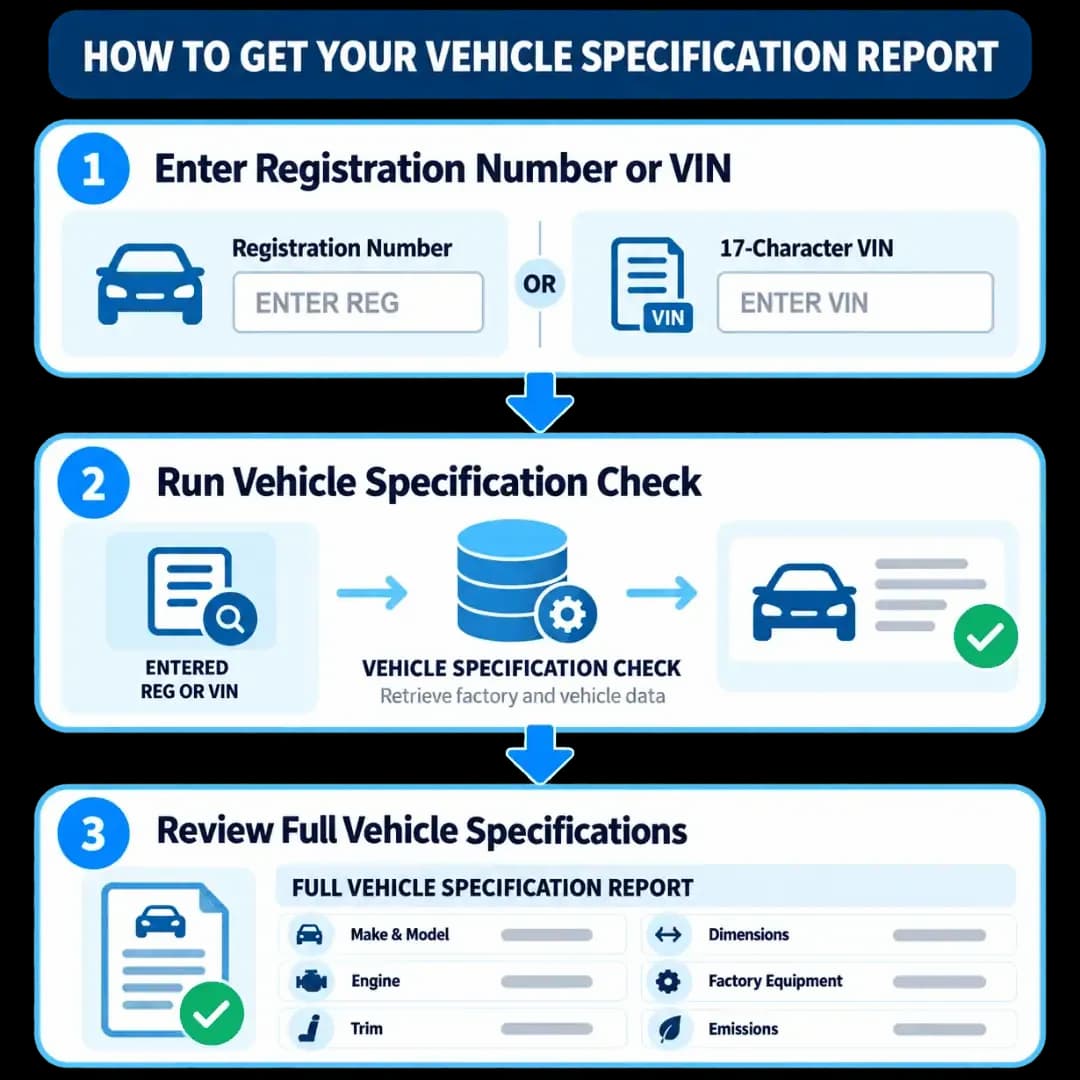
The process of obtaining your vehicle specification report is outlined below.
- Enter the Registration Number or VIN: Type your vehicle's UK registration number or 17-character VIN into the CarVeto search field. These identifiers retrieve verified factory build data from official records and OEM-linked specification databases for the vehicle specification report.
- Run the Vehicle Specification Check: Click ‘Enter’ to run the car specification check. The CarVeto data system processes the vehicle records and generates a vehicle specification report containing factory-assigned specification data.
- Review Your Full Vehicle Specifications: Check your full vehicle specification report to review engine details, trim level, dimensions, equipment list, and all factory-assigned build data for that specific vehicle.
Why is Specification Check Important Before Buying a Vehicle?
A specification check is important before buying a vehicle because it verifies the seller's description against the V5C logbook and factory specifications.
A car specification report provides the trim level, model variant, engine size, fuel type, vehicle specifications, and factory-fitted features, which helps to identify misdescribed vehicles.
This gives buyers accurate data for the exact vehicle they are purchasing instead of its general model to help avoid issues that affect value, running costs, and insurance of a vehicle.
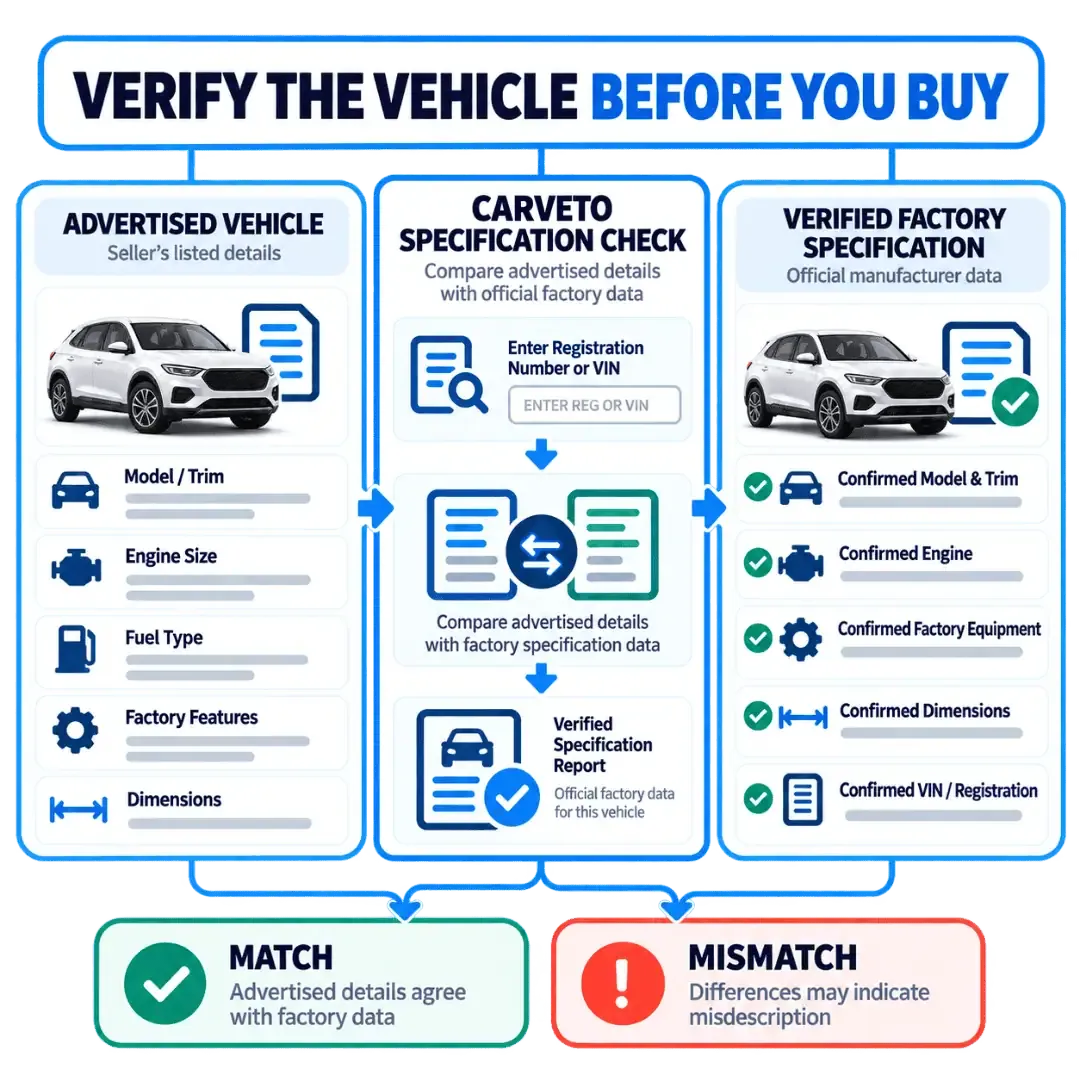
Verifies Seller Descriptions
A car specification check verifies seller descriptions by cross-referencing advertised vehicle details against official records and manufacturer build data.
Differences between the advertised vehicle specifications and the data in the report, such as the model, engine size, or factory-fitted equipment, can indicate that the vehicle has been misdescribed by the seller.
Confirms Trim and Model Variant
A car specification check confirms the trim of the vehicle and its model variant assigned at the point of manufacture.
This is important because two vehicles sharing the same model name differ in engine type, transmission type, and drivetrain configuration.
CarVeto's car specification check helps buyers distinguish between model variants and confirm the exact factory-assigned specification of that specific vehicle.
Validates Vehicle Specifications
A car specification check validates vehicle specifications, including power output, seating capacity, vehicle dimensions, towing capacity, CO₂ emissions, and the Euro emission standard.
Validated specifications from a car specification check confirm if the physical car matches its official manufacturer record.
This protects buyers from purchasing a vehicle with undisclosed mechanical or structural differences.
Buyers searching for an emissions checker, running an engine number check, or looking to check CO2 emissions by registration number can find this data within a car specification check.
Validates VIN and Registration Data
A car spec check validates VIN and registration data by cross-referencing the vehicle's 17-character VIN and registered number plate against DVLA records and manufacturer build sheets.
Inconsistencies between these vehicle identifiers indicate a cloned identity, a tampered VIN plate, or fraudulent re-registration.
Avoids Overpaying for Misdescription
A car specification check avoids overpaying for a misdescribed vehicle by confirming the exact factory configuration against the advertised details.
Discrepancies between the advertised trim level, engine size, or factory-fitted equipment and the official manufacturer build data of the vehicle give buyers an accurate pricing context.
Compares Similar Vehicles Accurately
A car spec check compares similar vehicles accurately by retrieving the exact factory-assigned specification for each vehicle.
Seller descriptions and general model listings group vehicle variants with different mechanical and performance attributes under the same name, which produces inaccurate comparisons.
Verified specification data in the specification report eliminates this ambiguity by giving buyers a reliable like-for-like basis for evaluating multiple vehicles before a purchase decision.
Confirms Factory-Fitted Features
A vehicle specification check confirms factory-fitted features by retrieving the original equipment list assigned to a vehicle at the point of production.
Aftermarket additions and dealer-fitted accessories are not part of a vehicle's factory specification, and sellers frequently present these as original equipment to inflate perceived value.
CarVeto's car specification check distinguishes between manufacturer-installed equipment and aftermarket additions such as the vehicle's original safety features, ADAS systems, and braking configuration.
This helps buyers accurately assess the vehicle’s true specification and make more informed purchasing decisions.
What is the Difference Between a Car Specification Check and a Full History Check?
The difference between a car specification check and a full history check lies in factory specifications, engine details, dimensions, equipment lists, ownership history, and mileage history.
CarVeto provides vehicle buyers with a free car spec check and a full vehicle specification check.
A basic free car check provides standard MOT data, while a comprehensive Vehicle History Report exposes critical legal, financial, and safety risks.
The differences between a car specification check and a full history check are given in the table below.
Data Category | Car Specification Check | Full History Check |
|---|---|---|
Factory Specifications | Included | Not Included |
Engine Details | Included | Not Included |
Trim Verification | Included | Not Included |
Dimensions | Included | Not Included |
Equipment List | Included | Not Included |
Ownership History | Not Included | Included |
Finance Status | Not Included | Included |
Write-Off Records | Not Included | Included |
Theft Records | Not Included | Included |
Mileage History | Not Included | Included |
Which Vehicle Manufacturers Do We Provide Car Specification Reports For?
We provide car specifications for all vehicle manufacturers such as Ford, Nissan, SEAT, Cupra, Suzuki and Bentley.
A CarVeto car specification check retrieves verified factory build data sourced from each manufacturer's original production records using a registration number or VIN (Vehicle Identification Number).
Car specification reports are available for the manufacturers listed below.
- Ford
- Vauxhall
- Volkswagen
- Audi
- BMW
- Mercedes-Benz
- Toyota
- Nissan
- Hyundai
- Kia
- Peugeot
- Citroën
- Renault
- Dacia
- Skoda
- SEAT
- Cupra
- Honda
- Mazda
- Suzuki
- Volvo
- MG
- Tesla
- Land Rover
- Jaguar
- Mini
- Lexus
- Porsche
- Fiat
- Jeep
- Alfa Romeo
- DS Automobiles
- Polestar
- BYD
- Omoda
- Jaecoo
- Leapmotor
- XPeng
- NIO (Currently, relatively limited registrations)
- Aston Martin
- Bentley
- Rolls-Royce
- McLaren
- Lotus
- Maserati
- Ferrari
- Lamborghini
- Morgan
- Caterham
- DAF
- Scania
- MAN
- Iveco
- Isuzu
- Volvo Trucks
- Mercedes-Benz Vans
- Ford Commercial Vehicles
- Volkswagen Commercial Vehicles
- Renault Trucks
- Saab
- Chrysler
- Dodge
- Chevrolet
- Rover
- Daewoo
- Pontiac
- Hummer
- Infiniti
- Daihatsu
- Proton
- Perodua
- Lancia
- Datsun
- SsangYong
Frequently Asked Questions (FAQ)
The vehicle types supported by a CarVeto car specification check are given below.
- Cars: A car specification check provides full factory build data, including make, model, engine, trim, and equipment for all UK-registered passenger cars.
- Vans: The car spec check gives verified engine, drivetrain, and payload specifications for UK-registered vans by using the registration number. A van check on CarVeto confirms gross vehicle weight, load rating, and body type, helping buyers assess payload capacity and suitability for commercial use.
- Light Commercial Vehicles (LCVs): The vehicle specification check provides structural and mechanical specifications, including axle configurations and engine data for LCVs.
- Motorcycles: The car specification check gives factory-assigned engine capacity, power output, and model specifications for UK-registered motorcycles by registration number. CarVeto's VIN verification motorcycle confirms frame type, fuel system, and transmission configuration against manufacturer records.
Yes, a car specification check provides details about your car's trim level by retrieving the derivative and equipment data assigned to that vehicle at the point of manufacture.
A CarVeto car specification check confirms this using either the vehicle's registration number or its 17-character VIN against OEM manufacturer records.
A registration number retrieves DVLA-held data, while VIN decoding provides the exact trim designation, factory-fitted equipment, and specification differences between vehicles sharing the same model name.
Yes, you can verify exact factory options from a vehicle specification report by entering a UK registration number or 17-character VIN.
A CarVeto car specification check retrieves the original factory-assigned equipment list directly from OEM manufacturer records to confirm which factory options were fitted to that specific vehicle at the point of production.
Yes, a car specification check reveals a misdescribed vehicle by verifying official DVLA records and manufacturer build data against the seller's description.
Differences between the seller's advertised vehicle details, the V5C logbook description, and the factory-assigned specification can highlight incorrectly described engine sizes, trim levels, drivetrain configurations, or equipment features.
A CarVeto car specification check by registration number or VIN helps identify these differences before a vehicle buyer commits to a purchase.
Yes, a car specification check can reveal your vehicle's BHP by retrieving the official power output assigned to that specific vehicle.
A vehicle specification report provides the manufacturer-assigned BHP figure using the registration number to help verify the vehicle's exact performance specification.
This information is sourced from official manufacturer records to ensure the BHP data reflects the specific vehicle rather than a general figure for the model range.
Yes, a car specification check helps verify DVLA logbook details by comparing V5C-registered information with the vehicle's original factory specification.
A CarVeto spec check uses the registration number to retrieve and validate key vehicle details against both the V5C logbook and manufacturer build data to ensure the physical vehicle matches its official registration records.
This comparison helps to identify discrepancies that may indicate vehicle cloning, ringing, or heavily modified vehicles that deviate from the original OE (Original Equipment) build sheet.
Verifying DVLA logbook details is the first step in a complete vehicle background investigation.
A full CarVeto vehicle history check goes beyond the V5C logbook by uncovering ownership records, outstanding finance, theft markers, and other historical information that cannot be verified from registration records alone.
Understand the DVLA Logbook to learn what information the V5C records confirm and how it supports full due diligence when purchasing a used vehicle.
If the vehicle specification report does not match the advertised engine size, it may indicate that the vehicle has been misdescribed.
A mismatch in a vehicle’s engine size or displacement affects insurance validity, road tax classification, and parts compatibility.
This makes it important to verify that the advertised details match the vehicle's official specification.
Yes, you can find vehicle dimensions using a car specification check report by entering a UK registration number.
A CarVeto car specification check retrieves the factory-assigned dimensions for that specific vehicle directly from OEM manufacturer records.
A VIN-based Check reveals more accurate vehicle specifications than a registration lookup because the VIN (Vehicle Identification Number) is a permanent factory-assigned identifier linked directly to the vehicle’s original build.
The VIN provides the manufacturer's build sheet, which provides the exact trim level, engine specification, and factory-fitted options assigned at production.
Registration records may not always reflect the full factory specification or detailed build information.
UK used car buyers can run a VIN Check on CarVeto to get a more precise and complete view of the vehicle’s original configuration.
Yes, a comprehensive car specification check shows ULEZ compliance status by retrieving the vehicle's official engine type, Euro emission standard, and fuel type.
This helps buyers avoid purchasing a vehicle that incurs daily ULEZ charges before committing to a purchase.
Yes, the age of a car directly impacts both its specifications and value because a vehicle's year of manufacture gives its factory specifications, including emissions class and WLTP fuel economy ratings.
These age-dependent specifications influence the vehicle's legal tax band, ULEZ compliance status, running costs, and market depreciation as emissions standards evolve.
Age-related specifications of a car require cross-referencing with official registration documents for accuracy.
You can run a Vehicle Age Check on CarVeto to retrieve the official registration date, exact age, and all age-dependent specification metrics for that specific vehicle.