

How Does the CarVeto Car Tax Calculator Work?
The CarVeto car tax calculator works by using your vehicle registration number to retrieve official vehicle information and calculate the road tax payable for your vehicle.
Road tax is calculated using key vehicle information linked to your registration, including the registration date, fuel type, engine size, emissions data, and tax class where applicable.
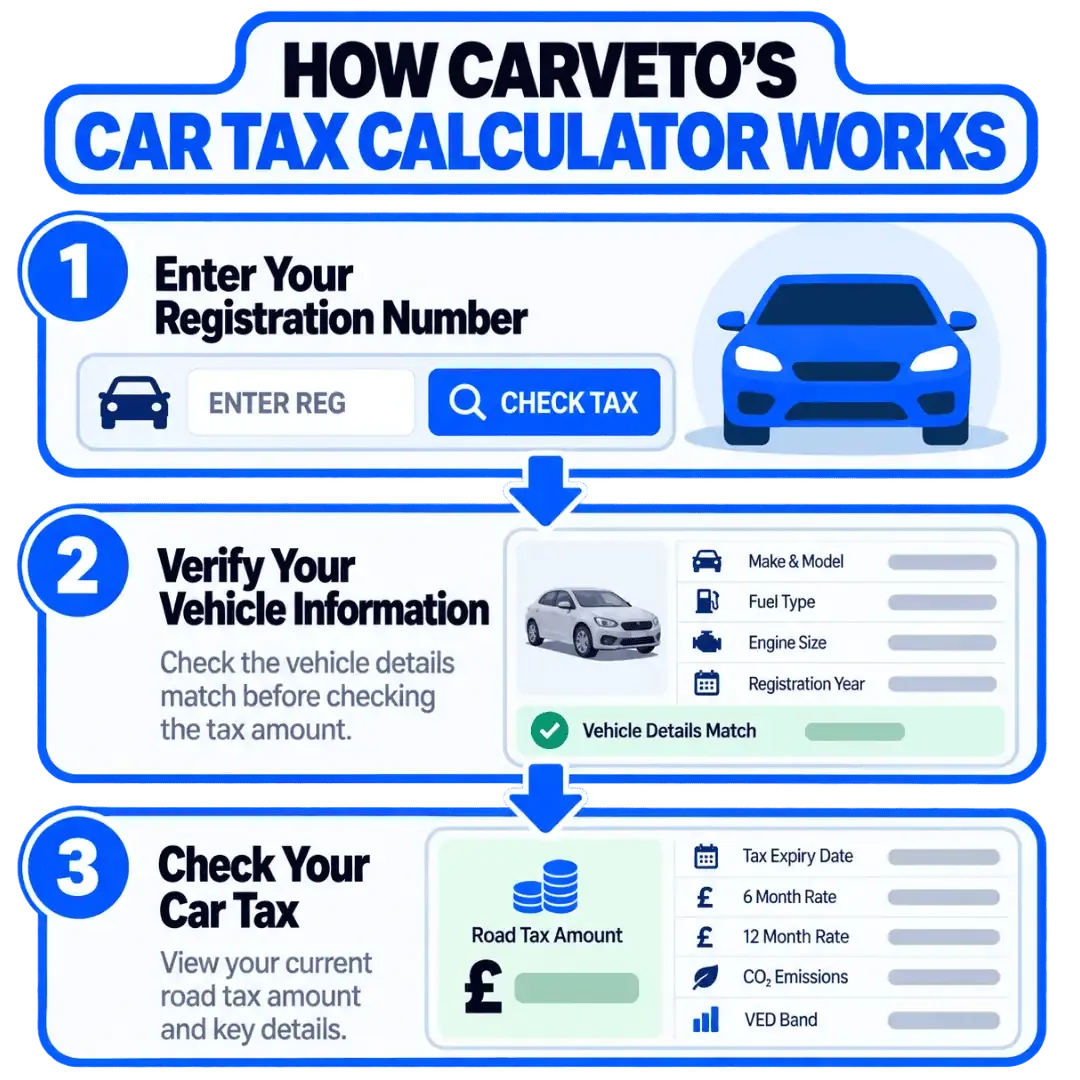
The 3 steps to use CarVeto's car tax calculator are given below.
- Enter Your Registration Number: Enter your UK vehicle registration into the CarVeto DVLA road tax calculator to identify your vehicle and begin the car tax check.
- Verify Your Vehicle Information: Make sure the displayed vehicle details, including the make, model, fuel type, engine size, and year of registration, match your vehicle before checking the car tax cost.
- Check Your Car Tax: View your estimated UK road tax amount based on your vehicle's official records so you can quickly find out how much Vehicle Excise Duty (VED) is payable.
What Does Our Free Car Tax Calculator Show?
CarVeto's free car road tax calculator shows the road tax expiry date, number of days remaining before renewal, 6-month road tax rate, 12-month road tax rate, CO₂ emission, and VED band.
This information helps you learn about the road tax cost and renew your vehicle tax on time.
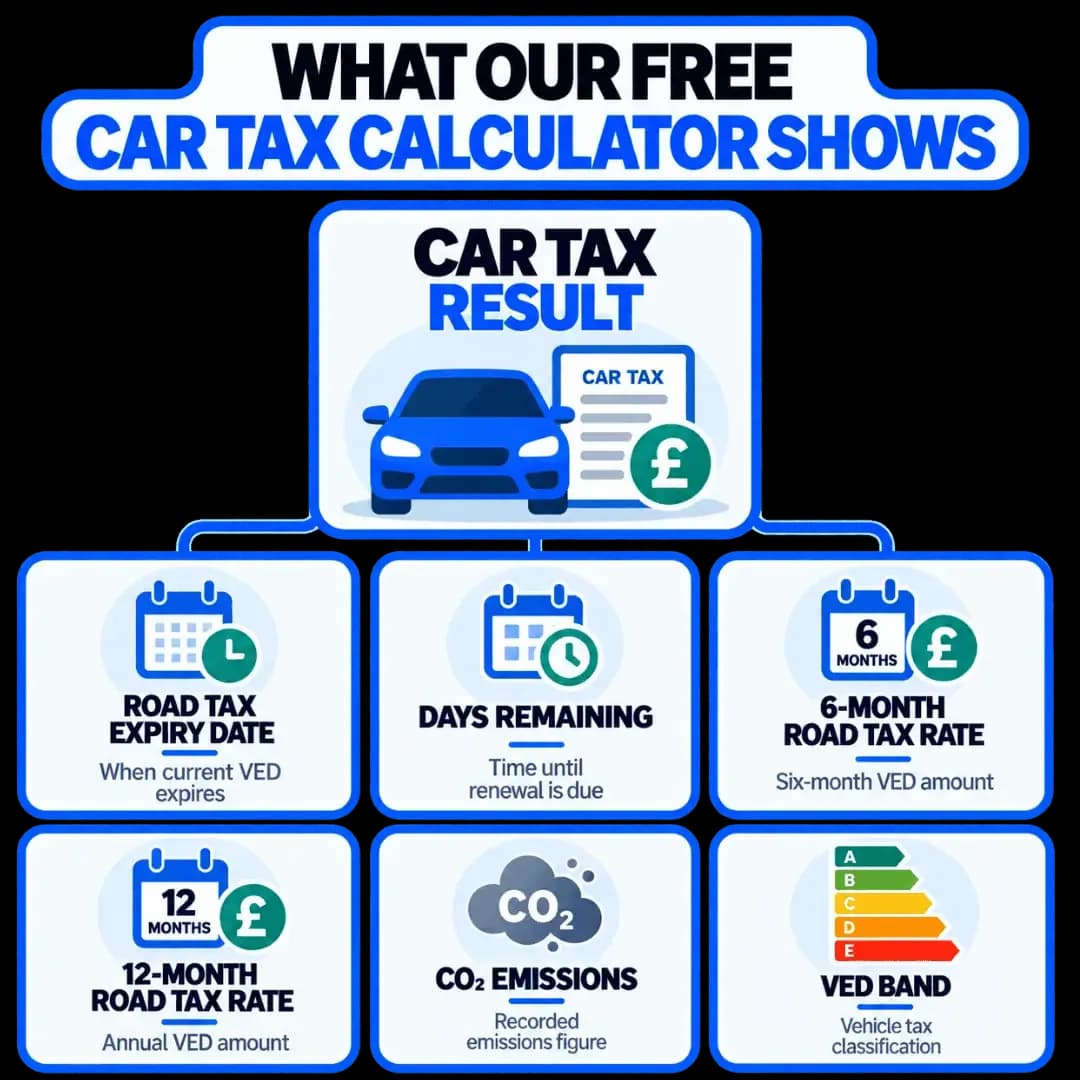
Important information shown by our free DVLA car tax calculator is given below.
- Road Tax Expiry Date: CarVeto's free car tax calculator shows the date your current Vehicle Excise Duty (VED) expires to help you renew your vehicle tax before it lapses.
- Days Remaining: Our car tax calculator displays the number of days remaining until your road tax expires, making it easier to plan your renewal on time.
- 6-Month Road Tax Rate: CarVeto's road tax calculator calculates the six-month Vehicle Excise Duty (VED) payable for your vehicle based on its official tax classification.
- 12-Month Road Tax Rate: Our DVLA car tax calculator displays the annual Vehicle Excise Duty (VED) payable, which allows you to compare the cost of a full year's road tax with the six-month option.
- CO₂ Emissions: CarVeto's car tax calculator shows your vehicle's recorded CO₂ emissions, which are used to determine the applicable road tax rate for many UK vehicles.
- Vehicle Excise Duty (VED) Band: Our road tax calculator identifies your vehicle's VED band, which confirms the tax category used to calculate the amount of road tax payable.
Read Customer Reviews of Our Car Tax Calculator
CarVeto is rated 4.8 stars on Google and Trustpilot for helping thousands of UK car buyers check road tax and verify key vehicle information before purchasing a used vehicle.
Many reviewers mention that our car tax calculator helped them reduce the risk of unexpected ownership costs after the sale.
UK car buyers praise that CarVeto’s car tax calculator helps them make more informed buying decisions and identify potential issues before committing to a vehicle purchase.
Many UK motorists appreciate the accuracy of our vehicle data, the ease of checking road tax by registration, and the confidence our reports provide when buying, selling, or owning a vehicle.
How Much Is Car Tax in the UK?
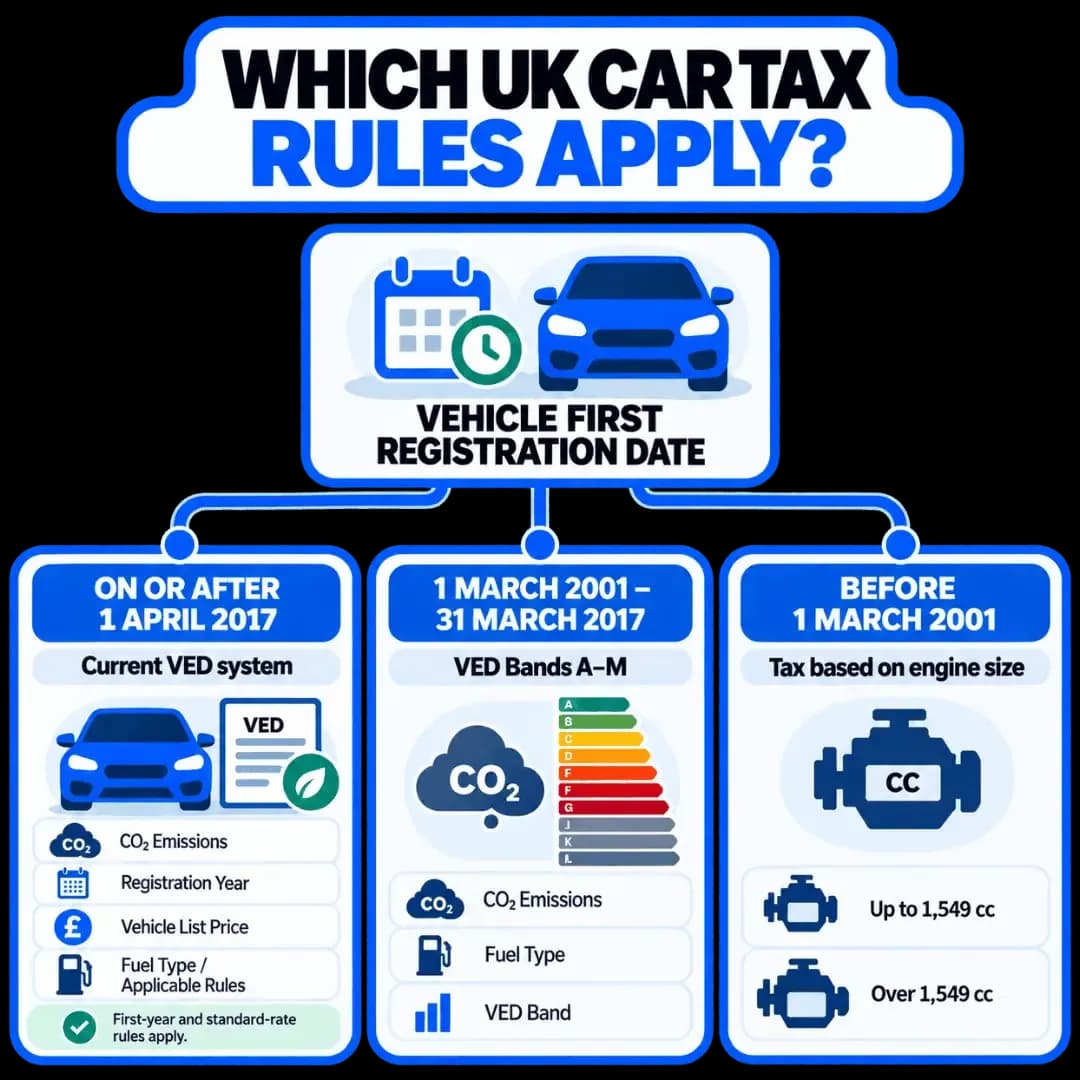
The amount of car tax in the UK depends on when your vehicle was first registered, as different Vehicle Excise Duty (VED) rules apply to different registration periods.
Vehicles registered on or after 1 April 2017 follow the current VED system, with tax based on factors such as CO₂ emissions, registration year, and list price.
Vehicles registered between 1 March 2001 and 31 March 2017 are taxed according to their fuel type and CO₂ emissions, while vehicles registered before 1 March 2001 pay road tax based on their engine size.
You can use the CarVeto car tax calculator to find out how much your road tax is using only your registration number.
The UK car tax rules for each vehicle registration period are explained below.
Cars Registered on or after 1 April 2017
UK cars first registered on or after 1 April 2017 follow the current Vehicle Excise Duty (VED) system.
The amount of car tax payable depends on whether it is the vehicle's first year of registration or a later year.
The first-year tax rate is calculated using the vehicle's official CO₂ emissions, and most vehicles move to a standard annual rate from the second year onwards.
Vehicles with a list price above the £40,000 threshold and electric cars above a £50,000 threshold are also subject to an extra tax.
This additional charge is known as the expensive car supplement and is payable for five years from the vehicle's second licence.
First-Year Tax Rate
The first-year tax rate applies when a new car is first registered in the UK.
The first-year Vehicle Excise Duty (VED) is calculated according to the vehicle's official CO₂ emissions (g/km) for cars registered on or after 1 April 2017.
New diesel cars that do not meet the Real Driving Emissions Step 2 (RDE2) standard may also be charged at the next highest first-year VED band.
The first-year Vehicle Excise Duty (VED) rates are shown below.
CO₂ Emissions | Diesel cars (TC49) that meet the RDE2 standard, petrol cars (TC48), Alternative fuel and zero emission cars | All other diesel cars (TC49) |
|---|---|---|
0g/km | £10 | £10 |
1 to 50g/km | £115 | £135 |
51 to 75g/km | £135 | £280 |
76 to 90g/km | £280 | £365 |
91 to 100g/km | £365 | £405 |
101 to 110g/km | £405 | £455 |
111 to 130g/km | £455 | £560 |
131 to 150g/km | £560 | £1,410 |
151 to 170g/km | £1,410 | £2,270 |
171 to 190g/km | £2,270 | £3,420 |
191 to 225g/km | £3,420 | £4,850 |
226 to 255g/km | £4,850 | £5,690 |
Over 255g/km | £5,690 | £5,690 |
Standard Annual Tax Rate
The standard annual tax rate applies from the second year onwards for most cars first registered on or after 1 April 2017.
The standard rate is not based on CO₂ emissions, and most petrol, diesel, hybrid, and electric vehicles pay the same annual Vehicle Excise Duty (VED).
The standard annual Vehicle Excise Duty (VED) rates are shown below.
Payment Type | Petrol or diesel, Electric & Alternative Fuel |
|---|---|
Single 12 month payment | £200 |
Single 12 month payment by Direct Debit | £200 |
Total of 12 monthly payments by Direct Debit | £210 |
Single 6 month payment | £110 |
Single 6 month payment by Direct Debit | £105 |
Expensive Car Supplement
The expensive car supplement is an additional Vehicle Excise Duty (VED) charge that applies to higher-value vehicles.
This supplement applies to cars with a manufacturer's list price of more than £40,000 and to electric or zero-emission vehicles with a list price of more than £50,000.
You must pay an additional £440 per year on top of the standard annual Vehicle Excise Duty (VED) if your vehicle exceeds the applicable list price threshold.
The supplement applies from the second time the vehicle is taxed and continues for five consecutive years.
Cars Registered Between 1 March 2001 and 31 March 2017
Cars first registered between 1 March 2001 and 31 March 2017 are taxed according to their fuel type and official CO₂ emissions (g/km).
These vehicles are classified into Vehicle Excise Duty (VED) bands from Band A to Band M.
Each band represents a specific CO₂ emissions range, which determines how much Vehicle Excise Duty (VED) the vehicle must pay.
Lower-emission vehicles are placed in lower VED bands and pay less road tax, while higher-emission vehicles fall into higher bands and pay higher Vehicle Excise Duty (VED).
The standard Vehicle Excise Duty (VED) rates for each VED band are shown in the table below.
VED Band | CO₂ Emissions (g/km) | Standard 6-Month Rate | Standard 12-Month Rate |
|---|---|---|---|
A | Up to 100 | N/A | £20 |
B | 101 to 110 | N/A | £20 |
C | 111 to 120 | N/A | £35 |
D | 121 to 130 | £93.50 | £170 |
E | 131 to 140 | £110 | £200 |
F | 141 to 150 | £123.75 | £225 |
G | 151 to 165 | £151.25 | £275 |
H | 166 to 175 | £178.75 | £325 |
I | 176 to 185 | £198 | £360 |
J | 186 to 200 | £225.50 | £410 |
K* | 201 to 225 | £244.75 | £445 |
L | 226 to 255 | £418 | £760 |
M | Over 255 | £434.50 | £790 |
*Includes cars with a CO₂ figure over 225 g/km but were registered before 23 March 2006.
Cars Registered Before 1 March 2001
Cars first registered before 1 March 2001 are taxed according to their engine size (cc) rather than their CO₂ emissions.
These vehicles fall into one of two Vehicle Excise Duty (VED) categories based on whether the engine capacity is up to 1,549 cc or over 1,549 cc.
The standard Vehicle Excise Duty (VED) rates based on engine size are shown below.
Engine Size | Standard 6-Month Rate | Standard 12-Month Rate |
|---|---|---|
Up to 1,549 cc | £126.50 | £230 |
Over 1,549 cc | £206.25 | £375 |
Frequently Asked Questions (FAQ)
The road tax for your car depends on its registration details, so there is no single Vehicle Excise Duty (VED) rate that applies to every vehicle in the UK.
The amount payable is determined by factors such as the vehicle's registration date, CO₂ emissions, fuel type, engine size (for vehicles registered before 1 March 2001), manufacturer's list price, and the Vehicle Excise Duty (VED) rules that apply to its registration period.
You can use the free CarVeto car tax calculator to find out how much your car tax is.
Simply enter your vehicle registration number to retrieve your vehicle's official details and check your road tax in seconds.
The main factors used to calculate UK car tax are given below.
- CO₂ Emissions: Vehicle Excise Duty (VED) for many vehicles is based on their official CO₂ emissions (g/km), as lower-emission vehicles pay less road tax than higher-emission vehicles.
- Fuel Type: Your vehicle's fuel type, such as petrol, diesel, hybrid, or electric, affects how Vehicle Excise Duty is calculated under the applicable UK tax rules.
- Vehicle List Price: Cars with a manufacturer's list price above the applicable threshold may be subject to the expensive car supplement, which increases the amount of road tax payable for five years.
- Registration Date: A vehicle's registration date determines which Vehicle Excise Duty (VED) system applies, as different registration periods use different factors, such as engine size or CO₂ emissions, to calculate road tax.
A car tax band is a classification system that determines the amount of vehicle excise duty (VED) you must pay.
The tax band is based on the vehicle's official CO₂ emissions for cars registered between 1 March 2001 and 31 March 2017.
Lower CO₂ emission vehicles are placed in lower tax bands and higher CO₂ emission vehicles are placed in higher tax bands.
UK cars registered before 1 March 2001 are taxed according to their engine size.
You can use our Free Car Check to verify your vehicle's tax band and access additional vehicle information.
You can check if your car is taxed by entering your vehicle registration number into the free CarVeto Car Tax Calculator.
Our calculator retrieves your vehicle's official tax information and shows whether your Vehicle Excise Duty (VED) is valid.
It also shows the road tax expiry date, days remaining, 6-month and 12-month tax rates, CO₂ emissions, and Vehicle Excise Duty (VED) band.
You should learn about the Checks Before Buying a Used Car to verify a vehicle's tax history, legal status, and other details before purchasing it.
You can pay car tax through several methods, including Online Tax Renewal, Direct Debit, and Post Office Renewal.
You can complete an Online Tax Renewal through the official DVLA vehicle tax service, pay by Direct Debit in monthly, six-monthly, or annual installments where available, or renew your Vehicle Excise Duty (VED) at a Post Office that offers vehicle tax services.
Car tax payment requires the reference number from your V11 vehicle tax reminder, V5C logbook, or V5C/2 new keeper slip.
A valid MOT certificate is also required, where applicable, before Vehicle Excise Duty (VED) can be renewed.
Yes, you can check your motorbike tax online by entering your motorbike's registration number into the free CarVeto Road Tax Calculator.
The calculator retrieves your motorbike's official vehicle information and displays its Vehicle Excise Duty (VED) status, road tax expiry date, and other tax details to help you check your motorbike tax in seconds.
Motorcycles are taxed under separate Vehicle Excise Duty (VED) rates based primarily on their engine size, rather than the CO₂ emissions used for most cars.
No, company car tax and road tax are two different types of vehicle tax in the UK. Road tax, also known as Vehicle Excise Duty (VED), is a tax paid to keep a vehicle legally used on public roads.
Company car tax is a personal tax paid by employees who use a company car for private journeys.
The differences between company car tax and road tax are given below.
Feature | Company Car Tax | Road Tax (Vehicle Excise Duty) |
|---|---|---|
Purpose | Tax on the personal use of a company car provided by an employer. | Tax for keeping a vehicle on public roads in the UK. |
Who Pays? | The employee using the company car. | The registered keeper or person responsible for taxing the vehicle. |
How It Is Calculated? | Based on the vehicle's P11D value, CO₂ emissions, and the applicable Benefit-in-Kind (BiK) rate. | Based on factors such as the vehicle's registration date, CO₂ emissions, fuel type, engine size (for older vehicles), and list price, where applicable. |
Paid To | HM Revenue & Customs (HMRC) through Income Tax. | Driver and Vehicle Licensing Agency (DVLA) as Vehicle Excise Duty (VED). |
Yes, the cost of car tax changes every year in the UK, as Vehicle Excise Duty (VED) rates are announced through the UK government's budget announcements.
These updates reflect inflation, environmental policies, or changes to the Vehicle Excise Duty (VED) system, such as revised CO₂ emissions thresholds or fuel type classifications.
The amount of road tax you pay continues to depend on factors such as your vehicle's registration date, CO₂ emissions, fuel type, engine size (for older vehicles), and, where applicable, its manufacturer's list price.
You should regularly Check Car Tax to verify your current vehicle tax details, check your latest road tax cost, and estimate your Vehicle Excise Duty (VED) using your registration number.
Electric vehicles are taxed at a flat rate in the UK, as these vehicles do not emit CO₂.
Electric cars first registered on or after 1 April 2017 are charged the first-year Vehicle Excise Duty (VED) at a flat rate of £10.
Electric vehicles pay the same standard annual Vehicle Excise Duty (VED) of £200 as most other cars from the second year onwards.
Electric vehicles with a manufacturer's list price exceeding £50,000 are also subject to the expensive car supplement.
These cars must pay an additional £440 per year on top of the standard annual Vehicle Excise Duty (VED) from the second licence, which continues for five consecutive years.
You can check if your car has an additional road tax charge by entering your registration number into the free CarVeto Car Tax Calculator.
The calculator retrieves your vehicle's official details and shows whether any additional Vehicle Excise Duty (VED) charges apply, such as the £440 annual charge for cars over £40,000.
You can also confirm your vehicle's tax details using its V5C logbook.
Use our Free Vehicle Check for a more complete overview of your vehicle's history and official records.
Vehicles that meet specific legal or statutory exemption criteria are exempt from paying Vehicle Excise Duty (VED) in the UK.
Some cars are automatically exempted from the car tax, while others must be claimed with the DVLA and are subject to specific eligibility requirements.
The vehicle types exempt from car tax are listed below.
- Vehicles used by a disabled person
- Disabled passenger vehicles
- Historic vehicles
- Mobility vehicles and powered wheelchairs
- Electric vehicles
- Mowing machines
- Steam vehicles
- Vehicles used for agriculture, horticulture and forestry
- Statutory Off Road Notification (SORN)
Driving or keeping an untaxed vehicle in the UK results in penalty notices, fines, vehicle clamping, vehicle impoundment, or prosecution, depending on the circumstances and the enforcement action taken.
Untaxed vehicles are identified through Automatic Number Plate Recognition (ANPR) cameras that allow enforcement authorities to detect vehicles that are not taxed.
You should renew your Vehicle Excise Duty (VED) before your road tax expiry date to avoid penalties and enforcement action.
Paying road tax annually is better than paying monthly since it is more cost-effective.
Vehicle Excise Duty (VED) can be paid by Direct Debit in monthly, six-monthly, or annual instalments, but monthly payments include an additional charge, which makes the total amount paid over the year higher than paying annually.
Monthly payments may be more manageable if you prefer to spread the cost, but paying annually offers the lowest overall cost.
You can use our DVLA Check to find out when your road tax is due and confirm the amount of VED payable.
No, your road tax and MOT do not usually expire at the same time. Vehicle Excise Duty (VED) and the MOT are independent legal requirements that are not aligned automatically.
An MOT is generally due every year based on the date of the vehicle's first registration or its previous MOT test, and road tax is renewed according to the date it was last taxed.
Our MOT Check helps you check your car tax and MOT expiry dates in one place, making it easier to verify your current MOT status alongside your vehicle tax information.
No, you do not need to pay car tax if your vehicle is registered as a SORN (Statutory Off Road Notification).
A SORN confirms that the vehicle is kept off public roads, so Vehicle Excise Duty (VED) is not payable while the SORN remains in effect.
You must tax your vehicle before driving or parking it on a public road again, as a SORN is no longer valid once the vehicle is returned to public roads.
You need to renew your road tax whenever your current Vehicle Excise Duty (VED) expires.
Most vehicles in the UK are taxed for 6 or 12 months, depending on the payment option you choose.
You may also have the option to spread the cost through monthly installments, where available, if you pay by direct debit.
Renewing your road tax before its expiry date keeps your vehicle legally taxed and avoids penalties for keeping or driving an untaxed vehicle on public roads.
Yes, you will get a refund on your road tax if you sell your vehicle.
Once the DVLA is notified that the vehicle has been sold or transferred, any full months of unused Vehicle Excise Duty (VED) are refunded automatically to the registered keeper.
The refund is calculated from the beginning of the next full month after the DVLA receives notification, and the new keeper must tax the vehicle before driving it on public roads.