
HPI Check: Verify Car History Before You Buy
Check a car’s history instantly to identify outstanding finance, stolen records, write-off status, and mileage discrepancies before you commit to a purchase.
Enter your registration number to run a car check instantly.


What Is an HPI Check?
An HPI check verifies a vehicle’s identity, legal status, financial liabilities, and recorded history using authoritative data sources to build a complete Car History Search.
It compiles information from finance lenders, insurance databases, police records, and registration authorities.
The check identifies whether a vehicle carries outstanding finance, has been reported stolen, recorded as a write-off, or shows inconsistencies in mileage and identity.
By consolidating data points into a single car history report, it establishes a clear and verifiable background for any vehicle.
What does HPI mean?
HPI stands for Hire Purchase Investigation, originally referring to checks used to identify outstanding finance agreements on vehicles.
Today, an HPI check extends beyond finance to include a full vehicle history check using multiple data sources to verify ownership, insurance history, and vehicle identity.
The term now represents a comprehensive system for checking a car’s background rather than a single finance-focused check.
What an HPI check does
An HPI check is used to confirm that a vehicle is legally owned, financially clear, and accurately represented before it is bought or sold.
It identifies whether a car has outstanding finance, confirms it is not listed as stolen, and ensures that key vehicle details such as mileage and identity records are consistent across official databases.
By validating these factors, a car history check prevents buyers from unknowingly purchasing a vehicle with hidden liabilities or incorrect information.
What information an HPI check shows
An HPI check shows core vehicle data including finance records, stolen vehicle markers, insurance write-off status, mileage history, ownership records, and vehicle identity information.
Data points form a structured car history report that reflects both the legal and historical condition of the vehicle.
Together, they define the key attributes that are verified to determine whether a car is clear, consistent, and safe to proceed with.
What Does an HPI Check Verify About a Car?
An HPI check verifies a vehicle’s identity, legal status, financial liabilities, and recorded history using authoritative data sources.
It checks eight core records: vehicle identity, outstanding finance, stolen vehicle status, insurance write-off classification, mileage history, ownership records, import and export status, and MOT and tax data.
Each record is matched against official databases to confirm that the vehicle’s details are consistent, traceable, and correctly recorded.
VIN, registration and vehicle identity checks (including plate changes)
An HPI check verifies vehicle identity by matching the VIN, registration number, and chassis details across multiple records.
It confirms that the vehicle’s VIN, registration number, and make and model specifications match across all recorded data sources.
It checks consistency between registration data and manufacturer-assigned identifiers.
Plate change history is included to track registration transfers over time.
These checks confirm that the vehicle’s identity is continuous and correctly recorded across databases by verifying the Make and Model of a Car.
Outstanding finance records
An HPI check verifies outstanding finance linked to a vehicle through lender and finance company records.
It identifies active finance agreements secured against the car and confirms whether a financial interest is registered against the vehicle’s registration and VIN.
For a more detailed explanation of how lenders record and track agreements, see our guide to an Outstanding Car Finance Check.
Stolen vehicle status
An HPI check verifies whether a vehicle is recorded as stolen using police databases and national theft registers.
It checks the vehicle registration and VIN against reported theft records to confirm whether a stolen marker is currently active.
To understand how theft data is recorded and flagged, you can explore our Stolen Car Check guide.
Insurance write-off categories (Cat A, B, C, D, S & N)
An HPI check verifies whether a vehicle has been recorded as an insurance write-off.
It identifies classification categories including Cat A, Cat B, Cat S, Cat N, and legacy categories Cat C and Cat D, based on the level and type of damage sustained.
For a full breakdown of classifications and what they mean in practice, see our Car Write-Off guide.
Mileage discrepancies and clocking
An HPI check verifies recorded mileage using data from MOT records and industry mileage registers.
It compares mileage entries across multiple time points to identify inconsistencies.
Records are sourced from official testing data and mileage reporting systems.
The check confirms whether the display mileage is consistent or shows irregular patterns through a Mileage History check.
Number of previous owners
An HPI check verifies the number of previous owners using DVLA registration data.
Records include the number of registered keepers and the dates of ownership transfer, supporting a Date of Change of Ownership check.
Import and export history
An HPI check verifies whether a vehicle has been imported or exported by analysing registration and licensing records.
It identifies changes in the country of registration linked to the vehicle.
Results confirm whether the vehicle has a recorded international history through a Car Import Check.
MOT history and tax status
An HPI check verifies MOT history and tax status using DVLA and MOT databases. It retrieves MOT test records, including dates and outcomes, and checks whether the vehicle is currently taxed for use on UK roads.
You can review how these records are structured and updated in our MOT Check and tax status guide.
What Risks Will an HPI Check Reveal?
An HPI check reveals financial, legal, and safety risks that directly affect vehicle ownership, usability, and value.
It interprets verified data points to identify whether a vehicle carries hidden liabilities, inconsistent records, or structural concerns.
Risks determine whether a car can be legally owned, safely used, and accurately valued before purchase.
Vehicle identity fraud (cloning / ringing)
Vehicle identity fraud occurs when a car’s registration and identity details do not match official records.
Cloned or “ringed” vehicles use false or duplicated identities taken from legitimate vehicles.
This can result in the vehicle being seized if its true identity is identified.
Outstanding finance and repossession risk
Outstanding finance creates a legal claim over the vehicle by the lender.
The debt remains attached to the car rather than the current owner.
This can result in the vehicle being repossessed if the finance agreement is not settled.
Stolen vehicle seizure risk
A stolen vehicle record indicates that the car has been reported as stolen and remains flagged in police databases.
Ownership cannot be legally transferred while a stolen marker is active.
This can result in the vehicle being recovered and returned to its original owner.
Structural damage and write-off risk
Insurance write-off records indicate that a vehicle has sustained damage assessed by an insurer.
Structural damage classifications reflect impact to the vehicle’s frame or safety systems.
This can affect the vehicle’s structural integrity, safety, and long-term value.
Mileage fraud and valuation distortion
Mileage discrepancies indicate inconsistencies between recorded mileage entries.
Altered or reduced mileage is commonly referred to as clocking.
This can result in an inflated vehicle value and inaccurate assessment of wear and usage.
Ownership inconsistencies and vehicle history gaps
Irregular ownership records may indicate gaps or inconsistencies in keeper history.
Frequent or unexplained changes in ownership can obscure the vehicle’s past usage.
This can make it difficult to establish a clear and continuous vehicle history.
Import/export risks and hidden vehicle origin issues
Import and export records indicate that a vehicle has been registered in multiple countries.
Differences in standards, specifications, or reporting can affect available records.
This can result in incomplete history or missing data within the vehicle record.
MOT failures, advisories and roadworthiness concerns
MOT records include test results, failures, and advisory notices over time.
Repeated failures or unresolved advisories indicate ongoing maintenance issues.
This can affect the vehicle’s roadworthiness and reliability.
How to Do an HPI Check on a Car
Run an HPI check by entering the vehicle registration number into a car history check tool and retrieving the recorded vehicle data.
The registration number is the primary input used to match finance records, theft markers, write-off history, mileage entries, and identity details.
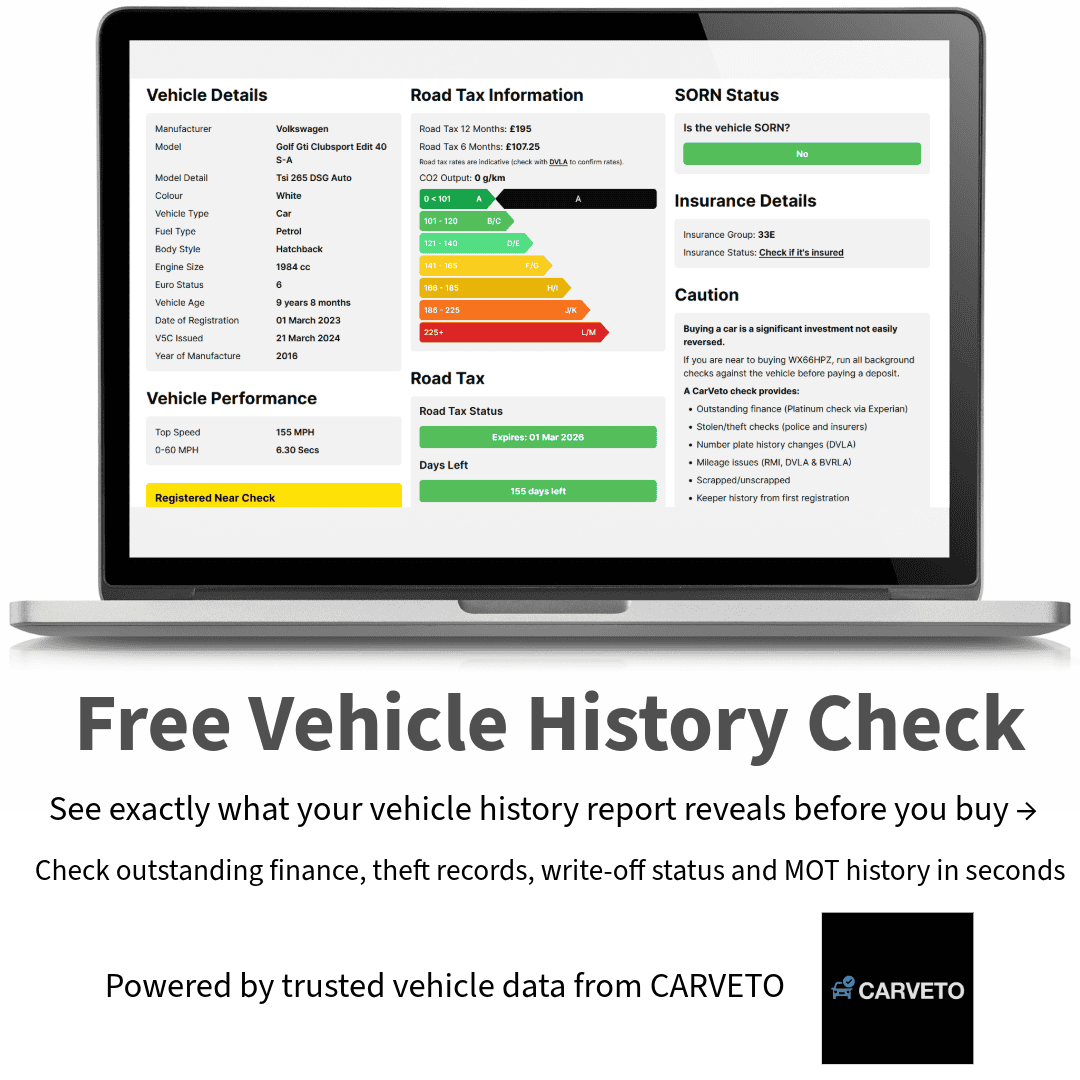
Once the report is generated, the returned data can be reviewed as a basic free HPI check or as part of a full vehicle history report.
What you need to run a check
A vehicle registration number is the primary detail required to run an HPI check.
The registration links the vehicle to its recorded finance, insurance, MOT, tax, and identity data.
A VIN can also be used to support identity matching where additional vehicle verification is needed.
How to check a car online step by step
Check a car online by entering the registration number and retrieving the available vehicle history records.
- Enter the registration number to run a Car Check and retrieve vehicle history data.
- Review the returned records for finance, stolen status, write-off history, mileage, identity, and ownership details.
- Access the full report where deeper vehicle history verification is required.
Free vs Paid HPI Checks: What’s the Difference?
Free HPI checks provide limited vehicle data, while full HPI reports verify a complete set of financial, legal, and historical records.
A free car check returns basic information such as MOT status and tax details, whereas a full vehicle history report includes finance, theft, write-off, mileage, and identity verification.
The difference lies in the depth of data retrieved and the level of verification applied to the vehicle.
Feature | Free HPI Check | Full HPI Report |
|---|---|---|
MOT History | ✅ Included | ✅ Included |
Tax Status | ✅ Included | ✅ Included |
Vehicle Details | ❌ Basic | ✅ Full |
Outstanding Finance | ❌ Not Included | ✅ Included |
Stolen Vehicle Check | ❌ Not Included | ✅ Included |
Insurance Write-Off | ❌ Not Included | ✅ Included |
Mileage Verification | ❌ Limited | ✅ Full |
Ownership History | ❌ Limited | ✅ Included |
Vehicle Identity Check (VIN/Plate) | ❌ Limited | ✅ Included |
Data Coverage | ❌ Limited | ✅ Full Multi-Source |
Is there a free HPI check in the UK?
Free HPI checks are available in the UK, but they provide only a partial view of a vehicle’s history.
Checks rely on limited or publicly available data and do not include full verification of finance, theft, or write-off records.
What a free check includes
A free HPI check includes basic vehicle data such as MOT history, tax status, and general registration details.
It is used as an initial lookup rather than a complete vehicle history check.
What a full HPI report includes
A full HPI report provides complete vehicle history verification across financial, legal, and identity records.
It includes finance data, stolen vehicle markers, insurance write-off classifications, mileage history, and ownership records sourced from multiple authoritative databases.
How much an HPI check costs
The cost of an HPI check in the UK varies depending on the level of detail provided.
Basic checks are low-cost or free, while full vehicle history reports are priced higher to reflect the additional data coverage and verification depth.
How to Read an HPI Report and Make a Decision
An HPI report is read by identifying whether the vehicle is clear or flagged across key records and using those results to determine whether to proceed, investigate further, or reject the purchase.
Each data point indicates either a clean record or a verified issue that affects ownership, legality, condition, or value.
The decision is based on the type, severity, and combination of findings within the report.
What HPI clear and flagged results mean
An HPI clear result indicates that no adverse records are present across finance, stolen status, write-off history, mileage, or identity checks.
A flagged result indicates that one or more records contain verified data such as outstanding finance, a stolen marker, a write-off classification, or inconsistent mileage.
These outcomes define whether the vehicle has a clean history or recorded issues that require evaluation.
When to walk away from a car
A vehicle should be rejected when it is recorded as stolen, linked to active outstanding finance, or shows confirmed identity inconsistencies.
Severe structural write-off records or multiple high-risk flags across the report also indicate unacceptable conditions.
Findings prevent secure ownership or indicate significant underlying issues.
When a vehicle issue may still be acceptable
A vehicle may still be considered where records show non-structural write-off classifications, minor mileage inconsistencies with explanation, or limited ownership changes without irregular patterns.
The acceptability depends on the clarity of records and consistency across the vehicle’s history.
These cases require verification against the overall condition and documentation of the vehicle.
How to use HPI findings to negotiate price
HPI findings can be used to adjust the purchase price based on recorded issues within the vehicle history.
Write-off classifications, mileage inconsistencies, and ownership patterns provide measurable factors that affect valuation.
Data points establish a basis for negotiating a lower price in line with the vehicle’s recorded condition.
When to Run an HPI Check Before Buying a Car
An HPI check is run before committing to a vehicle to verify its history at key stages of the buying process.
It is used to filter vehicles early, confirm details before viewing, and validate findings before completing a purchase.
Running a check at the correct stage ensures that vehicle history is verified before any financial or legal commitment is made.
Checking before viewing vs after viewing
An HPI check is run before viewing to filter out vehicles with adverse records such as finance, theft, or write-off markers.
It is run again after viewing to confirm that the inspected vehicle matches its recorded identity and history.
This sequence ensures that both listing-level and physical checks align with verified data.
Checking multiple vehicles
An HPI check is used during the shortlisting stage to compare multiple vehicles before selection.
Each check filters out vehicles with inconsistent or incomplete records.
This allows only verified vehicles to progress to viewing and further inspection.
Private seller vs dealer checks
An HPI check is applied to private sales, dealer listings, and auction vehicles to verify vehicle history independently of the seller.
Private sales rely entirely on buyer verification, while dealer listings may include partial checks or declared history.
The check ensures that the vehicle’s recorded data is consistent across all seller types.
Combining HPI checks with physical inspection
An HPI check is used alongside a physical inspection to validate both recorded and observed vehicle condition.
The check confirms historical and legal data, while inspection verifies mechanical and visual condition.
This combined approach ensures that the vehicle’s records and physical state are aligned before purchase.
Where HPI Data Comes From and How Reliable It Is
HPI data is sourced from authoritative organisations including government agencies, insurers, finance providers, and industry databases.
Sources supply verified records that are matched against vehicle registration and identity data to build a vehicle history report.
The reliability of an HPI check depends on the accuracy, availability, and timeliness of the data recorded across these systems.
DVLA, insurers and police data sources
HPI checks use data from the DVLA, insurance companies, and police databases, including DVLA Car Reg Checks, to verify vehicle registration, write-off records, and stolen vehicle status.
Insurance data is sourced through industry systems such as MIAFTR (now Navigate), which record write-off classifications and damage history.
Sources form the primary layer of authoritative vehicle data used in a car history check, with some information also accessible through a Government Car Check.
Finance companies and lenders
HPI checks use data from finance companies and lenders to verify outstanding finance linked to a vehicle.
This data is aggregated through credit and data providers such as Experian, linking finance agreements to vehicle registration and identity records.
Records confirm whether a financial interest is recorded against the vehicle.
National mileage registers
HPI checks use mileage data from MOT records and industry mileage registers to verify recorded mileage history.
These include contributions from organisations such as the BVRLA and wider industry reporting systems.
The data is used to compare mileage records and identify inconsistencies over time.
How accurate HPI data is
HPI data is accurate where records have been correctly reported and updated by the originating source.
Each data point reflects information recorded by the relevant authority at the time of entry.
Accuracy depends on the completeness and timeliness of updates across contributing systems.
When HPI data may be incomplete or missing
HPI data may be incomplete where records have not been reported, updated, or correctly linked to the vehicle.
Gaps can occur if information is delayed, omitted, or not recorded within contributing databases.
These limitations mean that a vehicle history check reflects available recorded data rather than unreported events.
HPI Check FAQs
Yes. You can run an HPI check without the V5C using only the vehicle registration number.
The registration number links the vehicle to its recorded history across finance, insurance, MOT, and identity data.
A VIN can be used where additional identity verification is required.
Yes. An HPI check shows outstanding finance recorded against a vehicle.
It retrieves lender data linked to the vehicle’s registration or VIN to identify active finance agreements.
This confirms whether a financial interest is attached to the vehicle.
Yes. A car can be HPI clear and still have issues if those issues are not recorded in the available data sources.
An HPI check verifies recorded data such as finance, theft, write-off, mileage, and identity.
It does not include unreported damage, mechanical faults, or condition-related issues.
No. An HPI check is not legally required before buying a car.
It is used to verify a vehicle’s financial, legal, and identity records before purchase.
This makes it a standard step in the car buying process.