

How Does Our Free Car Check Work?
CarVeto's free car check runs in 3 steps, using live DVLA, MOT and tax records to confirm a vehicle's legal status in seconds.
Step 1: Enter the registration number above in the search box to run a reg car check free. CarVeto matches the registration number against official DVLA records to locate the vehicle.
Step 2: CarVeto pulls live DVLA, MOT, and tax records to retrieve the vehicle's current tax status, MOT history, mileage entries and registration details.
Step 3: View your car's history and legal status instantly with our free car spec check report. You may upgrade to a Full Report for finance, write-off and stolen checks, plus the £10,000 finance data guarantee.
Complete Vehicle Insights in a Single Check
A free CarVeto check retrieves the key DVLA and MOT data you need to understand a vehicle’s identity, legal status, usage history, and risk checks before you buy it.
Vehicle identity and registration data confirm the car matches its official DVLA record.
This includes the make, model, VIN (Vehicle Identification Number) and full specification, checked for cloning and mis-description risks.
It also flags any mismatches between the advertised vehicle and DVLA-registered details, helping you confirm the car matches its description before you arrange a viewing.
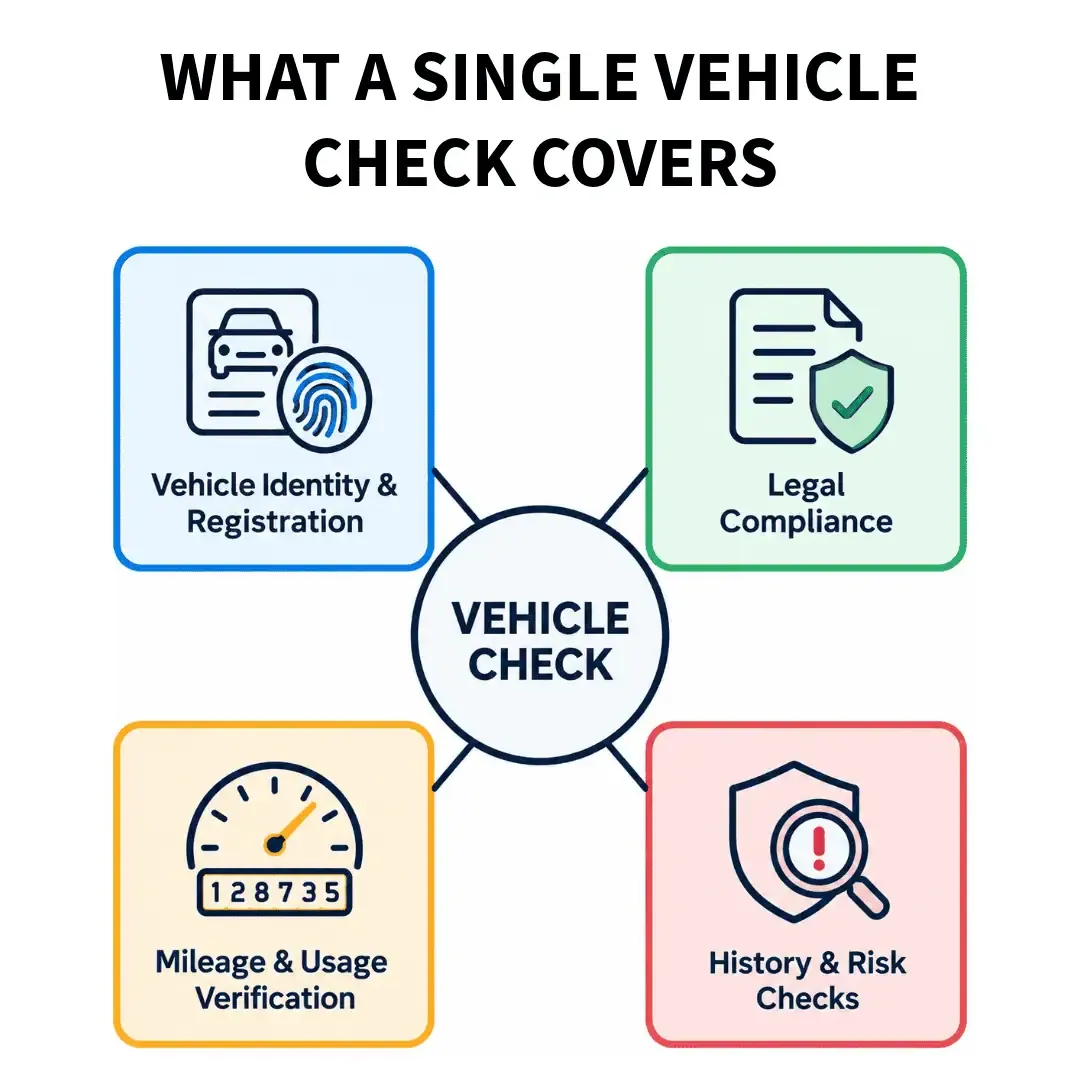
Legal compliance data shows the vehicle's MOT status, road tax, SORN (Statutory Off Road Notification) and ULEZ (Ultra Low Emission Zone) standing.
This includes the MOT expiry date, whether the vehicle has been declared SORN, and every MOT result covering passes, failures and advisory notes.
The legal compliance data helps you spot patterns of wear, maintenance gaps or warning signs before committing to a purchase. These checks confirm whether the car is currently permitted on UK roads.
Mileage and usage verification cross-checks DVLA-recorded mileage entries over time.
This creates a timestamped view of how the vehicle has been used over time, exposing clocked or rolled-back odometer readings.
The report also includes a basic keeper indicator and plate change history, which gives a clearer picture of ownership continuity and any registration changes.
History and risk checks reveal the most serious issues a used car can have, such as stolen markers, write-off status, scrapped records, and outstanding finance.
For deeper verification, such as financial checks, write-off history, stolen markers, or advanced mileage analysis, a Full History Check provides expanded risk and ownership data.
Vehicle Identity & Registration
Vehicle identity and registration details in our free car check report include official DVLA registration records, vehicle make and model information and VIN or chassis number verification.
It also confirms the number plate authenticity and provides the full vehicle specification details.
This data confirms that the car you are checking matches its official DVLA record.
These details act as a fingerprint for the vehicle, and a mismatch between any of them points to cloning, misdescription or a tampered identity.
Offenders often clone registration plates, alter logbooks or tamper with VIN markings to disguise stolen vehicles, making these checks essential before viewing any used car.
You should check the car details before viewing it to protect yourself from wasted trips and from buying a vehicle that isn't what it claims to be.
CarVeto matches the car's physical identity to DVLA-recorded data, helping you compare on-car details, VIN plates, stamped chassis numbers and manufacturer identifiers against the information returned in the report.
Any inconsistencies between the vehicle and DVLA records, no matter how small, can signal plate cloning, incorrect logbook details or wider fraud risks.
Identity checks protect you from unknowingly buying a stolen vehicle, which can be seized without compensation, and also reduce the risk of odometer manipulation, hidden write-offs or misrepresented history.
The checks included in vehicle identity and registration are written below.
Official DVLA Registration Record
Our free car check includes an official DVLA registration record that shows the vehicle's registration date, current keeper status and any recorded changes to its registration details, including previous number plates.
CarVeto's DVLA Vehicle Check retrieves this record directly from the DVLA, which includes emissions rating, Euro standard and CO₂ output.
These records help UK car buyers confirm the registration matches the car they are viewing before they commit to a purchase.
Vehicle Make and Model Information
CarVeto’s free car check shows the make and model information of the vehicle, which confirms the manufacturer, model variant, colour, and body type recorded against the vehicle's registration.
CarVeto cross-checks this against the advert to flag mismatches that often indicate an incorrect listing or a cloned plate.
VIN or Chassis Number Verification
Our car check report matches the vehicle's VIN (Vehicle Identification Number), which is its unique identity code, appearing at the base of the windscreen, on the driver's side door frame, inside the engine bay, and stamped into the chassis itself.
VIN or chassis number verification matches this stamped VIN against the number held on DVLA and manufacturer records, and all numbers must match exactly.
A VIN that does not match the DVLA-recorded VIN is one of the strongest warning signs of cloning or identity tampering, though it can also indicate an incorrect logbook.
CarVeto's VIN Check confirms the registration, VIN, and vehicle description align before you proceed. You should avoid purchasing the vehicle if anything looks altered, inconsistent or incomplete.
Number Plate Authenticity
CarVeto's free car check report includes plate-change history and DVLA-recorded identity data, which help you confirm whether the registration you are checking matches the real vehicle.
Number-plate cloning is a common fraud where criminals copy the registration of a legitimate vehicle and attach it to a different car to conceal a vehicle's identity.
Changes in plate history, such as frequent plate changes, mismatched dates or discrepancies regarding the vehicle's age, indicate cloning or fraudulent activity.
Always compare the physical plates against both the CarVeto DVLA-recorded details and the VIN to confirm the vehicle's identity and detect potential cloning.
You can also use our Number Plate Check to review official registration records and spot inconsistencies.
Full Vehicle Specification Details
A free CarVeto report includes the vehicle’s full technical specification so you can verify the car matches its advert and confirm the details are accurate.
These specification details cover engine size, BHP (Brake Horsepower), torque, fuel type, gearbox and body style, checked by DVLA and the manufacturer's records.
Vehicle specification mismatches are common in used-car listings as many sellers copy generic data, use template adverts or rely on incorrect third-party sources.
CarVeto's Car Spec Check verifies these figures so you can confirm whether the advertised features, such as engine power, trim level, or fuel efficiency, are genuine.
This gives you a reliable baseline of what the car should be, making it easier to spot a misleading advert or a vehicle that doesn't match its description.
Vehicle Legal Compliance
CarVeto's check provides key legal and compliance information, including MOT status, road tax status, SORN declarations, ULEZ compliance, emissions data, and MOT advisory history.
These checks help you assess a vehicle's legal status, roadworthiness requirements, and potential compliance costs before purchase.
The report also shows the current tax class, tax expiry date, whether the vehicle has an active export or SORN declaration, and when the next MOT test is due, confirming whether the car is currently roadworthy based on DVLA records.
Our free check reports also include an insurance coverage check to help you verify another important legal requirement before driving the vehicle.
An expired MOT, an active SORN declaration, or unpaid vehicle tax can make it illegal to use a vehicle on public roads.
A non-compliant emissions rating may also result in ULEZ or Clean Air Zone charges where applicable.
Checking these details before buying a car helps you avoid unexpected costs, legal issues, and compliance problems, and confirms that the seller is presenting accurate information about the vehicle's legal status.
You can run a full legal status overview using CarVeto's Gov Car Check.
The data points included in vehicle legal compliance are given below.
MOT Status and History
Our car check report includes full MOT status and history that shows every test the vehicle has undergone, including passes, failures, and the mileage recorded at each test.
CarVeto's MOT Check pulls this directly from DVSA records to help you confirm the car is currently roadworthy and spot recurring mechanical issues.
Road Tax Information
Road tax information included in our car check report shows the vehicle's tax class, current tax expiry date and the annual cost of keeping it taxed.
This information confirms whether the car is legally taxed and safe to drive, since driving an untaxed vehicle can lead to fines, enforcement penalties and vehicle seizure.
CarVeto's Car Tax Calculator helps you check the tax on car free and gives the exact tax band based on the vehicle's emissions and registration date.
SORN Declaration
CarVeto's free car check report confirms whether the vehicle has been formally declared SORN, meaning the vehicle has been formally taken off the road and is exempt from tax while undeclared for use.
An active SORN status on a car advertised for sale should be questioned directly with the seller before viewing.
ULEZ Compliance Check
ULEZ compliance data included in our car check report confirms whether the vehicle meets the emissions standard required to drive in Ultra Low Emission Zones without a daily charge.
This check protects buyers from unexpected running costs in cities with active clean air restrictions.
ULEZ charges and the Congestion Charge are separate schemes, so you may need to check both before driving in London.
Drivers can pay the Congestion Charge by number plate directly via the TfL (Transport for London) website, which applies specifically to driving within central London during charging hours.
Emissions and Euro Standards
CarVeto's free car check report includes the vehicle's CO₂ output and environmental classification as recorded by DVLA, which gives you a clear picture of its emissions standing before you buy.
These figures determine the car's annual tax cost and access to low-emission zones.
CarVeto's Car Tax Bands guide explains how these figures determine the car's annual tax cost and access to low-emission zones.
MOT Advisory History
Our car check report includes a full MOT advisory history that lists every advisory note raised during past tests, even where the vehicle still passed.
CarVeto's MOT Advisory Checks tool helps you spot components that have been repeatedly flagged, such as tyres, brakes, suspension, or corrosion, which often signal rising maintenance risk.
Mileage & Usage Verification
CarVeto's mileage and usage verifications include mileage history records and odometer reading verification to confirm whether a car's recorded mileage reflects its true usage history.
Accurate mileage is one of the strongest indicators of a car's real condition, reliability, and market value.
CarVeto's free car check establishes a timestamped pattern of how the vehicle has been used over time, and when those readings increase steadily and logically, the mileage is likely genuine.
A mileage curve that drops, flattens or jumps unexpectedly often signals tampering, cluster swaps or undeclared storage.
These signs are easy to miss without comparing DVLA-recorded entries over time.
Unverified mileage costs buyers money, since a falsely low reading often means paying more than the car's true condition justifies, and inconsistencies can also affect insurance cover, resale value, and the vehicle's legality.
CarVeto's Full History Check cross-matches' mileage from BVRLA and RMI datasets for deeper verification.
This reveals hidden discrepancies that are especially common in ex-lease vehicles, frequently traded cars or models with missing MOT periods.
The checks included in mileage and usage verification are given as follows.
Mileage History Records
Our car check report includes mileage history records showing DVLA-recorded mileage entries from every MOT test, creating a timestamped view of how the vehicle has been used over time.
Readings that increase steadily and logically help confirm that the vehicle's recorded mileage is consistent over time.
CarVeto's Check MOT Mileage History tool highlights sudden drops, frozen readings or unusual gaps that often signal tampering.
Our tool cross-matches mileage from BVRLA (British Vehicle Rental and Leasing Association) and RMI (Retail Motor Industry Federation) datasets, revealing hidden discrepancies that are common in ex-lease vehicles, frequently traded cars or models with missing MOT periods.
Odometer Reading Verification
Odometer reading verification data included in CarVeto's free car check report compares the mileage displayed on the car against the mileage logged in official records, flagging inconsistencies that indicate cluster swaps, rollback devices or undeclared storage periods.
CarVeto's Check Mileage tool flags inconsistencies that indicate cluster swaps, rollback devices, or undeclared storage periods.
Vehicle History & Risk Checks
Vehicle history and risk checks provided by CarVeto help you check car ownership, stolen vehicle records, write-off status, scrapped vehicle status and outstanding finance.
These reveal the most serious risks a used car can carry.
A vehicle history check also reveals issues that may not appear in advert photos or descriptions, such as inconsistent mileage, sudden keeper changes, write-off markers or missing MOT history, giving you the chance to investigate further, renegotiate the price or walk away entirely.
A stolen marker, an unresolved finance agreement or a hidden write-off can mean losing the car, your money, or both, regardless of how genuine the seller seems.
History checks also protect you from fraud risks, including cloned plates, incorrect logbook data and inaccurate advertising, all of which are harder to spot during a quick viewing but become clear once you compare the seller's claims with official vehicle records.
You should run a free car finance check and confirm this history before buying to identify risks that a vehicle inspection or test drive cannot reveal.
The checks included in vehicle history and risk checks are described below.
Ownership History
Ownership history data included in CarVeto's free car check report finds the car owner by registration number and the dates each change occurred, without exposing personal data.
Frequent or unusual keeper changes can signal inconsistent use or a higher-risk vehicle.
DVLA vehicle owner check free are not available due to strict UK data protection laws. CarVeto's Full History Check provides the keeper-change history that is legally available.
Stolen Vehicle Record Check
A stolen vehicle record check on CarVeto’s report confirms whether the car appears on the active Police National Computer (PNC) stolen markers.
CarVeto's Check if a Car is Stolen and flags this risk directly, since a stolen vehicle can be seized without compensation, even from an unknowing buyer.
Write-Off History
CarVeto’s car check report shows vehicle write-off history, which confirms whether the vehicle has previously been declared a total loss or repairable write-off by an insurer.
This record reveals the date and severity of any prior damage to help you assess whether the car has fully recovered from a serious incident.
Write-Off Category Information
Our car check report includes write-off category information that explains the severity of recorded damage, such as Cat N for non-structural issues and Cat A for total destruction.
A vehicle listed as Cat N or Cat S can be bought and driven legally once repaired, though insurance, resale value and safety may all be affected.
CarVeto's Insurance Write-Off Categories guide breaks down what each category means for safety, resale value and legal roadworthiness.
Write-off category information explains how severely a car was damaged and whether it is safe to return to the road. The 4 insurance write-off categories are listed below.
- Cat N: Category N write-off means non-structural damage, often cosmetic or electrical, but still requires proper repair.
- Cat S: Category S write-off indicates structural damage that must be professionally repaired and made roadworthy before use.
- Cat B: Category B write-off represents severe structural damage, meaning the vehicle must be broken for parts and the shell crushed.
- Cat A: Category A write-off is used for total vehicle destruction, with nothing left to salvage.
Scrapped Vehicle Status
CarVeto's free car check report confirms whether the scrapped vehicle status appears on DVLA records.
You should never buy a vehicle that shows a scrapped status. A car with a scrapped status being advertised for sale is a red flag that points to identity fraud or cloning.
Outstanding Finance Record Check
Outstanding finance record check data included in our car check report reveals whether a vehicle is still subject to an active finance agreement, such as PCP (Personal Contract Purchase) or HP (Hire Purchase).
Buying a financed car without confirming settlement can lead to repossession, even if you paid in good faith.
CarVeto's Check Outstanding Car Finance tool confirms the lender, agreement type and settlement status to protect buyers from risking repossession on a car they paid for in good faith.
What Our Users Say About Our Free Car History Check?
CarVeto is rated 4.8 on Google and 4.8 on Trustpilot, reflecting UK car buyers' trust in its fast and accurate vehicle history reports.
CarVeto has completed over 6.4 million vehicle checks and UK car buyers praise the speed and accuracy of the results to make decisions quickly.
CarVeto users say the vehicle history check helped them avoid costly mistakes by uncovering issues such as outstanding finance, mileage discrepancies, stolen vehicle markers, or write-off history before they viewed a car in person.
Many reviewers mention that the reports gave them the confidence to negotiate a fairer price, walk away from a risky vehicle, or proceed knowing the vehicle had been properly checked.
What Is the Difference Between Free and Full Vehicle History Checks?
The difference between free and full vehicle history checks is based on the availability and absence of some data points in both reports.
Free vehicle check includes basic information such as DVLA vehicle details, registration and tax status, MOT status, and DVLA mileage records.
Full Vehicle History Check shows detailed information including outstanding finance check, insurance write-off categories, plate change history, and market valuation.
These data points help UK car buyers decide which level of detail their purchase requires.
You can decide when a free check is enough and when a full report becomes essential by knowing what each level includes to avoid a costly or unsafe vehicle purchase.
The difference between the free CarVeto report and Full Vehicle History Check is given in the table below.
Data Field/Feature | Free Check | Full Vehicle History Check |
|---|---|---|
DVLA vehicle details (brand/model/body) | ✔ Included | ✔ Included |
Registration & tax status | ✔ Included | ✔ Included |
MOT status & expiry | ✔ Included | ✔ Included |
Full MOT history | ✔ Included | ✔ Included |
DVLA mileage records | ✔ Included | ✔ Included |
Multi-source mileage verification (DVLA+BVRLA+RMI) | ✖ Not included | ✔ Included* |
Outstanding finance check | ✖ Not included | ✔ Included* |
Insurance write-off categories (Cat A, B, S, N, plus legacy C & D) | ✖ Not included | ✔ Included* |
Salvage auction records | ✖ Not included | ✔ Included* |
Scrappage records | ✖ Not included | ✔ Included* |
Police stolen markers (PNC) | ✖ Not included | ✔ Included* |
Export/import marker | Export only | ✔ Included* |
Plate change history | ✖ Basic signal only | ✔ Included* |
Colour change history | ✖ Not included | ✔ Included* |
VIN Mismatch verification | ✖ Not included | ✔ Included* |
Market valuation | ✖ Not included | ✔ Included |
Risk score & purchase guidance | ✖ Not included | ✔ Included |
Price | Free | £12.95 |
*Data provided by Experian
Why Should You Use a Free Car Check Before Buying a Vehicle?
You should use a free car check, also known as a free car HPI Check (Hire Purchase Investigation), before buying a vehicle because it provides an initial view of the vehicle's identity, tax and MOT information before you hand over any money.
UK vehicles need regular MOT tests to stay roadworthy, so a check immediately shows whether the car you are viewing actually meets that legal standard.
Skipping this step can lead to expensive mistakes, since issues like outstanding finance, a hidden write-off or a cloned plate rarely show up in advert photos or during a quick viewing and require further vehicle history checks.
Running a free check takes 3 simple steps, including finding a car you are interested in, entering the registration, and seeing whether the vehicle is taxed, MOT'd, accurately described and legally safe.
A full car history check could reveal several costly issues at once, such as inconsistent mileage, sudden keeper changes, write-off markers or missing MOT history.
These issues give you the chance to investigate further, renegotiate the price or walk away entirely from buying the vehicle.
A free check also helps you identify information that may require further investigation for common fraud risks, including cloned plates, outstanding finance, incorrect logbook data and inaccurate advertising.
These risks are harder to spot during a viewing but can become clear when you compare the seller's claims against official vehicle records and carry out further vehicle history checks where necessary.
What Are the Penalties for Driving an Unchecked or Invalid Car in the UK?
The penalties for driving an unchecked or invalid car in the UK include MOT offences, roadworthiness offences, insurance offences, and vehicle tax offences.
Each offence is enforced separately by a different authority, with the police handling roadworthiness and insurance checks and the DVLA handling tax and registration.
A car missing more than one of these requirements can stack fines, penalty points and seizure risk all at once.
The key penalties for driving an unchecked or invalid car are listed below.
- MOT offence: Driving without a valid MOT certificate may result in a fine of up to £1,000, according to GOV.UK. This fine rises to £2,500 and 3 penalty points if the vehicle is judged dangerous. A quick MOT check confirms whether the vehicle is legally fit to drive and protects you from unnecessary fines.
- Roadworthiness offence: Driving a vehicle that is not roadworthy may result in the police seizing the vehicle on the spot. A seized vehicle carries a release fee of up to £200 plus a storage fee of £20 per day. Lesser faults, such as a broken brake light, are issued a rectification notice from the police requiring proof of repair within 14 days. A vehicle history check highlights MOT failures and advisories that may point to roadworthiness issues and cause vehicle seizure or enforcement action.
- Insurance offence: Driving a car without insurance carries a fixed penalty of £300 and 6 penalty points, with an unlimited fine and possible disqualification if the case reaches court. An insurance coverage check helps you confirm that the vehicle appears to have an active policy before driving, reducing the risk of fines and penalty points.
- Vehicle tax offence: Driving an untaxed vehicle may result in an automated £80 fine from the DVLA, which can escalate to a court fine of up to £1,000 if unpaid. A free vehicle check lets you verify the vehicle's tax status in seconds, which can save you from unwanted legal trouble and fines.
Do You Still Need a Physical Inspection After a Free Car Check?
Yes, you still need a physical inspection after a free car check, since the report and the car in front of you reveal different things.
A free check confirms the vehicle's online history, including tax status, MOT records and DVLA-recorded mileage, but it cannot tell you how the car actually looks, sounds or feels to drive.
A physical inspection reveals worn tyres, rust on the underside or wheel arches, corrosion, and poor repairs.
It also identifies dashboard warning lights and unusual engine noises that only become apparent once you are standing next to the car or sitting behind the wheel.
CarVeto’s free check flags risk areas worth investigating, such as a mileage gap or a sudden keeper change, and the physical inspection confirms whether the car matches what the report and the advert claim.
A short test drive helps surface mechanical noises, steering issues, braking inconsistencies, or unusual driving behaviour that neither the report nor a static inspection can catch.
A structured inspection checklist also helps you examine the bodywork, tyres, suspension, brakes, fluid levels, electrical functions, and interior condition.
For a complete walkthrough of what to examine during a viewing, use our Car Inspection Checklist.
Frequently Asked Questions (FAQ)
We retrieve your vehicle history data from the DVLA, the DVSA's MOT database, the Police National Computer (PNC), and MIAFTR (the Motor Insurance Anti-Fraud and Theft Register).
These sources provide registration details, MOT history, stolen vehicle markers, and insurance write-off records for every vehicle check.
A Full History Check also uses Experian for outstanding finance data, along with BVRLA, RMI, and the National Mileage Register for cross-verified mileage history. CarVeto also uses askMID, the Motor Insurance Database, to confirm whether a vehicle has an active insurance policy.
The data on these databases is sourced from official and licensed sources that provide trusted vehicle information from recognised UK databases.
CarVeto supports all major vehicle types, such as cars, vans, light commercial vehicles, and motorcycles.
CarVeto's motorcycle, light commercial vehicle, and van check returns the same DVLA registration and MOT history data as its standard vehicle history check does for other supported vehicle types.
All vehicle categories fall under the UK's annual MOT testing requirement once they are 3 years old.
Classic or imported vehicles may return limited data, but still include all available information.
Yes, the free car check at CarVeto is completely free, with no subscription, trial period or hidden charges.
A paid Full History Check is optional if you want finance, write-off or stolen-vehicle data on top of the free results.
A full car check report costs £12.95.
This single payment includes outstanding finance checks, write-off categories, stolen markers and multi-source mileage verification, including everything in the free check.
Yes, you can run unlimited free car checks at CarVeto on as many vehicles as you like.
You only pay if you choose to upgrade to a Full History Check for a specific vehicle that needs deeper verification.
Yes, you really need to check a car's history before viewing it, as it confirms the vehicle is taxed, MOT'd and accurately described before you travel to see it.
A car's service history is a critical piece of data, which reveals how well it has been maintained.
Buying without checking puts your money and safety at risk, since hidden finance, write-offs, or stolen markers do not show up during a quick viewing.
The information provided in a car history check at CarVeto is highly accurate, since it comes directly from DVLA, MOT databases, the Police National Computer and industry mileage sources such as BVRLA and RMI.
Car history accuracy depends on how quickly each provider updates its records, so very recent changes may take a short time to appear.
Yes, a free car history check can show a vehicle's MOT history, including every test recorded by the DVLA.
This covers passes, failures, advisories and the mileage logged at each test, giving a full chronological view of the vehicle's roadworthiness over time.
Yes, a free car check shows tax, MOT status and the due dates for both.
This includes the tax expiry date, the MOT expiry date, and whether the vehicle has been declared SORN.
No, MOT advisories in a car history check do not always indicate a problem, as an advisory flags something that is worn, deteriorating or close to the legal limit, even if it hasn't yet caused the vehicle to fail.
Advisories don't stop you from passing the MOT, but reviewing them still helps you understand ongoing maintenance needs and spot patterns before they become costly repairs.
Yes, the free car check includes the full MOT history recorded by the DVLA.
It shows MOT passes, failures, advisories and the mileage logged at each test.
No, a free car check does not show how many previous owners a car has had.
Ownership history is usually included in a Full Vehicle History Check instead, alongside the dates each change of keeper occurred.
This level of detail goes beyond what the vehicle's V5C logbook alone confirms in a quick check.
A free car check may only confirm if a vehicle is marked as exported, since this basic export marker comes directly from DVLA's registration record.
Detailed import and export history, including registration changes abroad, is generally available through a Full Vehicle History Check instead.
It's worth running a free car import check first before deciding if deeper verification is needed.
No, a free car check does not usually reveal a vehicle's accident history.
Accident and insurance write-off records are included in a Full Vehicle History Check, which covers whether the vehicle was previously damaged and how severe that damage was.
No, a free car check does not show previous plate changes. Full DVLA plate change history is available through CarVeto's full vehicle history check.
This deeper number plate check confirms every previous registration and the dates each change was applied.
Yes, you can check a car's mileage history by entering the registration number into CarVeto's free mileage tool, which pulls every DVLA-recorded mileage entry from past MOT tests.
This free UK mileage check creates a timestamped view of the vehicle's usage over time.
A free car check helps detect mileage fraud by comparing DVLA-recorded mileage from each MOT test.
Sudden drops, frozen readings, or unusual gaps show mileage tampering, odometer replacement, or missing vehicle history that isn't visible in the advert.
No, a basic DVLA check does not show if a car is stolen.
A dedicated stolen car check requires CarVeto's paid Full History Check, which confirms whether the vehicle appears on active Police National Computer stolen markers.
No, it is not safe to buy a car with outstanding finance unless the finance is fully settled.
A free car check cannot verify this, since outstanding finance data requires CarVeto's paid Full History Check to confirm the lender, agreement type and settlement status.
No, a free car check does not show if a car has been written off.
This data is only available through CarVeto's paid Full History Check, since write-off status isn't recorded on the vehicle's V5C registration document and must be checked separately.
Yes, a cloned car can still show a normal MOT history.
Criminals copy the registration and VIN from a legitimate vehicle, so the MOT history displayed may belong to the genuine car, not the cloned one being viewed.
Mileage data may not show correctly if past MOT tests were not logged properly or if DVLA records are still updating.
CarVeto's Full History Check cross-references BVRLA and RMI mileage records for extra clarity in these cases.
You should treat this as a high-risk warning before proceeding with the purchase if our car history check data does not match your car's details.
Mismatches in VIN, plate, or specification data signal car cloning, incorrect logbook details, or a misdescribed vehicle.
A vehicle may not appear in the car history check search results due to DVLA update delays, a recent private plate transfer, or a newly issued registration not yet present in the public dataset.
Some Northern Ireland registrations may also return limited coverage, since not all NI datasets sync with DVLA in the same way as GB plates.
Vehicle specs might differ from DVLA records in a car history check because sellers use incorrect or generic data.
A mismatch between a car's advertised specification and the DVLA record is usually caused by template listings, estimation, or third-party data errors.
You should always trust the DVLA-based specification CarVeto provides for accuracy.
Yes, the free check works for most Northern Ireland plates, returning standard DVLA and MOT data.
Some services, such as CarVeto's MOT and tax reminder service, are unavailable for NI-registered vehicles, since the DVA (Driver and Vehicle Agency (Northern Ireland) handles reminders separately from DVLA in Northern Ireland.
Renewal tracking is CarVeto's free service that alerts you by email or text before your MOT or tax is due, even if the official DVLA letter does not arrive.
Renewal tracking helps you avoid missing important renewal dates, as a missed MOT or vehicle tax renewal can result in fines, invalid insurance, or an expired MOT, especially if your contact details are not up to date with the DVLA.
When vehicle records are missing, the check usually returns limited or no data for that registration.
This commonly happens because the vehicle is too new, recently re-registered, or hasn't yet synced with the DVLA's public dataset.
No, CarVeto does not store your registration number.
It is used only to find vehicle information from official UK databases such as DVLA and DVSA, then discarded once the check is complete.
This process is fully GDPR (General Data Protection Regulation) compliant, ensuring your registration data isn't retained, shared or used for any purpose beyond returning your vehicle's history and legal status.
No, CarVeto does not show full insurance policy details.
The free insurance check report only displays an indicator via askMID and the insurer's group rating, from 1 to 50.
The complete policy information is held by insurers and cannot be shared publicly.
Is my car insured?
Check free via DVLA whether your car is currently insured, using DVLA-linked askMID data to confirm if an active policy is on record.