
Comprehensive Car Specification Check by Registration
A car specifications check uses a registration number and VIN to find the exact technical parameters, factory-fitted equipment, and structural dimensions assigned to a vehicle by the Original Equipment Manufacturer (OEM) during production.
Mechanically, a vehicle's specifications dictate its performance capabilities, emissions output, running costs, and legal road classifications.
These factory parameters include the engine configuration, brake horsepower (BHP), WLTP fuel economy, CO2 emissions, minimum kerb weight, and the exact drivetrain layout.
Data systems cross-reference Driver and Vehicle Licensing Agency (DVLA) records with official manufacturer databases.
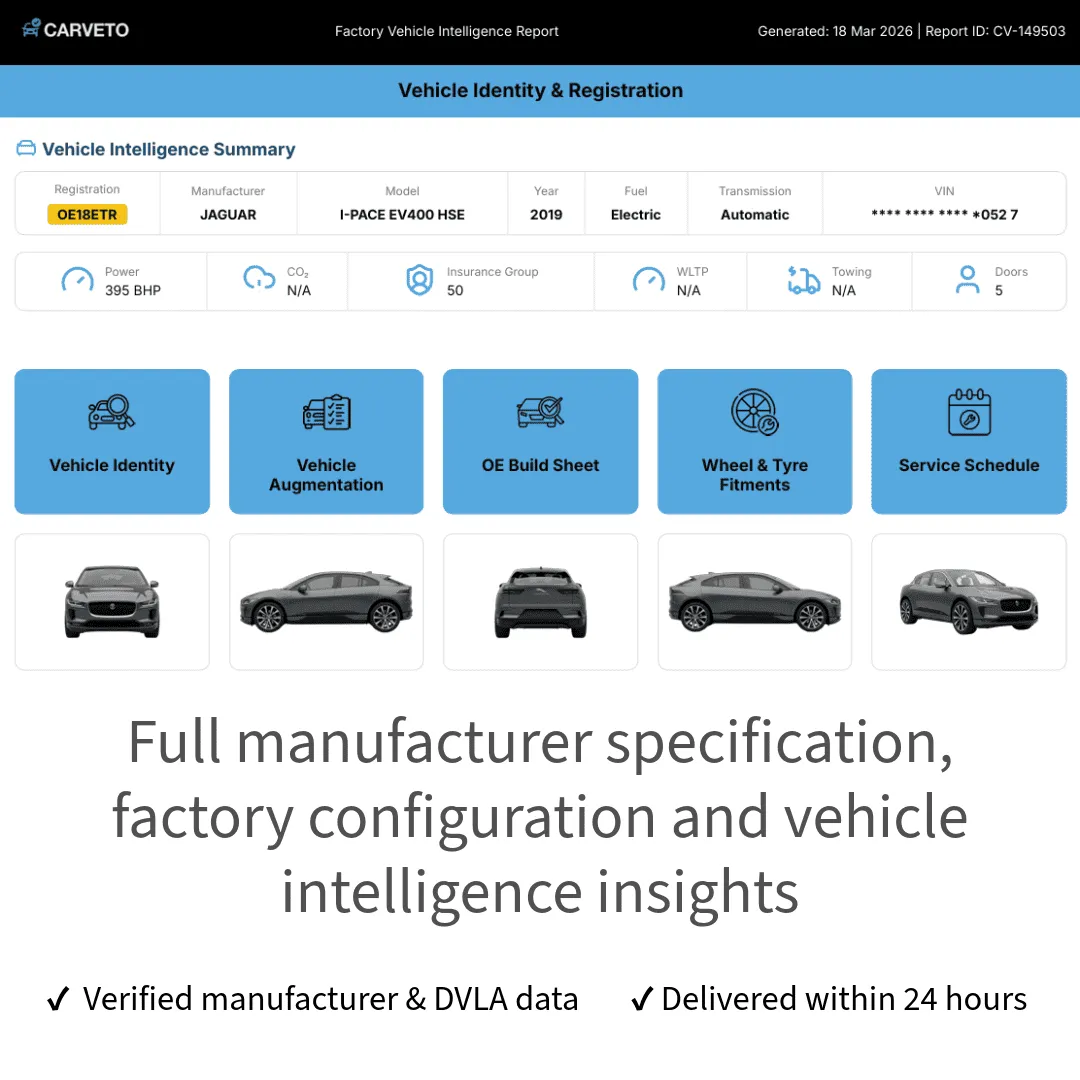
This process automatically retrieves the 17-character Vehicle Identification Number (VIN) to unlock the original OE build sheet, optional factory extras, and OEM-advised service schedules.
Factory build data differs significantly from basic logbook information and a standard car spec check.
Questions arise regarding how to find a car's exact specifications by number plate and why a VIN decoder provides more accurate data.
Buyers also ask what information is included in a full vehicle spec report, and what the difference is between a car spec check and a full history check.
In this guide, we will evaluate the complete factory specifications of a vehicle to protect buyers from misdescribed models before a purchase.
How to Find Your Car's Exact Model and Specifications by Number Plate
A registration plate search automatically retrieves a vehicle's hidden data from official manufacturer and government databases.
The system retrieves the car brand by cross-referencing Driver and Vehicle Licensing Agency (DVLA) records with original factory build sheets.
This identifies the precise make, model variant, and year of manufacture.
The Number Plate Search acts as a public key to unlock the vehicle's unique 17-character identification code.
Why Does a VIN Decoder Provide More Accurate Data Than a Registration?
A standard registration number provides V5C logbook data.
The VIN Lookup retrieves the exact factory build sheet assigned to that specific chassis on the production line.
The 17-character Vehicle Identification Number (VIN) bypasses standard DVLA records to extract the precise trim level, paint codes, and optional extras fitted by the Original Equipment Manufacturer (OEM).
The VIN also permanently records the exact year of manufacture, which dictates the vehicle's emissions standards.
What Information is Included in a Full Vehicle Spec Report?
A premium, factory-level vehicle spec report provides data far beyond a standard free check.
The comprehensive document includes exact trim levels, paint codes, and safety features retrieved directly from the manufacturer.
What Unique Factory Options Does a Vehicle Spec Check Show?
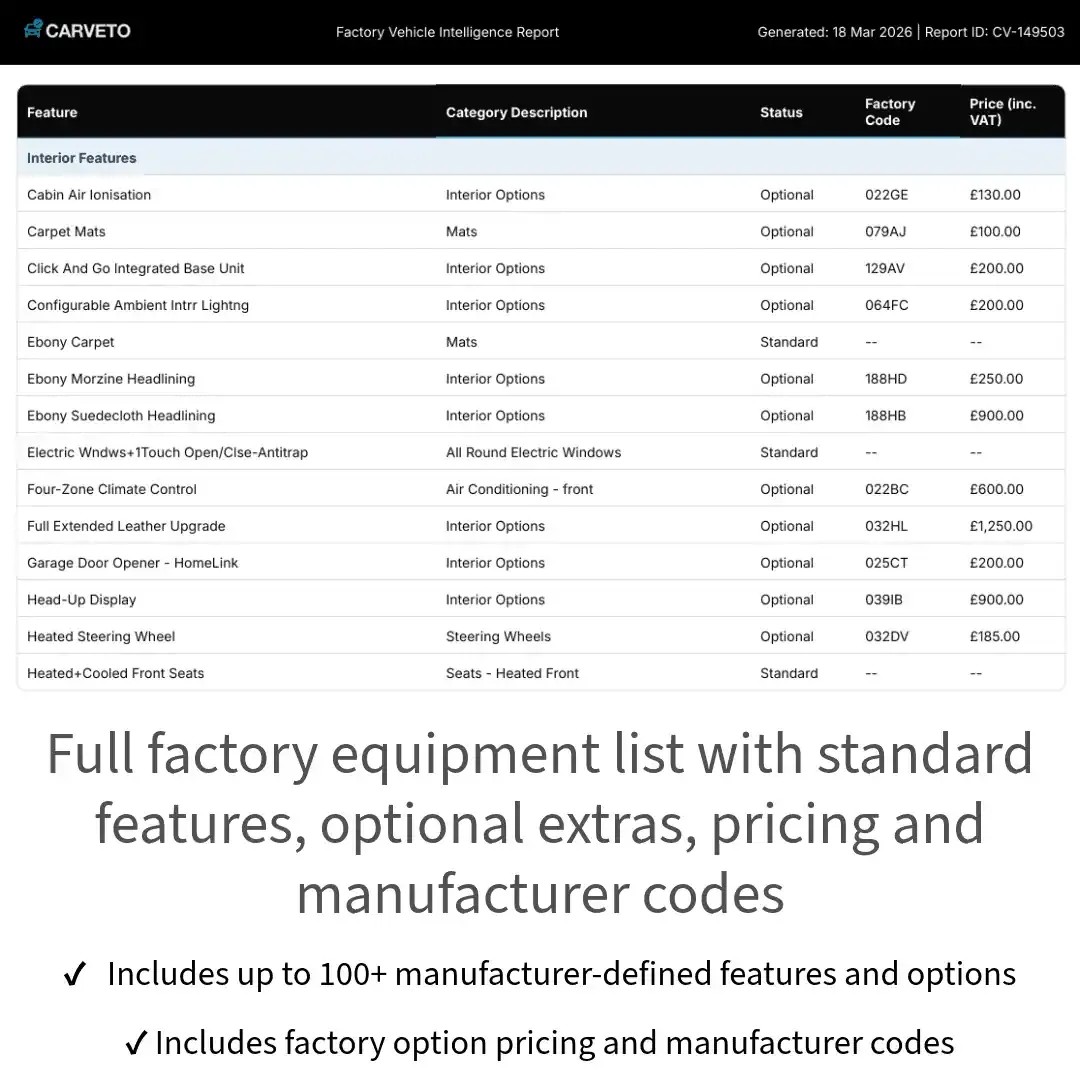
Standard spec checks omit optional equipment, whereas premium factory reports detail the exact build specification of the vehicle.
When a buyer needs to verify specific car option list upgrades, such as cruise control or 360-degree parking cameras, identifying the exact trim and variant list is required for all standard interior features and optional factory additions.
The data includes exact paint and trim codes, such as Metallic Paint or Ebony Windsor Leather, alongside specific audio packs like the Meridian Surround Sound system.
While interior and exterior options dictate aesthetics and comfort, a vehicle's performance is defined by its mechanical drivetrain.
What Are the Exact Engine and Performance Specifications?
A comprehensive report details the exact drivetrain metrics and vehicle statistics to Check Car BHP and performance capabilities.
The specification check explicitly states whether the vehicle is front, rear, or 4-wheel drive.
For example, a specification check on a 2019 Jaguar I-PACE EV400 retrieves the exact mechanical parameters:
- Engine configuration, cylinder arrangement, and engine capacity (cc)
- Total power output (395 BHP)
- Maximum torque (513 Nm)
- Top speed (124 mph)
- 0-60 mph acceleration (4.5 sec)
What Are the Fuel Capacity and Economy Specifications?
The report confirms the exact fuel system—petrol, diesel, EV, or hybrid.
The factory data details the exact fuel tank capacity in litres, alongside the recommended oil type and MPG ratings.
Confirming the exact fuel type and economy is critical for calculating monthly and annual running costs.
What Are the Structural Dimensions and Weight Limits?
The factory data provides the exact Car Dimensions and weight limits required for legal road use and towing.
Using the same Jaguar I-PACE example, the structural measurements include:
- Gross vehicle weight (2670 kg)
- Minimum kerb weight (2244 kg)
- Wheelbase (2990 mm)
- Boot space capacity (407 litres)
Maintaining a vehicle of this size requires strict adherence to manufacturer maintenance guidelines.
What Are the OEM Service Schedules and Repair Costs?
To determine upcoming maintenance costs, the report provides the OEM-advised basic service intervals and average fleet repair costs.
The data outlines the exact service schedule in miles and months, alongside the associated labour rates for the specific chassis.
Because maintenance schedules and component wear are strictly tied to a vehicle's lifespan, these metrics must be evaluated alongside the car's exact date of registration.
Does the Age of a Car Affect its Specifications and Value?
Yes. A vehicle's exact year of manufacture directly dictates its factory specifications, including its emissions class and WLTP fuel economy ratings.
To determine the exact age and year of a vehicle, a Car Age Check provides the official registration date to confirm these age-dependent metrics.
Because emissions standards evolve annually, the vehicle's age fundamentally impacts its legal tax bands, ULEZ compliance, and overall market depreciation.
Age-related specifications must always be cross-referenced with the official registration documents.
How to Verify the DVLA Logbook Details
To verify official DVLA vehicle details, a V5C logbook check confirms the registered data.
Checking the factory specifications ensures the physical car perfectly matches this official documentation.
This verification process protects buyers from purchasing cloned, "ringed," or heavily modified vehicles that deviate from their original OE build sheet.
Verifying the DVLA Logbook is only the first step in a complete vehicle background investigation.
What is the Difference Between a Car Spec Check and a Full History Check?
A car specification check reveals the exact factory data and equipment the vehicle was built with.
A Vehicle Check reveals the hidden past events that occurred after the vehicle left the factory.
While a basic free car check might provide standard MOT data, a comprehensive vehicle history check exposes critical legal, financial and safety risks.
These post-factory events include stolen checks, accident write-off categories, outstanding finance agreements, and mileage anomalies.