

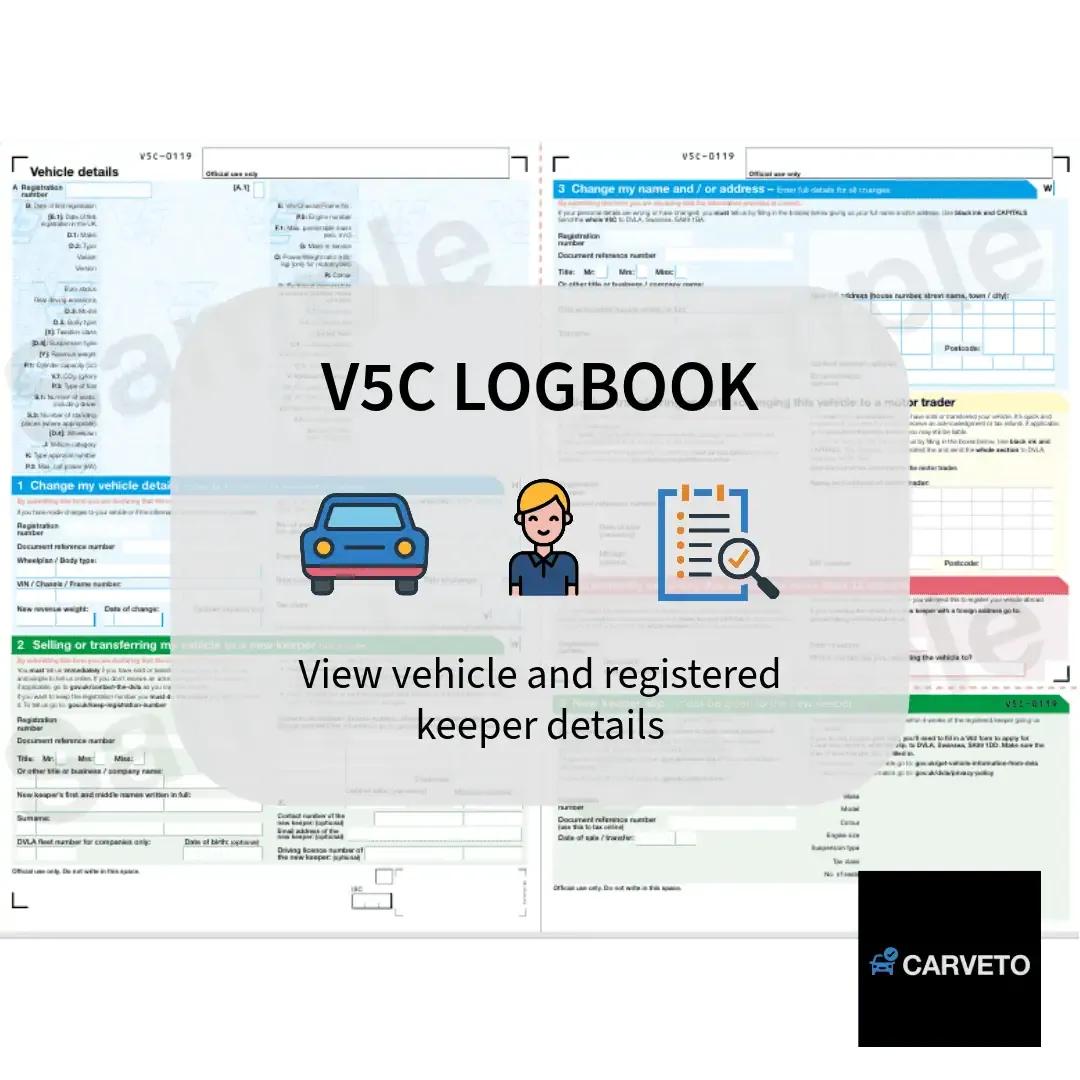
What Is a V5C Logbook?
A V5C logbook is the official DVLA document that records a vehicle’s registered keeper and key vehicle details in the UK.
The V5C is also called a vehicle registration certificate or V5 doc and is used to record changes to the vehicle’s registered keeper when the vehicle is sold or transferred to a new keeper.
The registered keeper is the person recorded by the DVLA as responsible for registering and taxing the vehicle.
The registered keeper is not necessarily the legal owner.
A finance company, for example, may legally own a vehicle while the customer appears as its registered keeper.
A V5C records several important details about the vehicle, as written below.
- Vehicle Details: Vehicle details on the V5C record include the registration number, VIN (Vehicle Identification Number), make, model, engine size, and fuel type.
- Registered Keeper Details: The V5C record has details about the registered keeper, including the name and address recorded by the DVLA.
- Previous Keeper Count: The V5C records the number of previous keepers associated with the vehicle.
- Colour Changes: The V5C records vehicle colour changes reported to the DVLA.
- Import Status: The import status of the vehicle is present on the V5C record, which indicates whether the vehicle was imported into the UK.
The V5C helps buyers assess the seller’s connection to the vehicle.
Buyers can compare the seller’s information with the V5C and the vehicle itself to identify differences in the registration number, VIN, vehicle details, or keeper information.
These discrepancies indicate concerns such as vehicle theft or car cloning.
A separate finance check is necessary because the V5C does not prove ownership or confirm that no finance remains outstanding.
The V5C also makes the DVLA keeper-transfer process more straightforward.
The seller uses the document to transfer the vehicle to the buyer, while the DVLA updates its registered keeper records.
A missing V5C makes the transaction less straightforward and requires additional checks before buying the car.
Current V5C documents are red, while older blue or green versions are outdated.
Buyers should check the document carefully if a seller presents an older-colored V5C, particularly when the document details do not match the vehicle or seller's information.
It is fraudulent if a seller only has the blue V5 with a serial number ranging from BI2305501 to BI2800000 or BG8229501 to BG9999030.
What Are the Risks of Buying a Car Without a V5C?
The risks of buying a car without a V5C include the vehicle being stolen, written off, financed, or cloned.
These issues can create financial or legal problems for a buyer who completes the purchase without carrying out additional checks.
A V5C logbook provides important information about the vehicle, its registered keeper, and the DVLA record.
A missing V5C removes an important document from the transaction and makes it harder to verify the car’s identity and history.
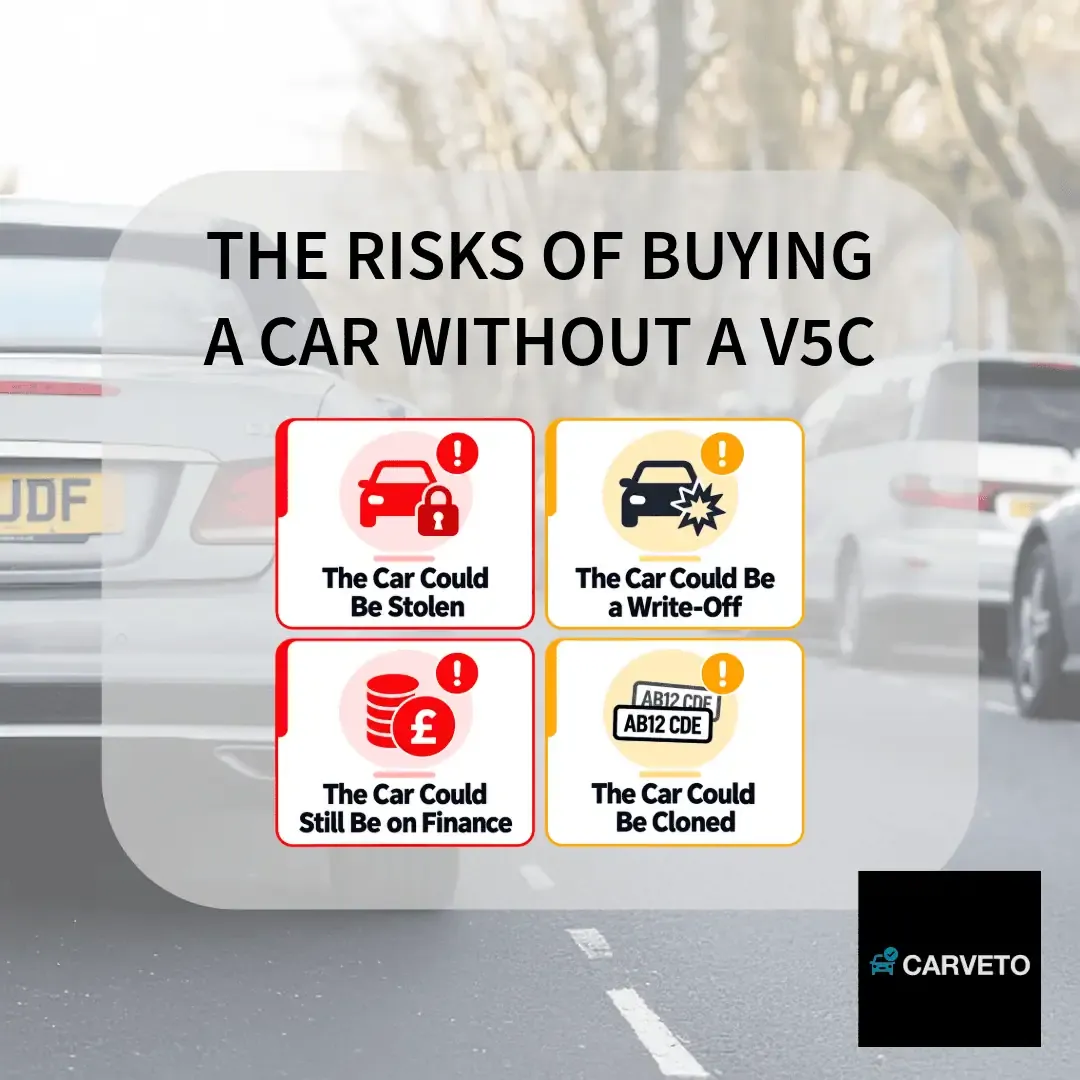
The risks of buying a vehicle without a V5C are explained below.
The Car Could Be Stolen
A missing V5C can increase the risk of buying a stolen car because the buyer has less documentation to verify the vehicle and the seller’s connection to it.
The V5C records the registered keeper, while the registration number and VIN provide additional identifiers for comparing the vehicle with its records.
Seller excuses such as “I lost it” or “the previous owner never gave it to me” should be treated as warning signs rather than proof that the car is legitimate.
Vehicle theft remains a significant problem in England and Wales.
The Office for National Statistics estimated around 617,000 vehicle-related theft incidents in the year ending September 2025.
Police can seize a stolen vehicle even if the buyer purchased it without knowing it was stolen, potentially leaving the buyer without the car or the money paid for it.
You can use CarVeto’s Stolen Car Check to easily identify stolen vehicles before you buy them.
The Car Could Be a Write-Off
A car being sold without a V5C could have a previous write-off history that the seller has not disclosed.
The missing V5C makes it harder for the buyer to compare the vehicle's recorded details with the seller's claims, which is important when checking whether the car has previously been written off.
UK write-off categories are A, B, S, and N, with Category S and Category N vehicles eligible for repair and return to the road.
The vehicle’s previous write-off status remains part of its history after repair.
A missing V5C makes it difficult to verify whether a car has been written off, so buyers should use other vehicle records to check its history.
A vehicle history check using the registration number can also identify previous write-off records.
You can also use our Insurance Write-Off Check to verify the vehicle for previous insurance write-off records.
The Car Could Still Be on Finance
A missing V5C can increase the risk of buying a car with outstanding finance.
A logbook loan uses the vehicle as security for borrowing, which gives the lender a financial interest in the vehicle until the loan is settled.
The registered keeper may therefore be selling a vehicle that remains subject to another party’s financial interest.
Outstanding finance can create a financial problem for the buyer if the seller has not settled the agreement.
A finance check using the registration number helps identify recorded finance before the purchase.
CarVeto’s Outstanding Car Finance Check provides available vehicle financial information, including the lender and agreement details.
The Car Could Be Cloned
A car without a V5C could be a cloned vehicle because the missing logbook removes an important document for checking the vehicle’s identity and registration details.
The missing V5C makes it harder for the buyer to confirm that the car’s identity matches its registration and recorded history.
A cloned car uses the identity of another legally registered vehicle, usually by displaying its registration number, while the genuine vehicle has a different history.
A missing V5C makes identity inconsistencies harder to spot because the buyer has fewer documents to compare with the car.
Buyers should compare the registration number and VIN across the vehicle, V5C, and available history records.
A stolen vehicle check using the registration number provides another way to identify potential cloning or theft concerns.
Can You Legally Buy a Car Without a V5C in the UK?
Yes, you can legally buy a car without a V5C in the UK, but the DVLA advises buyers not to purchase a vehicle without seeing its V5C.
The V5C is not proof of ownership, but it provides important vehicle and registered keeper information that supports the transaction.
The legal position is therefore different from the practical advice: a buyer may complete the purchase without a V5C, but the missing document creates additional checks and paperwork.
DVLA Guidance on V5C-Free Car Sales
DVLA guidance on V5C-free car sales is given below.
- Buying a Car Without a V5C: The DVLA does not prohibit buying a car without a logbook, but it advises buyers to see the vehicle registration certificate before purchasing.
- Seller Providing the V5C: The seller should normally have the V5C and use it to notify the DVLA that the vehicle has changed keeper.
- Replacing a Missing V5C: A buyer who does not receive a V5C must apply for a replacement using form V62.
- V62 Application Process: The V62 application allows the DVLA to issue a new vehicle registration certificate. The process differs depending on the circumstances of the purchase and whether the buyer has received any part of the original document.
The DVLA registered keeper is the person recorded by the DVLA as responsible for registering and taxing the vehicle.
The registered keeper is not necessarily the Legal Owner, so buyers should not treat the V5C alone as proof that the seller owns the car.
Common Misconceptions About V5C Requirements
The most common misconceptions about V5C requirements are given below.
- “It is illegal to buy a car without a V5C.” This is false because UK law does not prohibit a buyer from purchasing a car without seeing the V5C, although the DVLA advises against the transaction.
- “The V5C proves that the seller owns the car.” This is incorrect because the V5C identifies the registered keeper, not necessarily the legal owner.
- “A photo or photocopy of the V5C log book is enough.” This is not correct, as a copy does not provide the same assurance as checking the original document and comparing its details with the vehicle.
- “The buyer can simply use the seller’s V5C details to transfer the car.” This is wrong because the buyer must follow the DVLA’s keeper-transfer or replacement-document process that applies to the transaction.
Legal Requirements for Buying and Registering a Car
The legal requirements for registering a car without a V5C are given below.
- Complete Form V62: The buyer must complete Form V62 and send it to the DVLA to register the vehicle in their name. This application costs £25.
- Tax the Vehicle: The buyer must tax the vehicle before using it on the road.
- Keep the New Keeper Slip: The seller normally provides the green ‘new keeper’ slip when a V5C is available. Buyers should keep this slip because the DVLA uses it in certain registration situations.
- Wait For The New V5C: The new V5C usually arrives within 4 weeks after the vehicle is registered. A used vehicle registered online by the seller can result in the new V5C arriving within 5 to 7 working days.
What Are the Possible Reasons a Seller Does Not Have the V5C?
The possible reasons a seller does not have the V5C include a misplaced document, DVLA processing a new V5C, or the vehicle being recently imported into the UK.
Older, heavily damaged or salvage vehicles may also have unusual registration histories.
The seller’s explanation should match the vehicle’s circumstances and supporting documentation.
Some possible reasons a seller might not have the V5C are explained below.
V5C Was Misplaced by the Owner
An owner may misplace or lose the V5C and therefore have no logbook to provide at the time of sale.
A genuine seller should be willing to request a replacement V5C from the DVLA before completing the transaction.
A seller who refuses to replace a missing V5C raises concern because it prevents the car buyer from verifying the vehicle's registered keeper and details.
The refusal does not prove that the vehicle is stolen or has another problem, but it removes an opportunity to verify the vehicle’s registered keeper and details before purchase.
Seller Is Waiting for a New V5C
A seller may be waiting for a new V5C after recently acquiring the vehicle.
The DVLA issues a new registration certificate after the registered keeper changes, so a seller may not yet have received the document.
The seller should provide evidence of the keeper change or relevant DVLA application rather than relying on a verbal explanation.
Vehicle buyers should wait until the new V5C arrives and verify its details before completing the purchase.
Vehicle Was Recently Imported
A recently imported vehicle may not yet have a UK V5C because the vehicle needs to be registered with the DVLA before a UK registration certificate is issued.
The seller should provide the relevant import and registration documents to show how the vehicle entered the UK and how it was registered.
An imported vehicle offered for sale without a V5C requires additional scrutiny.
The seller should be able to explain its registration status and provide supporting paperwork.
A test drive or claim that the vehicle is ready for road use does not replace proof of UK registration.
Older or Salvage Vehicle
An older or salvage vehicle may have an incomplete or unusual registration history.
Vehicles commonly sold without a V5C include barn finds, written-off vehicles, and heavily damaged vehicles, particularly where the previous keeper, restoration, or registration details are unclear.
A vehicle buyer needs to register the vehicle with the DVLA themselves if no V5C is available.
Missing VIN details, unclear ownership records, or incomplete registration paperwork make the process more difficult and should be resolved before the purchase.
What Should You Do Before Buying a Car Without a V5C?
You should run a vehicle history check, verify DVLA records, and match the VIN with documents before buying a car without a V5C.
You should also get a written receipt from the seller, contact the previous owner, and avoid cash payments.
These checks help identify problems with the vehicle or seller before money changes hands.
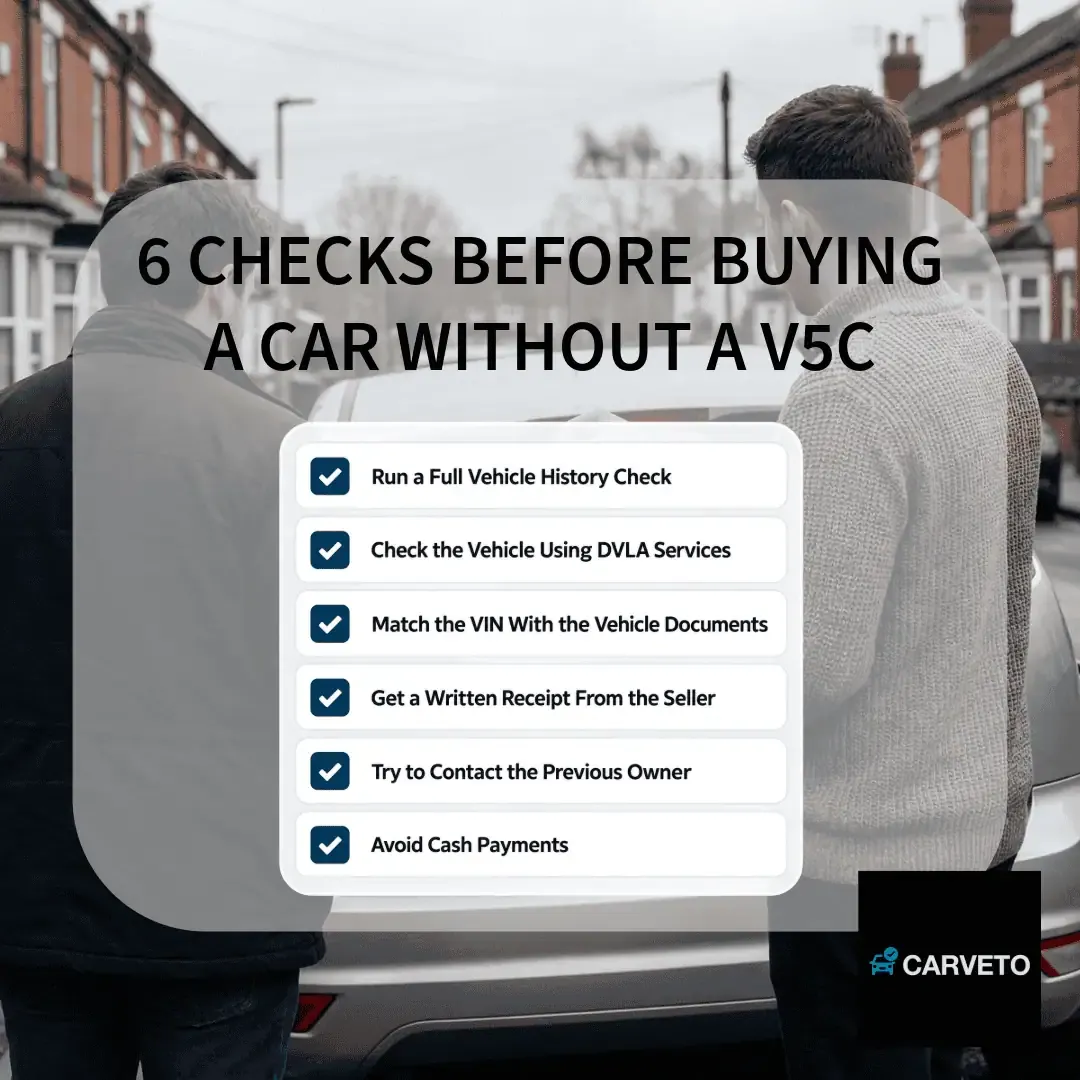
The steps to take before buying a car with no logbook are given below.
1. Run a Full Vehicle History Check
You should run a full vehicle history check to identify problems that may not be apparent from the vehicle’s appearance or the seller’s description.
A history report reveals the outstanding finance, theft status, write-off history, previous registration number or colour changes, and number of previous registered keepers of the vehicle.
The vehicle history should be consistent across the available records.
You should investigate discrepancies in the registration number, mileage, keeper history, colour or vehicle identity before proceeding with the purchase.
You can use CarVeto’s Car History Check to check the vehicle’s history and identify potential issues before buying.
2. Check the Vehicle Using DVLA Services
Use DVLA services to check details such as the vehicle’s MOT (Ministry of Transport Test) status, tax status and registration information after checking its full history.
The DVLA vehicle enquiry service provides key information about a vehicle’s official records.
The DVLA records should match the seller’s information and the vehicle itself. Differences in the vehicle details, registration, or recorded history need further investigation before purchase.
3. Match the VIN With the Vehicle Documents
You should match the vehicle’s VIN with the VIN recorded in the DVLA’s vehicle records and available documents.
The VIN identifies the individual vehicle and should match across the car and its available documents.
You can find the VIN on the driver's side dashboard, driver's side door frame, engine bay or chassis, under the bonnet, and in the vehicle documentation.
The VIN should match across every available record.
A mismatched, altered or tampered VIN is a serious warning sign, and you should not proceed until the vehicle’s identity has been established.
4. Get a Written Receipt From the Seller
Get a written receipt from the seller after confirming the vehicle’s identity to document the transaction.
A written receipt provides evidence of the transaction when the V5C is missing.
The receipt should include the vehicle registration number and details, agreed purchase price, seller’s full name and address, seller’s signature, and date of sale.
The receipt provides a record of the sale and may support the buyer when notifying the DVLA or applying for a new V5C.
5. Try to Contact the Previous Owner
Try to contact the previous owner after documenting the transaction details to verify the seller’s explanation and the vehicle’s ownership history.
The previous owner may provide useful information if a V5C is missing and the seller's explanation about the vehicle's history is unclear.
The previous keeper may be able to confirm when they sold the vehicle and whether the seller legitimately acquired it.
The DVLA does not provide buyers with previous keeper contact details because personal information is protected by data protection laws.
You need to ask the seller to provide the previous keeper’s details or make an introduction so the transaction can be verified.
6. Avoid Cash Payments
You should avoid cash payments for the car purchase, as a traceable payment method provides evidence of the transaction and the amount paid.
Bank transfers and card payments create a payment record that can support the buyer if a dispute arises.
A seller who insists on cash-only payment raises concerns when the vehicle also has no V5C.
Buyers should avoid handing over cash until the vehicle, seller and transaction have been properly verified.
Can You Get a Replacement V5C After Buying a Car?
Yes, you can get a replacement V5C after buying a car by applying for a new vehicle registration certificate from the DVLA using form V62.
This application depends on the circumstances, such as whether you received the V5C from the seller, lost it after the purchase, or bought the vehicle without receiving a V5C.
A buyer who bought a vehicle without a V5C must apply for its replacement by post using form V62.
A V5C Logbook Replacement application requires the buyer to provide evidence of the vehicle purchase and relevant vehicle details.
You should keep the sales receipt and other purchase documents because the DVLA may need evidence to verify the application.
A V62 application costs £25 in circumstances where a replacement fee applies.
The DVLA may also carry out additional checks before issuing the new V5C, which can delay the process if the vehicle details or registered keeper information need verification.
The new V5C is normally sent by post after the DVLA processes the application.
What Red Flags Should Make You Walk Away From a Vehicle?
The red flags that should make you walk away from buying a vehicle include cash-only deals, absent ID or address, and issues in the ownership history.
You should not buy a vehicle with no history or MOT, or if there is a mismatch between the vehicle location and V5C address.
Car buyers should not proceed with the deal when the seller cannot provide a credible explanation or supporting evidence for these concerns.
The possible reasons a seller might not have the V5C are explained below.
Seller Insisting on a Cash Deal
A seller who insists on a quick cash deal is suspicious, as they refuse traceable payment methods such as a bank transfer.
Cash payments leave less evidence of the transaction and make it harder to establish how much the buyer paid.
A seller who rushes the transaction or refuses to provide a clear payment trail gives the buyer less opportunity to verify the vehicle and seller.
You should complete vehicle checks before making payment instead of letting pressure from the seller finalise the decision.
Refusal to Provide ID or Address
A seller who refuses to provide basic identification or address details indicates potential risk.
The buyer needs accurate seller information for the receipt and may need those details for correspondence with the DVLA if the V5C is missing.
It is harder to establish who sold the vehicle and where the seller can be contacted after the transaction if the seller refuses to provide reasonable identification or address information.
You must not proceed with the deal when the seller will not provide basic details needed to document the sale.
Vague or Conflicting Ownership History
A vague or conflicting ownership history shows a problem with the vehicle’s background.
The seller should be able to explain when they acquired the car, who they bought it from, and why the V5C is unavailable.
The number of previous registered keepers should also be consistent with the seller’s claims and available vehicle records.
No MOT or Service History
A car with no available MOT or service history gives the buyer less evidence about its condition and past use.
You should check the available MOT Records and ask the seller for service records, invoices and MOT certificates where available.
A missing V5C with limited vehicle history increases risk for the buyer.
Gaps in MOT records, mileage history or servicing indicate issues such as a stolen or clocked vehicle.
Vehicle buyers can use an online MOT test to check the vehicle’s available MOT history before proceeding.
Vehicle Location Does Not Match the V5C Address
A difference between the vehicle’s current location and the address recorded on the V5C is not automatically a sign of fraud.
Owners can keep vehicles at a different address, and a seller may have moved without updating the DVLA record.
An unexplained mismatch between the vehicle’s location, seller information, and V5C details requires further investigation.
Buyers should ask the seller to explain the difference and compare the vehicle’s identity and history with the available records.
A weak explanation with other discrepancies may indicate a cloned or stolen vehicle or a fraudulent document.
Is Buying a Car at Auction Without a V5C Different?
Yes, buying a car at auction without a V5C logbook is different because auction vehicles may be sold with incomplete documentation and under the auction house’s own terms.
Car buyers need to check the vehicle’s details, such as the registration number, VIN, and MOT history, and also confirm which documents the auction house will provide after the sale.
The buyer should obtain the auction invoice, sale receipt, and any available vehicle documentation as evidence of the transaction and the vehicle’s details.
A missing V5C may make registration, obtaining a replacement logbook and future resale more difficult, particularly if the auction cannot provide sufficient evidence of the vehicle’s history or registration status.
What Are the Alternatives to Buying a Car Without a V5C?
The alternatives to buying a car without a V5C are given below.
- Wait for the Seller to Get a Replacement V5C: The buyer should ask the seller to obtain a replacement V5C from the DVLA before completing the purchase. This document gives you an opportunity to verify the registered keeper and vehicle details before paying.
- Choose a Car With a Complete Paper Trail: The car buyer can select another vehicle with a V5C, consistent MOT and service records, clear ownership history, and matching vehicle details. A complete paper trail makes it easier to verify the car before purchase.
- Buy From a Dealer or Auction With Buyer Protection: Vehicle buyers should purchase the car from a seller that provides clear purchase documentation and applicable buyer protection. You should check the dealer's or auction house's terms before purchasing because the level of protection varies between sellers and sales.
Can a Seller Prove Ownership Without a V5C?
Yes, a seller can provide evidence of ownership without a V5C, such as a purchase invoice or receipt, a finance settlement letter, previous purchase documents, or insurance and service records.
The V5C itself does not prove legal ownership of a vehicle. It identifies the registered keeper and who is responsible for registering and taxing the vehicle.
These documents support the seller’s claim of vehicle ownership but do not definitively prove that the seller has the legal right to sell the vehicle.
A seller should request a replacement V5C from the DVLA before completing the sale and allow the buyer to verify the vehicle details.
Can I tax and insure a car without a V5C?
Yes, you can insure a car without a V5C because insurers can use the vehicle registration number and other vehicle details to arrange cover.
Taxing the vehicle is different because the DVLA normally requires the 11-digit reference number from the V5C or the 12-digit reference number from the V5C/2 new keeper slip.
A buyer without either reference number must apply for a new V5C using form V62 before they can tax the vehicle through the standard process.
You can check our guide on Car Tax Without V5C to learn how to tax a vehicle when the logbook is missing.
What Happens If I Buy a Cloned Car?
If you buy a cloned car, it can be seized by the police, you can lose the car, and you will face difficulty recovering the money paid for it, even when you were unaware that the vehicle had been cloned.
A cloned car uses the identity of another legally registered vehicle, such as its registration number or VIN, to disguise a stolen or otherwise problematic vehicle.
Can You Get Your Money Back After Buying a Car Without a V5C?
Yes, you may be able to get your money back after buying a car without a V5C.
The outcome depends on who sold the vehicle, how the buyer paid and why the purchase is being disputed.
A missing V5C does not automatically give the buyer a right to a refund.
Different situations where you may get your money back if you bought a vehicle with no logbook are given below.
- A private seller may have to provide a refund if the seller misrepresented the vehicle, committed fraud, or breached the sale agreement. Private sales generally provide fewer consumer rights.
- A dealer may have to provide a refund if the vehicle was misdescribed, not fit for purpose, or failed to meet consumer law requirements.
- A bank transfer provides a payment record, but recovering the money is not automatic. The buyer should contact their bank promptly if they believe the transaction involved fraud.