
Urgent V5 Replacement: How to Replace Your V5C Quickly
You can replace a lost, stolen, damaged, or destroyed V5C through the DVLA (Driver and Vehicle Licensing Agency).
The online or phone service applies when your V5C details remain unchanged.
The online service is the quickest standard route for a replacement V5. These replacements arrive within 5 to 7 working days.
Postal applications are required when certain vehicle details, such as the engine size and fuel type, need changing.
A postal application is also required if you never received your V5C.
These applications take around 4 weeks, making them slower than online replacements.
You need your registration number, VIN (Vehicle Identification Number) or chassis number, name, and postcode recorded on the V5C to verify the vehicle and process the replacement.
The replacement service costs £25, which is payable by credit or debit card online or by phone.
A V5 replacement provides the current registration certificate for important vehicle administration.
Buyers should take extra care when purchasing a vehicle without its V5 log book. DVLA advises against buying a vehicle without the document.
Checking the vehicle’s registration, MOT history, and other records can help identify potential issues before purchase.
The DVLA does not offer a same-day or express V5C replacement service, so even urgent applications require the standard processing time.
What Is a V5C Log Book?
A V5C log book is the official document issued by the DVLA to register a vehicle and record its registered keeper.
A V5C log book is also known as a vehicle registration certificate.
It contains key vehicle information, such as the registration number, make, model, colour, and engine details.
The V5C log book also shows the registered keeper’s name and address.
The log book is important for managing your vehicle because it records the person responsible for registering and taxing it.
This document is used when selling a vehicle, taxing it, or updating certain vehicle and keeper details.
A V5C is not proof of legal ownership, as the registered keeper may be different from the vehicle’s legal owner.
The registered keeper can replace a lost, stolen, damaged, or destroyed V5C through the DVLA.
Our DVLA Vehicle Check can also help verify key vehicle details recorded.
Why Do You Need a V5C Log Book?
You need a V5C log book to confirm that a vehicle is registered with the DVLA.
It also shows who is responsible for the vehicle’s maintenance and tax.
The V5C records key vehicle details, including the registration number, make, and model, which helps identify the vehicle correctly.
Its reference details are also used when taxing or declaring SORN.
The V5C document is important when selling a vehicle or updating its details with the DVLA.
V5C log book information is important when selling your car and updating its details with the DVLA.
Keeping the V5C information accurate and up to date can help prevent administrative issues, delays, or potential penalties.
This document also identifies previous keepers for checking a vehicle before buying it.
A high number of previous keepers is not necessarily a concern, but it may warrant further questions.
What Should You Do If You Lose Your V5C?
You should apply for a replacement through the DVLA if you lose your V5C, or if it is stolen, damaged, or destroyed.
The DVLA provides 3 ways to request a replacement V5C: online, by phone, or by post.
You can apply online if you are the registered keeper and your details have not changed.
The replacement costs £25 and usually arrives within 5 to 7 working days.
You can apply by post using Form V62 if you cannot apply online.
This method is used when you need to change vehicle details or have not received the V5C after buying the vehicle.
Registered keepers can also request a replacement by phone when the V5C details remain unchanged.
You should have your vehicle registration number, VIN or chassis number, and the name and postcode registered with the DVLA.
These details are required to verify the vehicle and confirm your details when requesting a replacement V5C.
Anyone Buying a Car Without a V5C should check the vehicle details before completing the purchase.
How Can You Get a Replacement V5C Quickly?
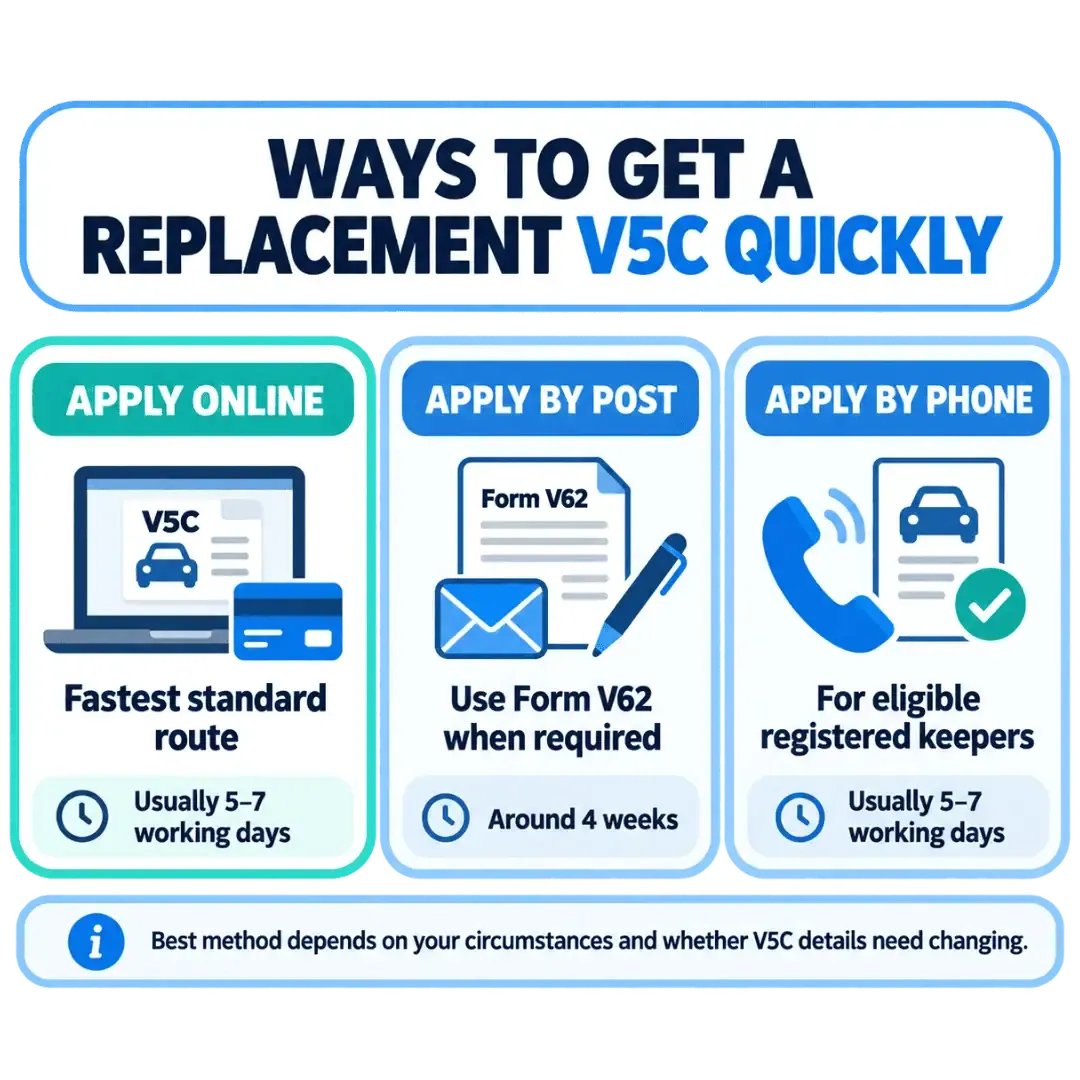
You can get a replacement V5C through online, phone, or postal applications, depending on your circumstances.
Online and phone applications are the quickest options, with the replacement usually arriving within 5 to 7 working days.
Postal applications take around 4 weeks and may be necessary when the online or phone services are unavailable.
Apply online
You can apply for V5 online when the registered keeper’s details have not changed through the GOV.UK vehicle log book service.
This is generally the fastest replacement option.
This service covers V5Cs that have been lost, stolen, damaged, or destroyed.
The online service is available only for eligible UK-registered vehicles that are not part of a fleet.
Eligible applications require the VRM (vehicle registration number), VIN or chassis number, and the name and postcode recorded by DVLA.
The V5C replacement costs £25, payable by debit or credit card.
The new V5C usually arrives within 5 to 7 working days at the registered address.
Apply by post
You can apply for a log book by post using Form V62 when you cannot use the online service.
You must use Form V62 to change vehicle details or apply for a V5C you never received after buying the vehicle.
Form V62 requires your vehicle and keeper details, along with the reason for your application.
You can download and print the form from GOV.UK.
Recent vehicle buyers may have the green new keeper slip (V5C/2).
The V5C/2 confirms that you are the new keeper and provides details from the previous V5C.
You should include this slip with Form V62 when applying for the V5C you did not receive after buying the vehicle.
The slip should be from the most recent V5C issued for the vehicle.
Send the completed form and required documents to DVLA, Swansea, SA99 1DD.
A replacement V5C applied by post usually arrives within four weeks.
V5C replacement applications requiring additional checks take longer.
The standard V5C replacement fee is £25 when applicable.
Payment can be made by cheque or postal order payable to DVLA, Swansea.
The fee may not apply when the correct new keeper slip is provided.
Apply by Phone
You can apply by phone when the online or postal process is not suitable.
This service is available to the registered keeper when the details on the lost V5 or damaged V5C remain unchanged.
Phone application requires the vehicle registration number, VIN or chassis number, and the name and postcode recorded on the V5C.
Having these details ready can help DVLA process the request.
You can contact DVLA on 0300 790 6802.
The DVLA contact number is available from 8 am to 7 pm Monday to Friday and 8 am to 2 pm on Saturdays.
The replacement fee is £25, which is payable by debit or credit card.
A phone application usually results in the replacement V5C arriving within 5 to 7 working days.
What Do You Need to Replace a V5C?
You need the vehicle VRM, VIN or chassis number, and the name and postcode recorded by DVLA to replace a V5C.
These details help DVLA identify the vehicle and verify the registered keeper’s information.
The information required for a V5C replacement is listed below.
- Vehicle Registration Number (VRM): The VRM is needed to locate the vehicle’s record in the DVLA database. The registration number shown on the vehicle and its V5C should be used for the replacement application.
- Vehicle Identification Number (VIN) or Chassis Number: The VIN or chassis number provides a unique identifier for the vehicle itself. This information helps distinguish the specific vehicle linked to the replacement V5C application.
- The Name and Postcode Currently Recorded by the DVLA: The name and postcode correspond to the registered keeper details held by the DVLA. Matching this information helps verify the application and process the replacement V5C.
How Much Does a Replacement V5C Cost?
A replacement V5C log book costs £25 when a replacement fee applies.
The same charge applies whether you apply online, by phone, or by post.
The replacement V5 document fee can be paid by debit or credit card when applying through an eligible service.
The £25 replacement fee is non-refundable once the application has been submitted.
Finding the original V5C later does not entitle you to a refund of the replacement cost.
How Long Does a V5C Replacement Take?
A replacement V5C arrives within 5 to 7 working days when you apply online or by phone.
Postal applications using Form V62 take around four weeks to arrive.
DVLA sends the replacement to the registered address currently held on its records.
Contact DVLA when your replacement V5C has not arrived within the expected timeframe.
Online or phone applicants should contact DVLA after 4 weeks, and postal applicants should contact DVLA after 4 weeks.
A £25 fee may apply when a V5C has not arrived after 6 weeks, and DVLA was not notified about the missing document.
Contacting DVLA within the recommended timeframe can help you avoid an additional replacement charge.
Can You Get a V5C Replacement Urgently?
No, you cannot get a V5C replacement urgently through a same-day, express, priority, or fast-track DVLA service.
Online applications are the fastest option and usually arrive within 5 to 7 working days.
Postal applications using Form V62 generally take around four weeks.
This method is necessary when you cannot use the online service or need to make certain changes to the vehicle details.
Applying online is the quickest standard route when you are the registered keeper and your relevant V5C details have not changed.
This option can be useful when you need a replacement for an upcoming vehicle-related task.
What Should You Know About Buying or Selling a Car Without a V5C?
You should know that buying or selling a car without a V5C is completely legal in the UK, but it reduces buyer confidence, affects resale value, and requires additional paperwork.
The V5C confirms the registered keeper and contains the registration number, make, model, and VIN.
The V5C is not proof of legal ownership.
Additional checks like a vehicle history check and outstanding finance check therefore may be needed when buying or selling without one.
What Should You Do When Selling a Car Without a V5C?
You should confirm that you are the legal owner before selling a car without a V5C.
The V5C records the registered keeper and is not proof of legal ownership.
You should also tell the buyer that the V5C is missing before completing the sale.
You should apply for a replacement V5C before selling the car.
Applying through the DVLA provides the buyer with an up-to-date registration document and can make the sale process more straightforward.
You should also provide a signed receipt confirming the sale and relevant transaction details.
The DVLA should be informed of the change of keeper after the sale.
What Should You Check When Buying a Car Without a V5C?
You should check the vehicle’s ownership, history, identity, and registration details before buying a car without a V5C.
A missing V5 document makes it harder to verify the vehicle and may indicate outstanding finance or other issues.
Proof of ownership can help establish that the seller has the right to sell the vehicle.
Its service history and MOT records can provide further evidence of maintenance, mileage, and roadworthiness.
You should match the VIN displayed on the vehicle with the VIN recorded in its available documents and history records.
A matching VIN helps confirm that the vehicle corresponds with the records provided by the seller.
The green V5C/2 new keeper slip is also important when the seller has retained it.
This slip can be used to tax the vehicle after purchase while waiting for the new V5C.
You can use our comprehensive vehicle history check to know about outstanding finance, stolen status, write-off history, and mileage discrepancies.
These checks provide greater confidence that the vehicle’s identity, history, and registration details are genuine before completing the purchase.
What Risks Are Involved in Buying a Car Without a V5C?
The main risks associated with buying a car without a V5C are outlined below.
- Stolen Vehicle: A car without a V5C can be harder to verify as legitimate and check whether it appears in stolen vehicle records. Our Stolen Vehicle Check can help identify whether the vehicle has been reported stolen.
- Outstanding Finance: Buying a car without a V5C can make it harder to establish whether finance remains outstanding. Our vehicle history check can identify recorded finance interests before purchase. This helps you avoid taking on a vehicle with an existing financial claim.
- Log Book Loans: A car without a V5C may have a log book loan secured against the vehicle. Any existing financial agreement can create complications for the buyer after purchase.
- Hidden Write-Off Status: Buying a car without a V5C can make its previous insurance history harder to establish. A vehicle history check can reveal recorded write-offs and applicable damage categories.
- Vehicle Cloning: A car without a V5C can be more difficult to match against its official registration records. Differences between the VIN, registration number, and vehicle details may indicate possible cloning.
- Tax and Registration Issues: Buying a car without a V5C means the buyer must complete additional registration steps with the DVLA. A V62 application may be required to register the buyer as the new keeper and obtain a replacement V5C. This application costs £25.
- Insurance Problems: Purchasing a car without a V5C may have unclear registration or history details that complicate insurance arrangements. Previous write-off history can also affect whether insurers provide cover and at what cost.
How Can You Verify a Car Without a V5C?
You can verify a car without a V5C by checking registration details through the DVLA Online Vehicle Enquiry service.
You should also physically inspect the vehicle’s identification numbers to confirm they match the available records.
The registration number provides the starting point for checking the vehicle’s recorded information through official and independent services.
Our comprehensive vehicle history check can reveal stolen status, outstanding finance, write-off history, and mileage discrepancies.
The GOV.UK MOT History Checker can also show previous test results, recorded mileage, failures, and advisories.
Our Free Car VIN Check provides another way to confirm that the vehicle matches its recorded identity.
The VIN physically displayed on the car should correspond with the VIN shown in the available vehicle history records.
The seller’s identification and proof of address provide additional evidence when ownership details are unclear.
Comparing these records with the physical vehicle can help identify inconsistencies before completing the purchase.
What Does It Mean If the Seller Does Not Have a V5C?
It means the V5C may have been lost, never received, linked to outstanding finance, or absent because of ownership concerns.
The missing document can make the vehicle’s history, identity, and registration harder to verify.
The main reasons a seller may not have a V5C are given below.
- The V5C Was Genuinely Lost: The seller may have misplaced, damaged, or had the original V5C stolen. A registered keeper can apply for a replacement V5C when the recorded details remain unchanged.
- The Seller Never Received a V5C: A seller may not have received the V5C after buying the vehicle or changing the registered keeper. The seller may need to apply to DVLA using Form V62 to obtain a new certificate.
- The Car Is Still on Finance: The vehicle could have outstanding finance that affects the seller’s ability to transfer it freely. Our comprehensive vehicle history check can help identify finance recorded against the car before purchase.
- The Car May Be Stolen, Cloned or Not Theirs to Sell: The missing V5C may mean the seller cannot readily demonstrate their connection to the vehicle. Stolen or cloned vehicles can have misleading registration details, so the vehicle’s identity and history should be checked carefully before purchase.
Which V5C Replacement Method Should You Use?
You should use the online GOV.UK Vehicle Log Book Service if you are the registered keeper and your details have not changed.
The phone service is another option when the V5C information remains unchanged.
A postal application is required when vehicle details need changing, or you never received the V5C after buying the vehicle.
The appropriate application method, cost, and processing time vary according to your circumstances.
The table below outlines the main V5C replacement methods.
Situation | Appropriate route | Cost | Typical processing time |
|---|---|---|---|
You are the registered keeper and the V5C is lost, damaged or destroyed | Apply online or by phone | £25 | 5-7 working days |
Your V5C is missing, and your name and address also need changing | Apply by post using Form V62 | £25 | Up to 6 weeks |
You bought the vehicle and have the green V5C/2 new keeper slip | Use the V5C/2 to tax the vehicle while the new V5C is processed; use Form V52 if the V4C does not arrive | Usually free with the new keeper slip | Usually around 4 weeks |
You bought the vehicle without a V5c or new keeper slip | Apply by post using Form V62 | £25 | Usually around 4 weeks |
You need to tax the vehicle without a V5C | Use the green B5C/2 if you have just bough the car; otherwise apply for a V5C using Form V62 | Tax cost plus any applicable V5C fee | Tax can be arranged while applying |
You need to sell the vehicle | Obtain the replacement V5C before selling where possible | £25 where applicable | 5-7 working days online or by phone for eligible registered keepers |
Can You Sell a Car Without a V5C Log Book?
Yes, you can legally sell a car in the UK without a V5C log book, but doing so can create greater risk for both seller and buyer.
The V5C records the registered keeper and important vehicle details, including the VIN, make, and model.
A missing V5C can make buyers more cautious because the vehicle’s registration details and history are harder to verify.
Concerns may arise about whether the seller has the legal right to sell the car.
Unclear ownership, finance, or vehicle history can increase these concerns.
The V5C identifies the registered keeper, but it does not prove who legally owns the vehicle.
Additional evidence may therefore be needed to establish the seller’s right to sell.
Selling without a V5C can make the transaction less straightforward.
The buyer may need to apply for a replacement V5C using Form V62.
DVLA advises buyers not to purchase a vehicle without a V5C, making thorough checks particularly important before completing the sale.
Can You Insure a Car Without Having the V5?
Yes, you can insure a car without having the V5C log book.
Most insurers can identify the vehicle using its registration number and your driver details.
The physical V5C is not normally required to arrange car insurance.
This means you can arrange cover after buying a car before the V5C arrives.
DVLA confirms that the vehicle registration number can be used to identify the vehicle and its recorded details when arranging insurance.
Some insurers may request additional information before providing cover.
This could include proof of ownership, keeper details, or other vehicle documentation.
You should also provide accurate information about your registered keeper status.
The V5C records the registered keeper, who may not be the vehicle’s legal owner.
Having insurance does not replace the need to register the vehicle correctly with DVLA.
A new keeper without a V5C may need to apply for one using Form V62.
Can You Tax the Car Without a Log Book?
Yes, you can tax the car without a log book through the GOV.UK Vehicle Tax service.
The available option depends on your circumstances and the document or reference number you have.
Current keepers can tax the vehicle online using the 11-digit reference number from their V5C.
Recently purchased vehicles can be taxed using the 12-digit reference number from the green V5C/2 new keeper slip.
A recent V11 vehicle tax reminder can also provide the reference needed to tax the vehicle.
This allows the current keeper to tax the vehicle without having the full V5C.
A replacement V5C is needed when you have none of the required documents or reference numbers.
Current keepers can apply for a replacement V5C and tax the vehicle at the same time.
New keepers without the green V5C/2 slip cannot use it to tax the vehicle.
They must apply for a new V5C by post using Form V62.
The vehicle can be taxed once the new keeper has the required V5C reference.
What if I Lost the Green Slip (V5C/2) When Buying a Car?
You can apply for a new V5C using Form V62 if you lost the green V5C/2 new keeper slip when buying a car.
The buyer should complete Form V62 and state that the green new keeper slip was lost.
A £25 fee applies when the slip is unavailable.
The completed form should be sent to the DVLA with the required payment.
A replacement V5C arrives within 4 weeks when you apply by post.
Losing the V5C/2 can also affect taxing the vehicle as a new keeper.
You cannot tax it without the new keeper slip, so you need to apply for a new V5C by post.
What Happens If I Find the Original Vehicle Registration Certificate After Applying for a Replacement?
The original document is no longer valid even if you find the original V5C after a replacement has been issued.
The replacement V5C becomes the current vehicle registration certificate held by DVLA.
The old V5C should not be used for taxing, selling, or updating the vehicle.
Returning the invalid document to DVLA helps prevent confusion over which certificate is current.
The replacement V5C should be kept and used for future vehicle registration matters.
The old certificate can then be dealt with according to DVLA’s instructions rather than being used again.
Can I Get a Refund if I No Longer Need the Replacement V5C?
No, you cannot get a refund if you no longer need the replacement V5C.
The £25 replacement V5C fee is non-refundable once you have used the service.
This remains the case if you later find your original V5C.
The replacement application should therefore only be submitted when a new V5C is needed.
Does a Replacement V5C Change the Document Reference Number?
Yes, a replacement V5C changes the document reference number.
Each replacement V5C receives a new 11-digit reference number from the DVLA.
The reference number on the previous V5C is cancelled once the replacement is issued.
The old number can no longer be used for official transactions.
A photo or photocopy of the old V5C cannot be used to notify a change of keeper online.
The seller must use the current V5C reference number for an online keeper transfer.
The vehicle’s registration number and recorded details remain unchanged after a replacement V5C is issued.
Only the V5C document and its reference number change.
Why Is It Important to Keep Your Address Up to Date on Your V5C?
Keeping your address up to date on your V5C helps DVLA send vehicle-related correspondence correctly.
This includes vehicle tax reminders and other official notices.
Police and parking authorities can use DVLA records when sending speeding and parking penalty notices.
An incorrect address can cause these notices to be sent to your previous address.
Missing a penalty notice can mean you do not respond within the required timeframe.
Unpaid penalties then escalate because the original correspondence was not received.
An outdated V5C address can also cause you to miss important vehicle administration correspondence.
DVLA requires you to update your V5C address when you move.
You can receive a fine of up to £1,000 for failing to do so.
How Do You Change Your Address on a V5C?
You can change your address on your V5C either online or by post using the DVLA’s available services.
Updating the address for the DVLA keeps your vehicle records accurate.
The online service provides a quicker way to change your address on your vehicle registration details.
This service requires your registration number, V5C document reference number, and new UK address.
The postal application process varies depending on the format of your V5C.
New-style V5Cs require the new address in Section 3, while older V5Cs use Section 6.
The completed V5C should be sent to the DVLA address shown on the document.
This address update is usually free when completed through the standard process.
How Do You Update Your Name on a V5C?
You can update your name on a V5C by post because the DVLA does not offer an online name-change service.
Your V5C type determines which section of the document you need to complete.
New-style V5Cs require your full new name in Section 3, without initials.
Older V5Cs require your full new name in Section 6, followed by your signature.
The older document also requires the whole V5C to be sent to the DVLA.
The application should include a letter explaining why your name needs to change.
Legal name changes also require supporting evidence, such as a deed poll.
The completed V5C and supporting documents should be sent to the DVLA address shown on the relevant document.
The current new-style V5C uses DVLA, Swansea, SA99 1BA.
Updating your name is usually free, and the DVLA states that a new V5C takes up to 6 weeks to arrive.
How Do You Update Vehicle Details on a V5C?
You can update your V5C details by completing the relevant sections and posting the document to the DVLA.
A new-style V5C requires the relevant changes in Section 1.
An older-style V5C requires the corresponding information in Section 7.
The changes can include the vehicle’s colour, engine size, fuel type, seating capacity, weight, chassis, frame, or body type.
Changes not listed in the relevant section should be explained in the vehicle details section.
Supporting evidence may also be required depending on the change.
Engine changes, for example, may require a garage receipt, manufacturer letter, or insurance report.
The completed V5C log book and required evidence should be sent to the appropriate DVLA address.
Most changes use DVLA, Swansea, SA99 1BA, while certain changes use SA99 1DZ.