

What Is a Police National Computer (PNC) Vehicle Check?
The PNC vehicle check is a UK law enforcement verification that identifies theft records, ownership disputes, and active police markers of a vehicle by using a registration number.
PNC check prevents the purchase of stolen vehicles, protects against financial loss from invalid ownership, and ensures the vehicle is legally registered, taxed, and insured.
The Police National Computer is a computer system for England and Wales, accessible only to police forces, the Driver and Vehicle Licensing Agency (DVLA), and other authorised government agencies.
Private buyers searching for “how to check if a car is stolen” by licence plate use CarVeto, which accesses PNC data directly to return an instant stolen status result.
The PNC carries digital records of drivers, vehicles, and lost or stolen property within a network of 3 connected databases: the PNC, the DVLA, and the MIAFTR.
This means a single free PNC vehicle check result can combine a real-time police flag with a day-old DVLA tax record, since each database updates at a different speed.
Is There a Database of Stolen Cars in the UK?
Yes, there is a database of stolen cars in the UK, held by the Police National Computer (PNC), the country's official vehicle crime repository.
UK police add a stolen marker to a vehicle's PNC record once a theft is reported, and the marker stays until the vehicle is recovered.
Public users cannot access the PNC directly, so approved providers such as CarVeto access this data through authorised channels.
Buyers can run a stolen vehicle check through CarVeto using the registration number to confirm whether a stolen marker exists before completing a purchase.
Which Databases Are Used in a PNC Vehicle Check?
The databases used in a PNC vehicle check are the Police National Computer (PNC), the DVLA, and MIAFTR.
Each database covers a different part of a vehicle's history and a driver's legal status, since no single source holds every record a buyer needs.
The PNC handles theft markers and police-related flags, the DVLA confirms registration and ownership details, and MIAFTR maintains insurance theft and write-off records.
The databases used in a PNC vehicle check are listed below.
- Police National Computer (PNC) Records: The PNC stores theft markers, police interest flags, and crime intelligence data to support stolen vehicle checks using a vehicle's registration number. PNC records confirm whether a vehicle is linked to an active police investigation, helping buyers verify this before they commit to a purchase.
- DVLA Vehicle Records: The DVLA database holds registered keeper details, car make and model data, colour, engine size, and export markers. A DVLA stolen vehicle check uses these details to confirm a vehicle's identity matches its official record.
- MIAFTR Insurance Records: The Motor Insurance Anti-Fraud and Theft Register records insurance theft, write-off, and salvage data sourced from the police stolen vehicle database in the UK and insurer networks. These records help buyers identify stolen, written-off, or fraudulently reintroduced vehicles before completing a purchase.
How to Check if a Vehicle Is Reported as Stolen?
To check if a vehicle is reported as stolen, review its registration number, Vehicle Identification Number (VIN), and insurance theft records using trusted UK databases.
These records confirm the vehicle's identity and uncover theft, cloning, and ownership fraud before purchase.
1. Vehicle Registration Number (Number Plate)
Use the vehicle registration number (number plate) to verify the vehicle's identity and check its stolen status through official records.
Check the registration number against DVLA and Police National Computer (PNC) records to confirm the vehicle exists in official databases and whether it has been reported as stolen.
Review the returned vehicle information, including the make, model, registration date, tax status, and MOT history, to ensure the details match the vehicle you are inspecting.
Finally, compare the registration number with the V5C logbook and DVLA records.
Matching information helps identify cloned vehicles, altered documents, or registration fraud and provides greater confidence before purchasing a used vehicle.
2. Vehicle Identification Number (VIN)
Next, use the Vehicle Identification Number (VIN), the vehicle's unique 17-character identifier, to verify its identity and detect theft-related fraud.
Compare the VIN with the registration number, chassis number, engine number, V5C logbook, DVLA records, and manufacturer data to confirm all vehicle identifiers match official records.
Inspect the physical VIN and compare it with the documentation to identify VIN tampering, cloned vehicles, ringing, altered identities, or forged ownership documents that may conceal theft records.
Perform a VIN check to gain additional ownership verification before purchasing a used vehicle if the registration details appear inconsistent or suspicious.
3. MIAFTR Insurance & Theft Register
Review the MIAFTR record to determine whether the vehicle has been reported stolen, recovered, or recorded as an insurance write-off.
If the vehicle has a write-off marker, check whether it is classified as Category A, B, S, or N to understand its legal status.
Category A and B vehicles cannot legally return to the road, while Category S and N vehicles may be repaired before resale.
Also verify whether the vehicle is imported or customs-undeclared, as inconsistent insurance records may indicate concealed theft history, valuation concerns, or legal ownership issues.
How Does CarVeto's Stolen Vehicle Check Work?
CarVeto's stolen vehicle check works by matching a registration number against data held in the PNC, DVLA, and MIAFTR to deliver your vehicle’s status report.
Our stolen vehicle check verifies a vehicle's legal status by matching its details against live police and insurance records.
CarVeto's stolen vehicle check involves the 3 steps listed below.
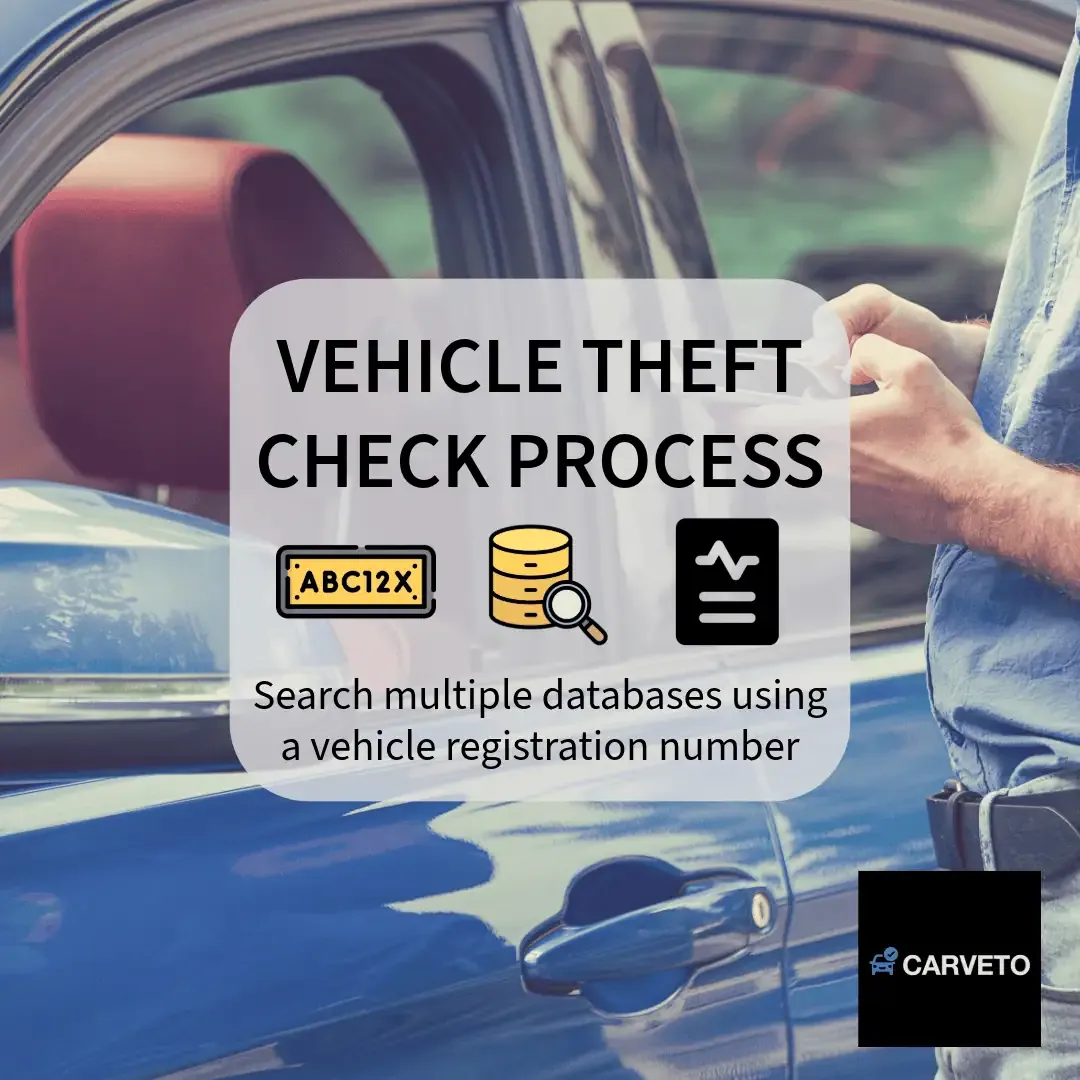
1. Enter the Registration Number
Enter the vehicle's registration number, or number plate, into our vehicle reg checker to start the check.
CarVeto uses this number plate to pull the vehicle's record from the PNC and confirm it matches official DVLA registration data.
2. Wait while System Checks Multiple Databases
Wait for a few seconds while CarVeto's system matches the registration number against the PNC, DVLA, and MIAFTR at once.
CarVeto queries PNC theft flags, validates DVLA registration data, and cross-references MIAFTR write-off claims to improve detection accuracy.
Our system also cross-checks the Vehicle Identification Number (VIN) against the number plate and V5C logbook to catch cloned or forged identities.
3. Get Stolen Vehicle Status Report
Get your stolen vehicle report once the database matching completes, which shows whether the vehicle carries a theft marker, a write-off record, or an export marker.
It also flags any mismatch between the physical vehicle and its official records that may signal cloning or fraud.
Our report covers the core status overview, while a full history check uncovers bigger risks such as outstanding finance.
What Does Our Stolen Vehicle Check Report Include?
Our stolen vehicle check report includes 3 categories of vehicle information: risk information, identity verification, and full vehicle specifications.
Vehicle risk information covers theft status, write-off history, outstanding finance, and import or mileage discrepancies that affect a buyer's decision.
Vehicle identity verification confirms that the VIN, engine number, and vehicle registration number match across all official records to rule out cloning or fraud.
Vehicle details and specifications list the make, model, fuel type, emissions data, and other technical attributes that confirm a vehicle's true identity and compliance status.
Vehicle Risk Information
Vehicle risk information in CarVeto’s stolen vehicle check report covers the data that reveals a hidden theft, finance, or write-off problem on a car.
This information includes a stolen vehicle report, an insurance write-off marker, outstanding finance, and signs of an undeclared import, mileage discrepancy, or colour change.
Each of these records protects a buyer from financial loss and legal trouble after a purchase.
The records included in vehicle risk information are listed below.
Vehicle Reported As Stolen
A stolen vehicle report confirms whether a car carries an active theft marker on the Police National Computer (PNC) or the Motor Insurance Anti-Fraud and Theft Register (MIAFTR).
Criminals sometimes conceal a stolen vehicle's history by changing its identity through cloning, where a legitimate vehicle's details are copied onto a stolen one.
They may also alter the V5C logbook to mask the true registration history.
Running a stolen status check against the PNC and MIAFTR at once catches these concealment attempts, since a cloned vehicle's details rarely match across official records.
A clear stolen status result confirms no active theft marker, so buyers should also review the vehicle's write-off history and outstanding finance data within the same report.
Sellers sometimes disguise a stolen vehicle as a write-off or a financed car to bring it back onto the market.
Insurance Write-Off Status
Our stolen vehicle check report reveals a vehicle's insurance write-off status, which falls into 4 categories, including Category A, Category B, Category S, and Category N.
CarVeto records the write-off category against each vehicle so buyers know exactly what condition a car was in before purchase.
Category A includes vehicles that are crushed and never legally returned to the road.
Category B covers vehicles that cannot be driven again, but their parts are salvageable for reuse.
Category S refers to vehicles that have suffered structural damage, requiring a professional inspection before the car is safe to drive again.
Category N applies to vehicles with non-structural damage only, meaning the car returns to the road once repairs are complete and verified.
Buyers should Check Write-Off status before agreeing on a price, since a write-off history affects both safety and resale value.
Outstanding Finance Status
An Outstanding Finance Check status confirms whether a finance company still holds legal ownership of the vehicle until the agreement is paid off in full.
CarVeto's stolen vehicle check report includes outstanding finance data within its vehicle risk information, so buyers get this confirmation alongside the stolen status result.
Buying a car with unpaid finance risks repossession, even if the buyer has already paid the seller in full.
Imported or Exported History
Our stolen vehicle check report reveals whether a vehicle has crossed UK borders, which affects both its legal status and its market value.
An imported vehicle that was never declared to customs may carry unpaid duty or VAT, and the buyer becomes responsible for this debt upon taking ownership.
A vehicle previously exported and reimported can also return with mismatched specifications, since other markets often use parts, emissions standards, or safety equipment that differ from UK requirements.
Buyers should treat any import marker flagged in our report as a reason to request full customs and registration documentation from the seller before completing a purchase.
Mileage History Record
A mileage record in our stolen vehicle report tracks the odometer readings logged at each MOT test, which exposes any gap between the displayed mileage and the vehicle's genuine history.
A sudden drop in recorded mileage, or a long gap with no MOT data at all, signals possible odometer fraud, sometimes called clocking.
Buyers should run a mileage check against the seller's claims and the vehicle's service history before agreeing on a price.
Colour Change History
A colour change history information in the stolen vehicle check report flags any mismatch between the vehicle's current colour and the colour recorded on its DVLA record.
A genuine colour change, such as a respray or wrap, is usually declared to the DVLA and reflected in official records.
An undeclared mismatch is a common sign of cloning, in which a criminal changes a stolen vehicle's appearance and gives it a different identity to avoid detection.
Our stolen vehicle check report confirms that a car's Vehicle Identification Number (VIN), engine number, and registration number match across all official records.
This report also checks the vehicle's colour against DVLA records and catches cloning, ringing, and document forgery, where a vehicle's true identity has been altered or copied onto a stolen car.
Our stolen vehicle check report provides the following vehicle identity verification details.
VIN Confirmation
A free VIN check, also called a stolen vehicle VIN check, compares the Vehicle Identification Number (VIN) stamped on the chassis against the VIN on the V5C logbook and DVLA database.
Common tampering signs include re-stamped or filed-down chassis digits, mismatched font or spacing, and a VIN sticker newer than the rest of the vehicle.
A mismatch usually signals cloning, where a criminal copies a legitimate car's identity onto a stolen vehicle of a similar make and model.
Buyers who spot these signs should stop the purchase rather than ask the seller to explain the discrepancy.
Engine Number Verification
CarVeto's report confirms that the number stamped on the engine block matches the V5C logbook and DVLA record.
Criminals tamper with engine numbers by grinding down and re-stamping digits, or by swapping in an engine without updating the official record.
A mismatch often points to a stolen engine, an unrecorded swap, or a vehicle rebuilt from mixed parts after an accident. Buyers should question any re-stamped, uneven, or worn engine numbers before completing the purchase.
Registration Number Consistency
The stolen vehicle check verifies that the number plate matches the VIN, V5C logbook, and DVLA record, using the same registration data as our number plate checker.
A genuine vehicle shows the same registration number across all 3 official vehicle records, with no gaps in its ownership or tax history.
Plate cloning occurs when a criminal copies a legitimate car's number plate onto a stolen vehicle of the same make, model, and colour, allowing it to pass routine police checks.
The fraud often comes to light when the original owner receives a fine for a location they never visited, since both vehicles now carry the same number plate.
Our stolen vehicle check report includes vehicle details and specifications such as make, model, transmission type, fuel type, body type, and engine capacity recorded for a car.
These records also include the year of manufacture, date of first registration, CO2 emissions data, and an environmental compliance report.
These details let buyers confirm a vehicle matches its advertised description and avoid unexpected running costs or compliance charges.
Our stolen vehicle check report provides the following vehicle details and specifications.
Vehicle Make
Our stolen vehicle check report confirms the manufacturer name recorded on the DVLA database matches the badge and documentation on the physical car.
The Ultra Low Emission Zone (ULEZ) and other clean-air zones charge or restrict entry for vehicles that do not meet emissions standards, and older diesel and petrol models are the most likely to be affected.
Buyers should confirm a car meets ULEZ and clean-air zone emissions standards before driving it into zones such as London or other UK city centres that enforce these charges.
Vehicle Model
CarVeto’s stolen vehicle check report confirms that the exact model name and variant recorded on the DVLA database match the vehicle being sold.
This detail also reveals whether the manufacturer has issued a safety recall linked to that specific model.
Transmission Type
Our stolen vehicle check report verifies whether the vehicle uses a manual or automatic gearbox, as recorded on its official specification.
Buyers should check this detail against their licence category, since some licences only permit automatic vehicles.
Transmission type also affects insurance pricing and resale value when the buyer sells the car later.
Fuel Type
Our stolen vehicle check report shows whether the vehicle runs on petrol, diesel, hybrid, or electric power.
Diesel vehicles registered before the current emissions standards often face ULEZ and clean-air zone charges.
This fuel detail helps buyers avoid unexpected daily fees, since electric and newer petrol models are usually exempt from these charges.
Body Type
Our stolen vehicle check report identifies the vehicle's structural category, such as hatchback, saloon, estate, or SUV, as recorded on the DVLA database.
Buyers use this detail to verify the car matches its advertised description and intended use.
Engine Capacity
Our stolen vehicle check report states the engine size in litres or cubic centimetres recorded for the vehicle.
This figure affects road tax bands, insurance costs, and performance expectations, helping buyers estimate ongoing running costs before purchase.
Year of Manufacture
Our stolen vehicle check report shows when a vehicle was built, which can differ from the registration date if the car sat unregistered in a dealer's stock.
Buyers can use this detail to assess the car's age-related depreciation and remaining service life.
Date of First Registration
Our stolen vehicle check report shows when the vehicle was first registered with the DVLA.
The registration date determines the vehicle's age for tax, MOT, and warranty purposes.
This date helps buyers confirm the seller's claimed vehicle age and avoid overpaying for an older car.
CO2 Emissions Data
Our stolen vehicle check report confirms the vehicle's recorded carbon dioxide output.
This figure sets the Vehicle Excise Duty (VED) band, which determines the annual road tax rate the buyer will pay.
Higher-emission vehicles also face larger charges when entering ULEZ or clean-air zones, making this figure relevant to running costs.
This carbon emission data helps buyers budget for ongoing tax and zone charges before committing to a purchase.
Environmental Compliance
Our stolen vehicle check report verifies whether the vehicle meets current emissions standards, including ULEZ and Clean Air Zone requirements.
A non-compliant vehicle faces daily charges or restricted access in zones such as Greater London, which buyers should factor into their running cost calculations.
Client Testimonials for Our Stolen Vehicle Check
Our stolen vehicle check service is rated 4.8 out of 5 stars by verified customers for detecting theft markers, cloned identities, and outstanding finance before they buy a vehicle.
Buyers consistently highlight the speed of the service, as entering a registration number delivers instant results without any wait.
Customers also point to the check's accuracy in spotting red flags, such as mismatched VIN or registration details, that helped them walk away from a purchase before losing money.
Many clients credit CarVeto's stolen vehicle check for protecting them from the financial and legal risks of buying a stolen car before paying a deposit.
One Trustpilot review described a buyer who used the check and discovered the vehicle had rolled-back mileage and outstanding finance, neither of which the seller had disclosed.
Which Vehicles Can You Run a Stolen Check On?
You can run a stolen check on cars, vans, motorcycles, and motorhomes.
This premium check applies to any of these vehicles registered in Great Britain with a valid registration number or Vehicle Identification Number (VIN).
CarVeto runs this check across multiple vehicle categories, from light commercial vehicles to lorries and Heavy Goods Vehicles (HGVs).
Our check matches each vehicle's details against the PNC, DVLA, and MIAFTR records to confirm whether it carries a theft marker, regardless of vehicle type.
The vehicle types eligible for a stolen check are listed below.
- Cars: Our stolen vehicle check applies to any car before a private or used car sale.
- Vans: CarVeto's premium stolen vehicle check covers any van before a commercial or private sale.
- Motorcycles: Our stolen vehicle check verifies any motorcycle before a private sale, since motorcycles remain a frequent target of theft.
- Light Commercial Vehicles: CarVeto's stolen vehicle check confirms any light commercial vehicle's stolen status before business or fleet use.
What Are the Risks of Buying a Stolen Car?
The risks of buying a stolen car include police seizure, total financial loss, ownership disputes, insurance complications, cloned vehicle fraud, and hidden mechanical damage from prior misuse.
A buyer can lose both the car and their money despite having no knowledge of the theft, making a stolen status check the buyer's best protection.
The risks of buying a stolen car are listed below.
- Risk of Police Seizure: Police can seize a stolen vehicle from its current owner at any time, regardless of whether the buyer knew it was stolen. The buyer may then face police enquiries and must show proof of purchase, such as receipts or bank records, to demonstrate they bought the car in good faith.
- Financial Loss Risk: Buyers who lose a seized vehicle rarely recover the purchase price, since the money paid to a fraudulent seller disappears along with the car. An unusually low asking price or a cash-only payment request often signals this risk in advance.
- Ownership Disputes: A stolen vehicle never transfers legal ownership to the buyer, which means the original owner retains the right to reclaim it even after a sale. A stolen vehicle disguised through a counterfeit V5C logbook makes this dispute harder to resolve quickly.
- Insurance Claim Rejection: Most insurance policies do not cover stolen or fraudulently obtained vehicles, so a claim on a vehicle later identified as stolen is typically rejected outright. This rejection means the buyer recovers none of the money lost, since no insurer will cover the claim.
- Cloned Vehicle Fraud: A buyer can unknowingly purchase a stolen vehicle disguised with a cloned identity, since mismatched VIN, registration, or colour details rarely stand out without a dedicated check. A cloned vehicle has often been driven aggressively before resale, leaving engine, transmission, or clutch damage that is not visible during a normal inspection.
What Other Vehicle Checks Are Needed Before Buying a Used Car?
The other vehicle checks needed before buying a used car are checking outstanding finance, verifying insurance write-off status, detecting mileage discrepancies, reviewing previous ownership history, and confirming vehicle specifications.
These checks help buyers confirm legal ownership, financial liability, and true vehicle condition before completing the purchase.
The other checks needed before buying a used car are explained below.
Financial and Legal History Checks
Buyers need an outstanding finance check to confirm that the vehicle is free of active agreements such as hire purchase (HP), personal contract purchase (PCP), or logbook loans.
Unpaid finance can lead to repossession after the sale, even if the buyer paid the seller in full.
An insurance write-off check is equally important, since it confirms whether the car has been declared a total loss under categories A, B, S, or N.
This status directly affects the car's safety, value, and insurability going forward.
A mileage discrepancy check is the third essential check that compares MOT history, service records, and ex-lease or rental data.
This comparison catches odometer tampering before the buyer pays for a car with a falsified history.
Ownership and Specification Checks
Buyers need a previous car ownership check to see how many keepers the vehicle has had.
Frequent ownership changes in a short period can signal an underlying fault or a seller trying to sell the car quickly before a problem is discovered.
A vehicle specification check is also important as it confirms that the make, model, and technical details on the DVLA database match the physical car.
This match helps catch cloned or misrepresented vehicles before purchase.
A vehicle recall check is another check that identifies any unresolved manufacturer safety recalls.
Driving a car with an open recall can carry safety risks the seller may not have disclosed.
Physical Condition and Inspection Checks
Buyers need physical condition and inspection checks to confirm the vehicle matches its advertised description and to catch any mechanical or bodywork issues a seller has not disclosed.
Mechanical wear indicators such as tyre condition, brake performance, and suspension wear reveal how well the vehicle has been maintained.
An On-Board Diagnostics (OBD) scan also reveals fault codes that the dashboard warning lights have not yet triggered.
A test drive evaluation and a bodywork inspection round out this process by exposing steering faults, unusual noises, or bodywork damage that can point to a previous accident.
These checks extend beyond stolen vehicle verification by ensuring the car is legally owned, free from outstanding debt, and accurately represented.
Buyers can run a Car History Check using the registration number to access all results in a single report.
Frequently Asked Questions (FAQ)
The signs that indicate a vehicle may be stolen are written below.
- A mismatch between the Vehicle Identification Number (VIN), the registration number, and the V5C logbook signals possible cloning.
- Physical tampering signs, including filed-down digits, mismatched fonts, re-stamping on the chassis plate, damaged number plates, repainted sections, or mismatched body panels, suggest a tampered identity number.
- Damaged number plates, repainted sections, or mismatched body panels indicate the vehicle's identity or appearance has been altered.
- A price well below market value often signals a stolen vehicle being sold quickly before detection.
- A seller who insists on cash-only payment is a warning sign, since it avoids the paper trail a bank transfer creates and leaves the buyer unable to prove the purchase later.
- A seller who delays or refuses to show the V5C logbook, service history, or proof of ownership raises immediate suspicion.
- A mismatch between the vehicle's colour, make, or model and its official DVLA record can indicate a cloned identity.
- An active theft flag or unresolved fraud alert on a Police National Computer (PNC) or MIAFTR check confirms the vehicle's stolen status.
You should follow the steps given below if a vehicle is reported as stolen.
- Do not go through with the sale or return the vehicle to the seller, as handling a known stolen vehicle can create legal complications for you.
- Contact the police immediately by calling 101, or 999 if the situation is urgent, and report your vehicle as a suspected stolen vehicle.
- Provide the registration number, make, model, and colour of the vehicle, along with your check result, so police can confirm the report against their records.
- Request a Crime Reference Number from the police, since you will need this number for any insurance claim or dispute with the seller.
- Hand the vehicle over to the police once instructed, rather than attempting to keep or resell it yourself.
- Tell your insurer immediately, since a reported stolen vehicle cannot stay insured under your name, and they will need your Crime Reference Number to process any claim.
- Update the DVLA record to remove your details as the registered keeper, since ownership reverts to the original owner once police confirm the theft.
Yes, the police can seize a stolen vehicle after purchase, even if the buyer had no idea it was stolen.
Ownership of a stolen vehicle never legally transfers to the buyer, so the original owner or their insurer keeps the right to reclaim it.
The buyer must then recover the purchase price directly from the seller, since the police have no obligation to compensate them.
You should report a stolen car to the police by following the steps given below.
- Call 999 if the theft is in progress, or dial 101 to report a stolen vehicle after the event.
- Provide the vehicle registration number (number plate) to identify the car in police systems.
- Provide the VIN and key vehicle details, including make, model, colour, and distinguishing features.
- Confirm the time and location of the theft to support accurate reporting and investigation.
- Provide owner and keeper details, including name, address, and proof of ownership if requested.
- Request a crime reference number to track the case and support insurance claims.
- Notify your insurance provider and submit the crime reference number to begin the claims process.
Reporting a stolen vehicle updates the Police National Computer (PNC) and connected databases, which lets law enforcement and vehicle check services flag the car as stolen.
You can also call Crimestoppers on 0800 555 111 to report a stolen vehicle anonymously if you have information about a theft but prefer not to contact the police directly.
You should confirm whether a vehicle is already recorded as stolen by checking its number plate with our Stolen Vehicle Check tool.
Yes, you can buy a recovered stolen car from a private seller, but it carries higher legal, financial, and safety risks due to limited verification and a lack of dealer accountability.
Private sellers provide limited disclosure compared to dealerships, which makes ownership history harder to verify, so you must confirm the seller has the legal right to sell the car.
Buying a recovered stolen car from a private seller carries the risks of ownership disputes, hidden mechanical damage, and outstanding finance or fraud markers.
A private sale offers fewer legal protections, so running a stolen vehicle check before purchase confirms the seller's details against the V5C logbook and helps avoid fraudulent transactions.
Yes, a stolen vehicle check uses DVLA records to confirm a car's registration, tax status, and registered keeper details alongside police theft data.
These DVLA records also confirm the vehicle's make and model, which helps detect a cloned identity when the physical car does not match its official specification.
To check if a car has been in an accident or written off, follow the steps given below.
- Check the vehicle's write-off category: Confirm whether the vehicle has been declared a total loss under insurance categories such as Category A, B, S, or N. A free car insurance check can confirm this status using only the registration number. Category A and B vehicles cannot return to the road, while Category S and N indicate structural or non-structural damage that affects safety and value.
- Check the salvage and damage records: Review these records to reveal the origin of the write-off, including accident damage, theft recovery, or insurance loss claims. This process functions as a damage check by confirming structural damage, repair history, and re-entry into the market.
- Check the V5C logbook and MOT history: Look at the "Special Notes" section on the V5C logbook's first page, since the DVLA sometimes records a write-off status there directly. Run an MOT road tax check to review the MOT history for repeated advisories on structural corrosion, suspension damage, or a sudden mileage gap. These signs can signal accident damage that was repaired but never declared to an insurer.
- Inspect the vehicle in person: Check for uneven panel gaps or mismatched paint texture, since these can indicate a past collision. Tyres with uneven wear across the same axle can also reveal a collision that no database check has recorded.
You can also run a "Check if a Car is Written Off" search using the registration number to confirm the insurance category, then arrange a professional inspection to assess the vehicle's safety and repair history.
Check if a car has outstanding finance by verifying active financial agreements registered against the vehicle, using its registration number, sometimes called an HPI check.
An outstanding finance check identifies financial agreements such as hire purchase (HP), personal contract purchase (PCP), lease agreements, and logbook loans recorded against the vehicle.
These agreements represent outstanding debt, meaning the finance provider retains legal interest until repayment is complete.
Secured finance agreements, such as HP and PCP, are tied directly to the vehicle itself, unlike a standard unsecured loan, which is why the lender keeps legal ownership until the debt is cleared.
Yes, you can buy a car with outstanding finance, but only if the existing debt is settled as part of the transaction, since the lender retains legal ownership until the loan is fully repaid.
Buying the car without settling this debt first leaves you at risk of repossession, even if the seller has already signed the V5C logbook over to you.
The safest way to buy a financed vehicle is to pay the outstanding balance directly to the finance company, then pay the seller any remaining equity once the lender confirms the debt is cleared.
You should request a settlement letter from the lender as proof that the loan has been paid off, since this protects you if a dispute arises later.
You can also contact the finance company directly to verify the outstanding balance independently, rather than relying on the seller's word alone.
An outstanding finance check calculates financial risk by confirming whether the vehicle carries secured debt, outstanding debt, or active financial agreements.
You should run an "Outstanding Finance Check" to verify financial liability and avoid repossession risk before agreeing on a payment method with the seller.
The types of vehicle theft that can lead to stolen markers are given below.
- Vehicle Theft: Stealing an unattended vehicle, taking the keys during a burglary, or tampering with the Controller Area Network (CAN) bus all trigger a stolen marker.
- Illegal Possession: Taking a vehicle without the owner's consent under the Taking Without Owner's Consent (TWOC) offence, or holding one unlawfully after a carjacking or robbery, can result in a stolen marker.
- Fraudulent Sale: Obtaining a vehicle through deception, or disguising one using a cloned registration plate or a tampered Vehicle Identification Number (VIN), often carries a marker linked to the original theft.
- Organised Crime: Targeting a vehicle for export to foreign markets, or breaking it down for parts, does not remove its stolen marker, even after it leaves the country.
- Recovery Investigation: Placing a vehicle under police investigation adds an unconfirmed marker until officers verify the theft report, after which the marker becomes confirmed or is removed.