
SORN a Vehicle: How to Declare Your Car Off the Road
A SORN (Statutory Off Road Notification) tells the DVLA (Driver and Vehicle Licensing Agency) that a vehicle is being kept off public roads.
The registered keeper must declare SORN when the vehicle is no longer taxed or insured and will remain off-road.
The vehicle must then be kept on private land, such as a driveway, garage, or private parking area.
Public roads, pavements, and public car parks cannot be used to store a SORN vehicle because these locations do not meet the off-road requirement.
A valid SORN removes the need to pay vehicle tax while the vehicle remains off-road.
Insurance is also not required during this period, provided the vehicle continues to be kept off public roads.
CarVeto's SORN guide explains the available methods for declaring SORN through GOV.UK, by phone, or by post using form V890.
The guide also explains the main DVLA SORN requirements and how long a SORN remains valid.
These rules cover the circumstances in which a SORN ends, including when the vehicle is taxed, sold, scrapped, or permanently exported.
This information helps you understand how to SORN a car and maintain the correct legal status while the vehicle remains off-road.
What Is SORN?
SORN (Statutory Off Road Notification) is an official UK government declaration made to the DVLA stating that a vehicle is no longer being used, parked, or kept on public roads.
The registered keeper must actively declare SORN, as this status does not arise automatically when a vehicle is not being driven.
A SORN vehicle must remain completely off public roads and be kept on private land, such as a driveway or garage.
The SORN declaration also affects the vehicle's tax and insurance requirements.
A valid SORN vehicle is exempt from VED (Vehicle Excise Duty) while it remains off the road.
Any full months of unused tax are refunded automatically where applicable.
A vehicle is also removed from active insurance enforcement under CIE (Continuous Insurance Enforcement) after being declared SORN.
SORN applies to the vehicle rather than to the owner.
A new keeper must therefore make a separate SORN declaration if the vehicle remains off the road after ownership is transferred.
The previous keeper's SORN declaration does not automatically carry over to the new keeper.
Around 3.4 million UK vehicles are SORNed annually, demonstrating the widespread use of the SORN system across the UK.
When Do You Need to SORN a Vehicle?
You need to declare a DVLA SORN when a vehicle is unused and will no longer be taxed or insured for road use.
The DVLA requires the registered keeper to make the declaration before or after the vehicle tax expires.
SORN only applies when the vehicle is kept entirely on private property, such as a garage, driveway, or private estate.
You should declare a vehicle SORN in the following situations.
- You plan to cancel your vehicle insurance or allow the policy to lapse while keeping the vehicle off public roads.
- You do not intend to renew your vehicle tax because the vehicle will remain unused and off the road.
- Your vehicle is undergoing repairs or is currently unroadworthy, so it will remain off public roads until it is repaired and ready for use.
- Your vehicle has failed its MOT, and you do not plan to repair it immediately. This vehicle should remain off public roads while awaiting repairs or further testing.
- You have purchased a car but do not plan to drive it immediately, provided you keep it on private property.
- You own a classic or collectible vehicle that you use seasonally or do not intend to drive on public roads. This allows it to remain stored off-road when not in use.
Note: A SORN is not required when a vehicle remains taxed and insured, regardless of how often it is driven. SORN becomes necessary when the vehicle will remain off public roads without valid tax or insurance. The registered keeper should declare SORN before cancelling insurance. A registered keeper can face enforcement action if the vehicle is uninsured without a SORN, even when it is kept on private land. SORN provides a legal route to suspend vehicle tax and insurance obligations while the vehicle remains off public roads.
How to Declare SORN with the DVLA?
To declare SORN with the DVLA, you can use one of three methods, including online via GOV.UK, by phone, or by post using form V890.
The method you choose depends on whether you have the vehicle’s V5C log book, a V11 vehicle tax reminder, or neither.
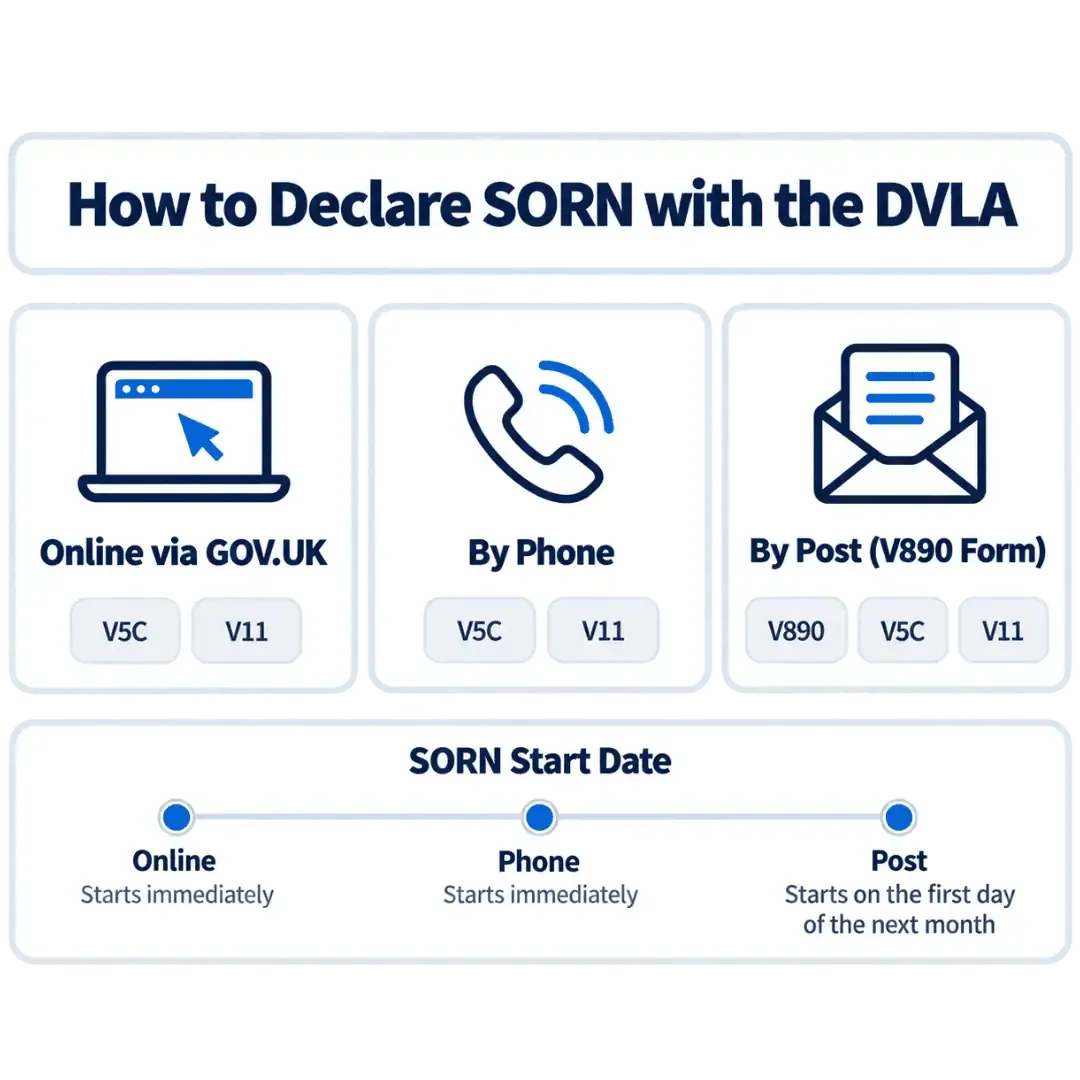
You can declare a vehicle SORN with the DVLA by any of the following options.
- Online via GOV.UK: Use the GOV.UK vehicle tax service to declare SORN online. You should use the 11-digit number from your V5C logbook or the 16-digit number from your V11 reminder to complete the application. A SORN made using a V5C starts immediately. The one made using a V11 begins on the first day of the following month.
- By Phone: Call the DVLA on 0300 123 4321; the service is available 24 hours a day. Your V5C or V11 reference number is required when making the SORN declaration.
- By Post (V890 Form): Declare SORN by post by completing form V890 if you do not have the V5C logbook. You can also apply by post when you are not yet the registered keeper. This form can also be used to declare SORN on behalf of someone else or a business. You should then send the completed form to DVLA, SORN Applications, Swansea, SA99 1AR.
Note: Declaring a vehicle SORN is free, although a fee applies if you need to request a replacement logbook using form V62.
How Long Does a DVLA SORN Last After Declaration?
A SORN lasts indefinitely once declared and does not need to be manually renewed.
A SORN ends only when the vehicle is taxed, sold, scrapped, or exported.
The start date depends on the method used to make the declaration. A SORN starts immediately when the declaration is made using the V5C logbook.
A SORN declared using the V11 tax reminder starts on the 1st day of the following month.
The V11 tax reminder can be used to apply for SORN up to 2 months in advance.
An active SORN makes the vehicle exempt from VED and removes it from insurance enforcement under CIE.
This vehicle must remain off public roads and be stored on private land while the SORN is active.
How Do You Cancel or Renew SORN?
You can cancel or renew SORN by changing the vehicle’s legal status with the DVLA.
A separate cancellation or renewal request is not required.
A SORN ends automatically when the vehicle is taxed, sold, scrapped, or permanently exported.
Vehicle tax can be arranged online through GOV.UK using the 11-digit V5C reference number.
The same service is available by phone through DVLA’s automated service or at a Post Office offering vehicle licensing services.
A valid MOT (Ministry of Transport) and active insurance recorded on the Motor Insurance Database (MID) are required before the vehicle can be taxed for road use.
The vehicle must remain off public roads until the tax is confirmed.
Driving an untaxed vehicle can result in fines under the Vehicle Excise and Registration Act 1994.
A SORN also ends when ownership transfers to a new keeper, the vehicle is scrapped and reported to the DVLA, or permanently exported.
The DVLA closes the SORN record after processing the V5C update for a sold vehicle or receiving the certificate of destruction for a scrapped vehicle.
The vehicle becomes subject to VED requirements and CIE compliance tracking once the SORN ends.
What Happens If You Don’t Declare SORN?
You can face an £80 fixed penalty notice if you do not declare SORN for an untaxed vehicle that is kept off-road.
Court action can result in a fine of up to £1,000, while further enforcement may include clamping, seizure, or destruction of the vehicle.
The registered keeper may also lose entitlement to any unused vehicle tax refund.
The DVLA monitors compliance using vehicle tax and insurance data to identify vehicles that have neither valid cover nor an active SORN.
The Motor Insurers’ Bureau (MIB) supports insurance enforcement through the CIE system.
This enforcement applies to vehicles kept off-road without formally notifying the DVLA or parked on a public road without valid tax or SORN.
The DVLA expects SORN to be declared before vehicle tax or insurance expires.
Declaring SORN later does not cover any earlier period when the vehicle was untaxed or uninsured.
Any period without valid tax, insurance, or an active SORN may result in enforcement action.
Can You Drive a SORN Vehicle?
No, you cannot drive or park a SORN vehicle on public roads.
A vehicle with an active SORN must remain off public roads unless it is being driven to or from a pre-booked MOT test.
The vehicle can be driven for this purpose if the MOT appointment is confirmed and it has valid insurance.
The journey must also be made without unnecessary stops or diversions.
The driver should carry proof of the MOT booking if stopped, and the appointment may be verified with the test centre.
The MOT exemption does not cover other journeys, including test drives by private buyers, trips to garages or repair centres, and diagnostics.
It also does not include road checks or vehicle delivery.
A SORN vehicle that needs to be moved for any other reason must be transported using a trailer or recovery vehicle.
Driving a SORN vehicle outside the pre-booked MOT exception is unlawful and may result in enforcement action.
How to Check SORN Status Online?
To check SORN status online, you can use CarVeto’s Free Car History Check.
This check helps establish whether the vehicle has been legally declared off the road.
It also provides supporting information about its current tax and MOT position.
The CarVeto check combines SORN information with important vehicle details, including vehicle tax status, MOT history and due date, and vehicle identification data.
These details help verify the vehicle’s legal status before a private purchase, after submitting a SORN, or before cancelling insurance.
Our DVLA checker provides another way to verify the vehicle’s current record.
This service can display the current SORN status, tax and MOT details, and the date of the last DVLA update.
The vehicle registration number is required for this check, while the make and model are sometimes needed to validate the vehicle details.
A vehicle with no SORN recorded is still subject to VED and CIE requirements.
Checking the status before taxing or driving a previously SORNed vehicle helps confirm that the vehicle is legally ready for road use.
This check is also useful when buying a vehicle declared off the road or cancelling insurance for a SORN vehicle.
What Happens to Your Car Insurance When You SORN?
Your car insurance does not automatically end when you SORN your vehicle.
A SORN vehicle does not require active insurance under DVLA rules or CIE.
An existing insurance policy remains active until it is cancelled with the insurer.
The timing of car insurance cancellation is important.
SORN confirmation from the DVLA should be received before the insurance policy is cancelled to avoid a potential CIE enforcement gap.
Your insurer can then confirm whether cancellation fees apply or whether you are entitled to a refund.
Laid-up insurance is another option for vehicles that remain off the road.
This type of cover can provide fire and theft protection, which may be useful for valuable or garage-stored vehicles.
Public-road use remains prohibited for a SORN vehicle unless the required legal conditions are met. Valid insurance is also required for any permitted road use.
What Should You Know Before Buying a SORN Car?
Before buying a SORN car, you should know that the SORN status does not transfer to the new keeper.
You cannot drive it on public roads unless you are travelling to a pre-booked MOT test.
The vehicle can legally be bought. The new keeper must either tax and insure it before driving or submit a new SORN declaration if it will remain off-road.
A SORN vehicle should remain on private land while the SORN is active.
Keeping it on a public road breaches SORN requirements. SORN vehicles are commonly kept off the road because of expired or failed MOTs, long-term storage, or restoration projects.
The reason for the SORN can provide useful context when assessing the vehicle’s condition and history.
The vehicle’s SORN status, MOT history, and storage location should be checked before purchase.
You can also use our HPI check to help identify these details before completing the purchase.
CarVeto’s free Car Data Check provides additional vehicle information for buyers.
These checks help you understand what is required after the purchase, depending on whether you plan to drive the vehicle or keep it off-road.
A buyer intending to drive the vehicle must have valid insurance, vehicle tax, and a current MOT before road use.
Vehicles that will remain off-road require a new SORN declaration using the V5C or V5C/2 with form V890 and must be kept on private land.
What Are the SORN Rules for Motorbikes, Vans, Classic Cars, Campervans and Lorries?
The SORN rules for motorbikes, vans, classic cars, campervans and lorries are the same as those for other road-registered vehicles.
SORN applies when a vehicle is untaxed, uninsured, and kept off public roads, regardless of its type, age, engine size, or emissions.
Motorbikes may require SORN when stored between seasons, while classic cars may need it during periods of storage or restoration.
Campervans can require SORN between trips, while vans and light commercial vehicles may need it during work gaps.
Lorries can also require SORN during fleet downtime or while awaiting repairs.
The same SORN requirements apply to project vehicles, show cars, and vehicles kept in storage.
These vehicles require SORN when they remain off-road without valid tax or insurance, just like other road-registered vehicles.
The vehicle’s type, engine size, age, or emissions do not provide an exemption from SORN requirements.
SORN should therefore be declared before the vehicle tax expires or the insurance lapses.
This keeps the vehicle’s legal status up to date with the DVLA.
Can a SORN Vehicle be Parked on the Road?
No, a SORN vehicle cannot be parked or kept on a public road.
This vehicle must remain entirely off the public highway while the SORN is active.
Suitable storage for SORN vehicles includes a garage, driveway, or other private land.
Publicly maintained roads, streets, pavements, and public or residential car parks are not permitted storage locations.
Parking a SORN vehicle in these areas breaches DVLA rules and can result in fines, clamping, or vehicle seizure.
A limited MOT exception allows a SORN vehicle to be driven on a public road.
The journey must be directly to or from a pre-booked MOT test, with the required insurance in place.
Can I Drive a SORN Car to an MOT Test Without Tax and Insurance?
Yes, you can drive a SORN vehicle to a pre-booked MOT test without vehicle tax, but valid insurance is still required.
SORN does not exempt the vehicle from insurance requirements, so appropriate cover must be in place before the journey.
The MOT appointment must be booked and confirmed before you travel.
The journey must follow a direct route to the test centre without unnecessary stops or diversions.
Proof of the confirmed MOT appointment should be available if you are stopped.
The vehicle must be safe to drive on public roads for the journey.
A recovery or towing service should be used if the vehicle has dangerous faults or cannot be driven safely.
Driving without valid insurance remains illegal, even when travelling to a pre-booked MOT test.
Can I Drive a SORN Car to a Garage for Repairs?
No, you cannot drive a SORN vehicle to a garage for general repairs.
GOV.UK guide allows road use only for a pre-booked MOT test, making garage journeys unlawful.
Any other journey to or from a garage falls outside this exception.
A trailer or vehicle recovery service should be used to transport a SORN vehicle for repairs.
Can I SORN My Car Without a Driveway?
Yes, you can SORN your car without having a private driveway, provided it is kept on private land.
Suitable storage for a SORN vehicle can include a rented garage, private car park, or other off-street private parking.
A SORN vehicle cannot be kept on a public road because SORN only applies while the vehicle remains off the public highway.
Can I SORN MY Car Without a V5 or V11?
Yes, you can SORN your car without a V5C logbook or V11 reminder.
You can apply SORN by post using form V890, which must be completed and sent to the DVLA.
Online SORN applications require either a V5C or a V11.
Postal applications should include the V5C/2 new keeper slip with form V890 where applicable.
A replacement V5C can be requested using form V62 if the logbook is unavailable.
How Do I Get My Car Back on the Road After SORNing?
You can get your car back on the road after SORNing by taxing the vehicle using the V5C.
The vehicle must have valid insurance and a current MOT before it can legally be driven on public roads.
The car can then legally return to public-road use, provided the required tax, insurance, and MOT remain valid.
Can I Sell a SORN Car?
Yes, you can legally sell a SORN car while it remains off the road.
The existing SORN ends when ownership transfers, so the status does not carry over to the new owner.
The buyer must tax and insure the vehicle before driving it on public roads.
A new SORN declaration is required if the vehicle will remain off-road.
A trailer, flatbed truck, or recovery service is required if the vehicle needs to be transported while it remains SORN.
The seller must complete the V5C with the buyer’s details and notify the DVLA of the sale.
Responsibility then passes to the new owner, who must arrange the appropriate tax and insurance or declare a new SORN.
How Do You Report a SORNed Vehicle Being Used on the Road?
You can report a SORNed vehicle being used or kept on the road through the DVLA’s online report an untaxed vehicle service.
This service allows you to notify the DVLA about suspected SORN violations.
Providing the vehicle’s registration number, make, model, and colour helps the DVLA identify the vehicle and investigate the report.
You should provide the location of the vehicle, including the street, town, postcode, and the date you saw it.
A DVLA vehicle enquiry can confirm whether the vehicle is untaxed or recorded as SORN before you submit a report.
These reports can be made anonymously, so the vehicle owner will not be told who reported the vehicle.
Reporting suspected SORN misuse helps the DVLA enforce road-tax rules and supports safer road use.
Do I Need Temporary Insurance for a SORN Vehicle?
No, you do not need temporary insurance for a SORN vehicle while it remains off the road.
The vehicle must stay entirely on private land, such as a driveway, garage, or other private property.
Optional laid-up insurance can protect against risks such as fire, theft, or vandalism while the vehicle is stored.
This cover is not a legal requirement for maintaining SORN.
Insurance becomes necessary when the vehicle returns to public-road use.
The vehicle must also be taxed before it can be driven, except for the journey to or from a pre-booked MOT test.
How Do I Avoid Paying a SORN Fine?
You can avoid a SORN fine by declaring the vehicle off the road before its tax or insurance expires.
A SORN must be formally declared with the DVLA rather than simply allowing the vehicle tax to expire.
The DVLA does not accept backdated SORN applications, so an early declaration helps prevent gaps in compliance.
This approach keeps the vehicle’s legal status up to date and reduces the risk of penalties or enforcement.
How to SORN My Car in Northern Ireland (NI)?
To SORN your car in Northern Ireland, you must declare it through the Driver & Vehicle Agency (DVA), rather than the DVLA.
The declaration can be made online or by post using your vehicle logbook.
The SORN requirements are the same in Northern Ireland as in Great Britain.
The same penalties apply when a vehicle is untaxed, uninsured, or used on public roads without meeting the relevant requirements.
Is It Free to Make a SORN?
Yes, it is free to make a SORN, and no fee is charged for declaring a vehicle off the road.
The declaration can be made online, by phone, or by post using form V890.
A fee may only apply if you need to request a replacement V5C because your original logbook is unavailable.