

What is Car Clocking?
Car clocking is the illegal practice of altering a vehicle's odometer to display a lower mileage than the car has actually travelled.
This odometer fraud is carried out manually on older mechanical odometers or with digital tools on modern electronic ones.
Any deliberate mileage adjustment without disclosure to the buyer constitutes tampering under UK law.
Sellers usually clock a vehicle to inflate its resale value or to avoid excess mileage penalties when returning a leased or PCP-financed car.
Knowingly selling a car without disclosing a mileage discrepancy is a criminal offence, as set out under the Consumer Protection from Unfair Trading Regulations 2008 and the Fraud Act 2006.
A clocked car carries 2 main risks: hidden wear and tear, and financial loss.
Hidden wear and tear stays hidden because the false mileage makes the buyer believe the car needs less maintenance than it actually does.
Financial loss happens because the buyer pays a price based on that same false mileage, and only discovers the true value once they try to resell the car themselves.
CarVeto’s car mileage check, also known as a car clocking check, protects buyers from this risk by comparing the odometer reading against MOT history and service records.
This comparison exposes any gap between the displayed mileage and the vehicle's genuine usage history, protecting buyers from financial loss.
What is the Process for Identifying if a Car is Clocked?
Identifying if a car is clocked requires checking discrepancies across physical wear, service records, and official government data.
CarVeto cross-references the current odometer reading against historical MOT records and DVLA data to spot sudden mileage drops or anomalies in a vehicle's genuine usage history.
This process relies primarily on database records such as MOT history and the National Mileage Register for a verified mileage trail.
This mileage trail is far harder to fake than a logbook entry, since each MOT reading is recorded independently rather than supplied by the seller.
The vehicle mileage verification is also supported by physical signs, such as worn pedals or a smooth steering wheel on a high-mileage car.
A service history that doesn't match the displayed mileage is another useful signal.
These signs are not as reliable as database records, since they depend on a buyer's interpretation rather than an independently logged reading.
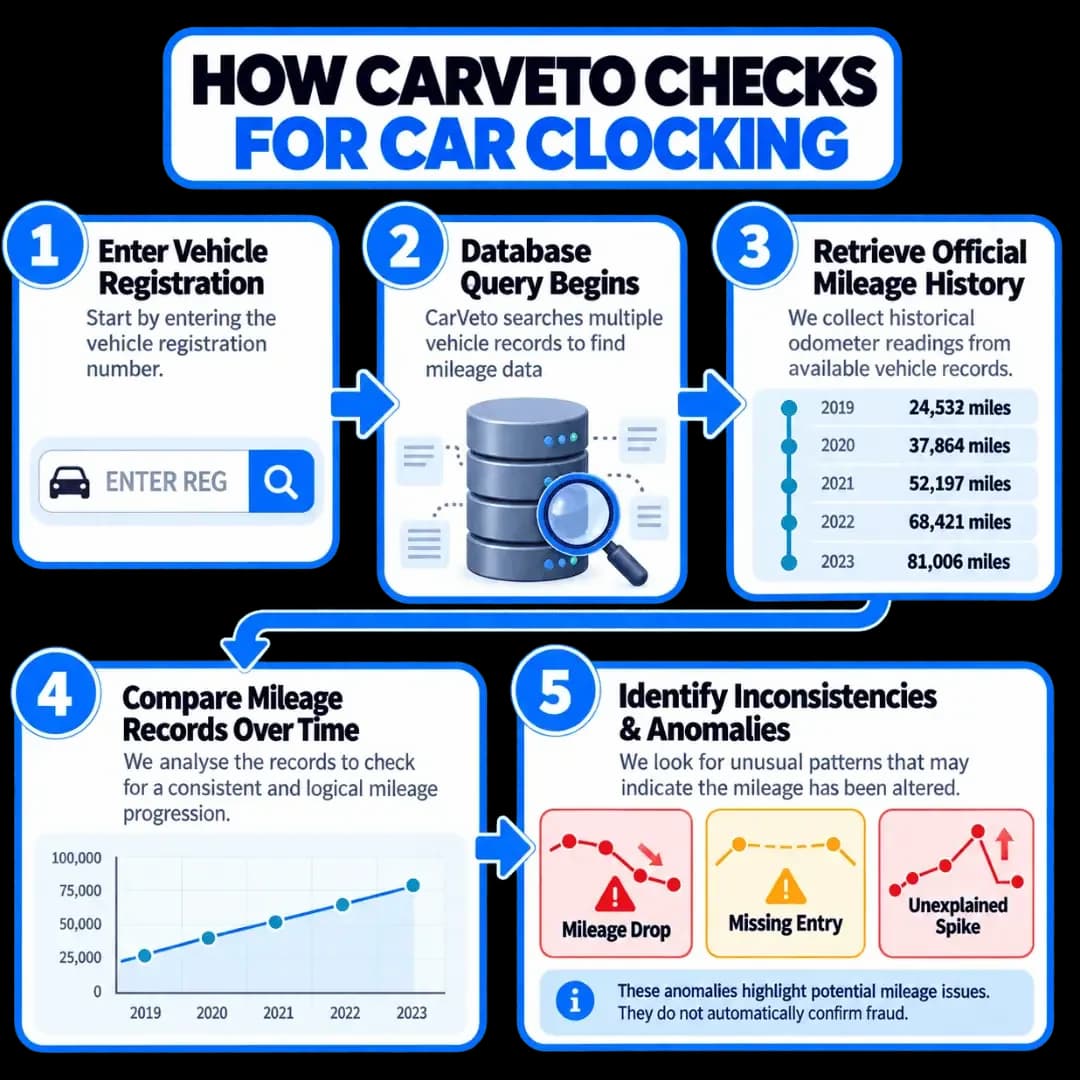
The steps for identifying a clocked car are given below.
1. Enter Vehicle Registration
The buyer enters the vehicle's registration number into CarVeto's mileage check tool to check mileage history and retrieve its historical mileage records.
2. Database Query Begins
CarVeto runs a DVLA mileage check against the vehicle's registration to retrieve the officially registered mileage data from the DVLA database.
3. Retrieve Official Mileage History
Our mileage checker then collects independently recorded odometer readings to check MOT mileage across every annual test, building a chronological timeline of the vehicle's recorded readings.
4. Compare Mileage Records Over Time
CarVeto then compares each MOT odometer reading against the figure recorded at the previous MOT test to confirm a steady increase aligned with the vehicle's estimated yearly mileage.
5. Identify Inconsistencies and Anomalies
CarVeto's mileage report flags any anomalies found, such as sudden drops, missing MOT entries, or unexplained spikes, to give buyers clear mileage fraud warning signs from a car mile check.
Where Does Our Mileage History Data Come From?
Our mileage history data comes from a trusted UK trade data network, combining over 180 million data points recorded during MOT tests, leasing, and rental agreements.
This trade data network includes DVLA registration records, a DVSA mileage check from MOT test records, RMI servicing data, and BVRLA rental data, each capturing a reading at a different life stage.
CarVeto's free check draws on DVLA and basic MOT data for a quick overview, while a premium report combines all 4 sources to build a more complete mileage history.
These 4 databases give buyers a more complete mileage picture together, as each source captures odometer readings at a different life stage.
Our mileage data captures odometer readings between MOT tests, since RMI servicing visits and BVRLA rental records each log a mileage reading outside the vehicle's annual MOT date.
The combined dataset also cross-validates each reading, since a figure confirmed by 2 or more independent sources is far harder to fake than 1 entry alone.
Our mileage checker tool instantly compares these records to highlight mileage discrepancies, missing entries, or sudden drops, giving buyers a verified basis for evaluating a car before purchase.
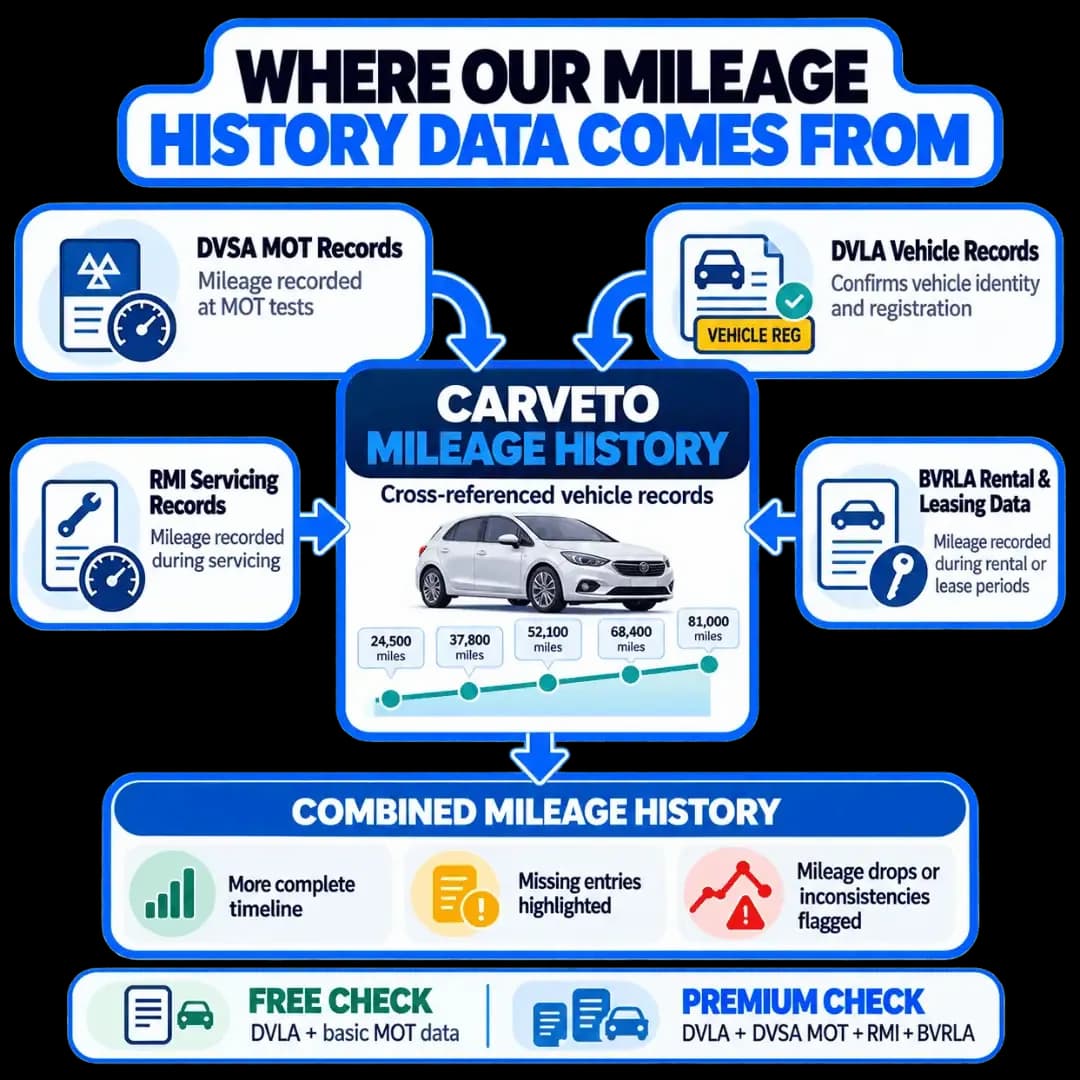
The sources of our mileage history data are listed below.
- DVSA MOT Records: DVSA MOT records are the official mileage readings logged by the Driver and Vehicle Standards Agency (DVSA) at every annual roadworthiness test. DVSA logs these readings for every car over 3 years old, creating a verified annual mileage checkpoint across the vehicle's tested life. CarVeto extracts these readings to build a verified annual mileage trail within its mileage history data.
- DVLA Vehicle Records: DVLA vehicle records are the official registration and keeper data maintained by the Driver and Vehicle Licensing Agency (DVLA) for every vehicle registered in the UK. DVLA does not record mileage directly, but these records confirm a vehicle's identity by holding its registration and keeper history. CarVeto uses this identity data to match mileage readings from MOT, RMI, and BVRLA sources to the correct vehicle. Vehicles with personalised registrations can be verified using our Private Number Plate Check to confirm their DVLA registration details before reviewing the mileage history.
- RMI Servicing Records: RMI servicing records are the mileage readings logged by garages, dealerships, and repair businesses within the Retail Motor Industry Federation (RMI) network at every service visit. RMI member businesses record these readings throughout the year, capturing mileage at every service visit a vehicle undergoes. CarVeto extracts these readings to fill the mileage gaps between annual MOT tests, as service visits occur more frequently than once a year.
- BVRLA Rental and Leasing Data: BVRLA rental and leasing data are the mileage readings recorded by rental and leasing companies within the British Vehicle Rental and Leasing Association (BVRLA) network during a vehicle's contract period. BVRLA member companies capture these readings at regular intervals during the contract, creating a mileage trail for vehicles before they enter the used car market. CarVeto uses this data as the earliest mileage checkpoint for newly leased vehicles that carry no MOT or service history yet.
See What Users Say About Our Mileage Check Reports
CarVeto's mileage check holds a 4.8 out of 5 rating, with users consistently highlighting its accuracy in catching odometer discrepancies that expose clocked vehicles before purchase.
Clients regularly praise our mileage history check for exposing gaps between MOT records that the seller never mentioned.
Customers highlight that CarVeto’s mileage check report saved them from overpaying for a vehicle worth thousands less than its asking price.
Vehicle buyers often comment on the speed of the report, noting that entering a registration number delivered instant results without any wait.
Clients trust our report's accuracy because it cross-checks mileage across multiple data sources rather than 1 record that could be incomplete.
Our mileage check users confirm that CarVeto's mileage trend indicators clearly highlight sudden mileage drops and unexplained gaps between MOT records.
Car buyers frequently mention recommending the service to friends and family after avoiding a costly mistake themselves.
Many customers conclude their reviews by saying that our report gave them the confidence to negotiate a fair price or walk away from a vehicle entirely.
What Are the Benefits of Reviewing Mileage History?
The benefits of reviewing mileage history are protection from hidden issues before purchase, reduced financial risk from a clocked vehicle, and prevention of resale or insurance complications.
Reviewing mileage history also supports maintenance planning and business mileage compliance.
Buyers often ask, “should I check my car mileage” before agreeing on a price, and the answer is yes, since mileage directly affects a vehicle's value, condition, and long-term running costs.
These benefits of reviewing mileage history are explained below.
- Highlighting Hidden Issues Before Purchase: CarVeto's mileage check reveals undisclosed issues before purchase, such as unusual mileage jumps, gaps, or a mismatch between the car's condition and its displayed mileage reading.
- Verifying Service and MOT History Against Mileage: Our mileage check confirms whether maintenance milestones happened at the manufacturer's recommended mileage and reveals any advisories or recalls logged at a specific mileage reading.
- Identifying Abnormal Usage and Ownership History: CarVeto’s mileage check reveals whether a vehicle was used commercially rather than privately and confirms whether a previous owner's stated use matches the vehicle's actual mileage history.
- Reducing Financial Risk From a Clocked Vehicle: Our mileage check confirms the car's true mileage before purchase and protects buyers from the financial risk of overpaying for a vehicle whose clocked reading inflates its market value.
- Preventing Future Resale and Insurance Complications: CarVeto's mileage check protects resale value and prevents insurance complications by confirming the declared mileage matches the vehicle's true mileage history before purchase.
- Supporting Business Mileage and HMRC Compliance: Our mileage check supports HMRC mileage allowance claims and employer reimbursement by providing documented mileage evidence that His Majesty's Revenue and Customs requires for business travel.
Are Mileage Discrepancies Always Fraud?
No, mileage discrepancies are not always fraud, since legitimate causes such as clerical errors or unit conversion mistakes can create the same mismatch as deliberate tampering.
Mileage anomalies fall into 2 broad categories: genuine recording errors and intentional fraud.
A buyer needs to identify which one applies before deciding whether a vehicle is unsafe to purchase.
Spotting an irregular reading early helps buyers ask the right questions and avoid costly surprises before completing a purchase.
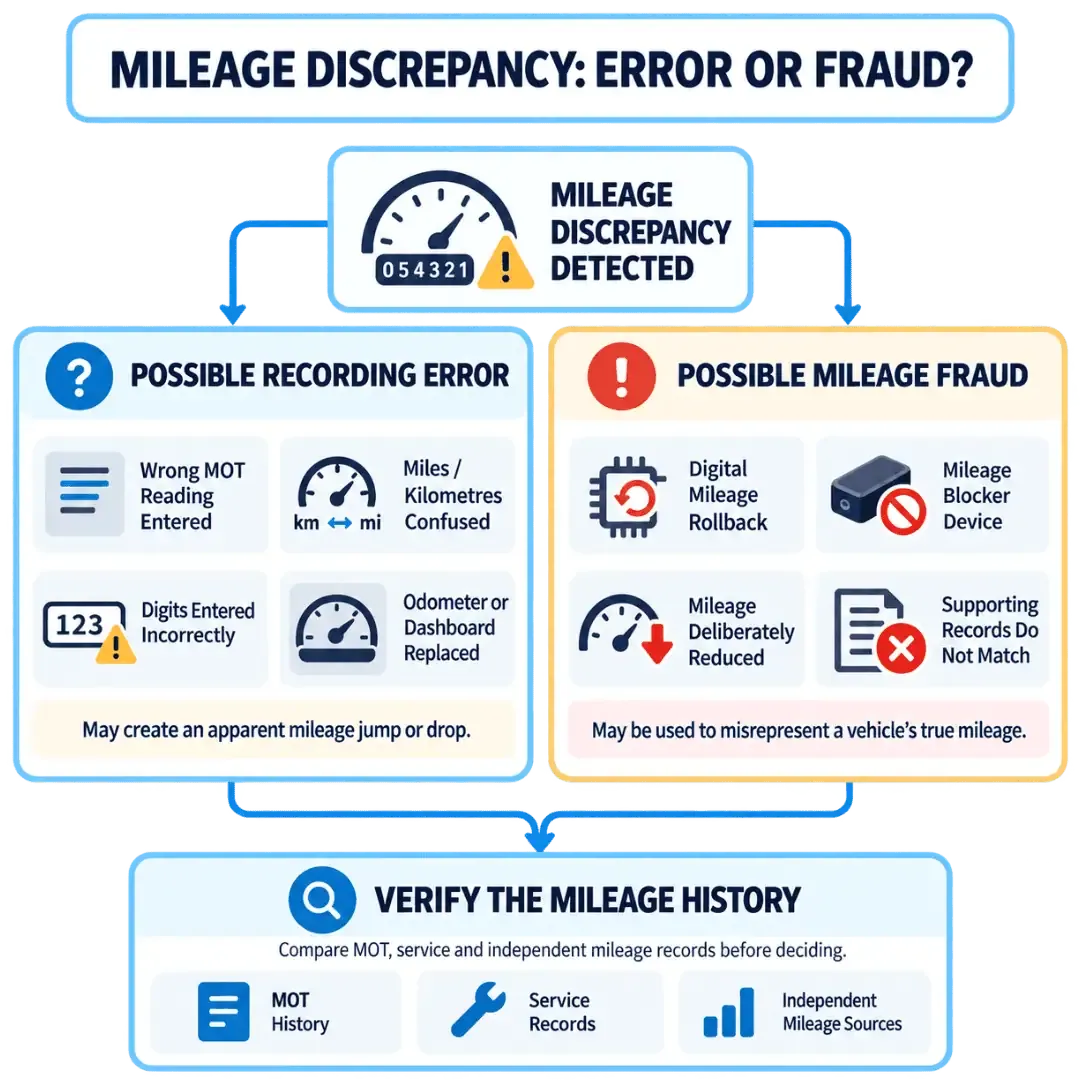
Recording errors happen for ordinary administrative or mechanical reasons, not because anyone intended to deceive a buyer.
An MOT tester can simply enter the wrong figure during testing, creating a one-off discrepancy that doesn't repeat in later records.
Imported vehicles can also have a mismatch, as some countries record distance in kilometres rather than miles.
A missed unit conversion makes the mileage appear to jump or drop sharply between entries.
A typographical mistake, such as transposing 2 digits, can create a mileage gap that looks serious but is really just a data entry slip.
A replaced odometer or swapped dashboard cluster alters displayed mileage without intent to deceive, but criminals exploit this same method as a deliberate fraud to mask a vehicle's true mileage.
Fraud, by contrast, involves a deliberate act to lower the displayed mileage and increase the car's resale value.
Criminals do this through digital mileage rollback using diagnostic tools, or by fitting a mileage blocker device that stops the odometer recording while the car is driven.
Fraud is harder to dismiss as a simple mistake when it appears alongside other red flags, such as a reluctance to provide service records or an unusually low asking price.
Spotting a mileage anomaly early protects the buyer financially, since a discrepancy left unchecked becomes harder and more expensive to challenge once the purchase is complete.
A pre-purchase mileage check, such as an MOT history cross-check, or a comparison against RMI and BVRLA records, catches most discrepancies before any money changes hands.
So, buyers who ask "can mileage be altered?" should know the answer is yes.
That is why running a check car miles search across multiple independent sources also helps confirm whether the cause is an honest mistake or deliberate fraud.
What Is the Difference Between Free and Premium Mileage Checks?
The difference between free and premium mileage checks lies in their data sources, MOT record depth, ownership insights, fraud detection capability, and pre-MOT coverage.
These differences help buyers decide which check fits their situation.
A free check provides a quick, no-cost look before viewing a car, flagging any obvious DVLA mileage inconsistency.
A premium check suits a buyer ready to commit to a purchase, since RMI and BVRLA data confirm mileage consistency across multiple sources.
The differences between free and premium mileage checks are covered in the table below.
Feature | Free Mileage Check | Premium Mileage Check |
|---|---|---|
Data sources | DVLA mileage history only | DVLA, RMI mileage, and BVRLA mileage check data |
MOT records | Basic MOT mileage check readings | Full MOT history cross-referenced with RMI and BVRLA |
Ownership insights | Limited to DVLA keeper data | Combined with service and rental history for fuller ownership insights |
Fraud detection | Flags clear inconsistencies only | Detects clocking and rollback patterns across multiple sources |
Pre-MOT coverage | None, relies on MOT data only | Covers mileage before the first MOT using RMI and BVRLA records |
Best for | A quick initial overview | Full verification before completing a purchase |
Is It Safe to Buy a Car With Mileage Problems?
Buying a car with mileage problems is generally unsafe and financially risky, whether the issue involves odometer discrepancies, abnormally high mileage, or suspiciously low mileage.
A clerical slip with no other red flags is generally an acceptable risk, while mileage drops, missing MOT entries, or an evasive seller point toward fraud.
Some discrepancies are genuine data entry errors, such as an MOT tester's typo, rather than fraud, which involves deliberately misrepresenting the total mileage of a car to inflate its resale value.
Selling a vehicle with knowingly false mileage also breaches UK consumer protection law.
A logged mileage error becomes a permanent marker on the car's history, regardless of whether the discrepancy resulted from an honest mistake.
This marker lowers the car's value and makes it harder to sell.
Future buyers cannot confirm how worn key components, such as the timing belt, clutch, or brake pads, really are without a verified mileage history.
Mileage problems aren't limited to high readings, as a low-mileage car can carry its own risks.
Long periods of inactivity degrade rubber seals, fluids, and tyres, even when the tyres still show plenty of tread.
A well-maintained higher-mileage car can therefore be more reliable than a low-mileage car that has sat unused for years.
Buyers considering a flagged car should ask for service records, MOT certificates, and invoices to support the mileage story, and check whether their warranty depends on verified mileage.
An independent mechanic's inspection or an Electronic Control Unit (ECU) scan can confirm whether the car's true condition matches its claimed mileage.
CarVeto’s premium HPI Check adds a final layer of verification by reviewing every entry across DVLA, RMI, and BVRLA data before you commit.
Frequently Asked Questions (FAQ)
To verify a vehicle for mileage issues, you need the documents given below.
- Vehicle registration and V5C: The registration number and V5C logbook are the primary identifiers needed to run an official mileage check against DVLA and other reputable data sources.
- MOT certificates and history: MOT certificates are the clearest way to track mileage progression, since every odometer check at an MOT test records the exact reading at that point in time.
- Service history and invoices: Service history and invoices are physical or digital records from previous services or rentals, giving you another checkpoint to compare against the claimed mileage.
- Physical condition: A vehicle's wear and tear, such as the pedal rubbers, steering wheel, and seats, should match its claimed mileage, since heavier wear can signal an inaccurate reading.
No mileage data is available because the vehicle is too new for its first MOT, has a non-UK registration, underwent recent administrative changes, or faces Northern Ireland testing limitations.
Other causes include an imported vehicle whose records never transferred to UK databases, plate changes, an incomplete V5C update, or odometer failure and tampering.
Missing RMI or BVRLA records from private servicing is another common cause for no mileage data.
A missing record does not necessarily mean the vehicle has a problem, but it does mean a buyer cannot rely on database checks alone.
CarVeto’s DVLA Vehicle Enquiry confirms the vehicle's basic registration details as a starting point.
Service invoices, MOT certificates, or repair receipts from the seller help fill the gap that official data leaves behind. Missing data on a new vehicle or recent import is a normal, low-risk gap.
The same gap on a used vehicle with years of ownership is a stronger reason to request independent verification.
You can verify car mileage if there is no data by checking physical wear indicators, supporting documentation, and the car's internal computer. The alternative verification methods are listed below.
- Compare the car's age against its mileage, since unusually low or high mileage for that age often signals that a mileage rollback check is needed.
- Request supporting documentation from owners, since mechanics log the exact mileage on invoices every time a car has an oil change, new tyres, or a routine service.
- Inspect high-contact areas such as the steering wheel, driver's seat, and pedal rubbers, since excessive wear on a car showing low mileage suggests the odometer has been tampered with.
- Connect an OBD2 scanner to read mileage data stored in the engine, transmission, and ABS modules, which is harder to tamper with than the dashboard display.
- Contact the manufacturer or main dealer network if the seller has no service documents, since most digital records let you check car mileage by VIN free.
- Obtain a supplementary premium report to cross-reference DVLA, RMI, and BVRLA data together, which catches discrepancies that physical inspection alone cannot confirm.
- Arrange a professional inspection with an independent mechanic to assess the vehicle's true condition against its claimed mileage.
- Contact the DVLA directly if a serious discrepancy remains unresolved, to flag the issue and request guidance on correcting the vehicle's official record.
You need to contact the MOT test centre directly within 28 days of the error, as the centre can issue a corrected certificate within this window.
Older MOT or DVSA errors require sending proof such as invoices, service job cards, or repair bills to the DVSA at [email protected] to request a correction.
Errors involving BVRLA or RMI records should be reported to CarVeto's support team directly, and we will work with those sources to resolve the issue.
An uncorrected mileage error lowers resale value, raises clocking suspicion on future history checks, and triggers unfair excess mileage charges on leased vehicles.
Yes, a mileage discrepancy can indicate a serious issue, such as odometer tampering, unreported severe damage, or simply a clerical error.
Odometer tampering, known as clocking, is a criminal offence under the UK Fraud Act 2006, since it inflates a car's value while hiding wear on the engine and transmission.
A discrepancy can also signal unreported severe damage, since a car with 150,000 real miles showing 70,000 may be overdue for critical safety work like a timing belt or brakes.
A mileage discrepancy can invalidate insurance and finance terms, as a false mileage figure means the insurer and lender based their original agreement on incorrect data.
A discrepancy alone cannot confirm whether the cause is serious or just clerical.
Buyers should investigate fully using our mileage check report before making any decision, as it cross-references DVLA, RMI, and BVRLA data for the clearest picture.
The legal consequences of selling a clocked vehicle include prosecution under the Fraud Act 2006, Section 2, breach of consumer protection law, and civil compensation claims.
Mileage adjustment is not automatically illegal, since legitimate reasons exist, such as replacing a faulty odometer during a repair.
A seller's failure to disclose a known discrepancy is what triggers illegality, not the adjustment itself.
The Fraud Act 2006 prosecutes undisclosed clocking as fraud by false representation, carrying a maximum penalty of an unlimited fine and 10 years in prison. Most cases receive far lighter sentences than this maximum.
The Consumer Protection from Unfair Trading Regulations 2008, Regulation 6 also prohibits this practice, and Trading Standards can prosecute both dealers and private sellers under it.
The Consumer Rights Act 2015, Section 22 lets a buyer reject a clocked vehicle bought from a motor trader and demand a full refund, since it was not as described.
A buyer can also sue privately to recover the gap between what they paid and the car's true value, plus related repair costs.
Yes, you can check the mileage history of imported vehicles, EVs, and commercial vehicles using data sources such as MOT records, import markers, and ECU data.
A diagnostic scanner reads this directly from the engine or transmission module, which is how to check ECU mileage.
An imported vehicle builds UK MOT records once registered, while an import check reveals time spent abroad before that.
Japanese imports carry extra risk, since their odometers are often originally recorded in kilometres rather than miles.
Electric and hybrid vehicles let you check MOT and mileage the same way as any petrol or diesel car once they reach 3 years old.
Pairing this mileage check with a battery health check gives a fuller picture of an EV's true condition, since mileage alone does not reveal battery wear. Commercial vehicles also have a checkable mileage history.
Vans pass their first annual MOT at 3 years old like a standard car, while Heavy Goods Vehicles (HGVs) require an annual test from first registration, creating earlier mileage records.
Keeping mileage records creates a verified timeline of a vehicle's wear and tear against its manufacturer-recommended service intervals, such as oil changes, tyre rotations, and fluid flushes.
This timeline prevents premature breakdowns, preserves warranty coverage, and supports accurate budgeting for upcoming major repairs.
They also support warranty protection, fleet monitoring, cost control, route optimisation, and vehicle replacement planning.
Tracking mileage records improves vehicle maintenance in the ways given below.
- Tracking your odometer reading lets you match it against manufacturer service intervals, such as the standard 30,000, 60,000, and 90,000-mile services, preventing costly damage.
- A logged mileage history helps you anticipate when high-wear components, such as brake pads, tyres, and suspension parts, will need replacing, so you can budget for repairs in advance.
- An accurate mileage log keeps your warranty valid, since many warranties depend on servicing the car at the manufacturer's specified mileage milestones.
- Recorded mileage data reveals an unexpected MPG change, an early warning sign for mechanical issues, confirmed by learning how to check engine mileage through onboard diagnostics.
- Tracked mileage data supports fleet monitoring for businesses running multiple vehicles, controlling servicing costs and planning vehicle replacement.
- A well-documented mileage history supports a strong service record, which helps secure the best market value at resale.
You can check the odometer reading of your car by following the steps given below.
- Turn the ignition to the "on" position without starting the engine, then look beneath the speedometer or cycle through dashboard settings labelled TRIP, ODO, or DISP.
- Run a check for MOT History of a Car to view a UK vehicle's previous test records and confirm the mileage has progressed consistently year over year.
- Connect an On-Board Diagnostics (OBD2) scanner to the vehicle's dashboard port to retrieve mileage readings stored across multiple modules, including the engine, ABS, and gearbox control units.
- Check past service invoices and repair receipts, since mechanics log the exact mileage at every visit, giving you another checkpoint to compare against the dashboard reading.
Mileage decreases between MOTs for the following reasons.
- A keying error produces a lower recorded mileage when a tester accidentally types the wrong number into the MOT Testing Service, such as hitting the wrong digit on the keypad.
- A unit confusion error results in a recorded drop when an imported speedometer, or a kilometre-switched dashboard from driving in Europe, leads a tester to misread miles.
- A trip meter error creates an apparent decrease when a tester accidentally reads the resettable trip meter instead of the vehicle's total lifetime mileage on the dashboard.
- Deliberate odometer tampering triggers a genuine mileage decrease when a seller illegally winds back the reading to increase the car's resale value, though this is rarer than a clerical mistake.
Car clocking is common in the UK, with 1 in 16 used cars having a mileage discrepancy, according to RAC reports.
Odometer fraud is partly possible because cheap equipment, costing as little as £150, can now manipulate digital odometers.
Clocking allows sellers to inflate a car's resale value while hiding significant mechanical wear, which can cost a buyer thousands of pounds in lost value or unexpected repairs.
CarVeto helps buyers avoid becoming part of these statistics by cross-referencing a vehicle's mileage against DVLA, RMI, and BVRLA data before purchase, catching a rollback or inconsistency that a glance at the dashboard would never reveal.
Any mileage over 10,000 miles per year or above 100,000 miles total on an older car is considered high mileage in the UK. The national average sits around 7,100 miles annually.
Dividing the odometer reading by the car's age gives a quick way to judge whether a car is high mileage.
Passing 100,000 miles is a major resale threshold, but a well-maintained car can still be a sound purchase beyond this point.
Motorway mileage causes far less mechanical strain than the same mileage built up through stop-start town driving, since constant braking wears components faster.
This means 2 cars with identical odometer readings can have very different mechanical conditions, depending on how those miles were driven.
A car's service history reveals more about its true condition than the mileage figure alone.
Running a check with an OBD2 scanner confirms whether the recorded mileage matches the wear visible in the vehicle.