

Why motorists trust CarVeto
Free CAZ Check by Registration
Check your vehicle's Clean Air Zone assessment in CarVeto's free report using a UK registration number.
Licensed DVLA Vehicle Data
CarVeto uses licensed DVLA records to identify vehicles and provide emissions information that supports CAZ assessments.
Over 6.4 Million UK Vehicle Checks
More than 6.4 million vehicle lookups have been completed through CarVeto's checking services.
Google Customer Rating 4.8/5
Motorists have rated CarVeto 4.8 out of 5 on Google for its vehicle-checking services.
What Is a Clean Air Zone Check?
A Clean Air Zone (CAZ) check uses a vehicle's UK registration number to assess whether it could be charged for driving in an English Clean Air Zone.
The result depends on the zone's rules, vehicle category, fuel type, Euro emissions standard and any applicable exemptions.
A vehicle may be chargeable in one zone but not another.
How Does CarVeto's Free Clean Air Zone Checker Work?
CarVeto's free Clean Air Zone checker uses your UK registration number to identify your vehicle and provide CAZ information in your free vehicle report.
Follow these three steps to check your car:
- Enter Your Registration Number
Type your UK registration number into CarVeto's vehicle checker. - Confirm Your Vehicle Details
Check that the returned make and model match your vehicle before reviewing the report. - Review Your Free CAZ Check
View your vehicle's CAZ assessment and supporting emissions information in the free report.
What Information Does Our Free Clean Air Zone Check Show?
CarVeto's free vehicle report shows your Clean Air Zone (CAZ) assessment alongside emissions information, verified vehicle details and other useful records.
The report also provides separate compliance assessments for London's ULEZ and Scotland's LEZs.
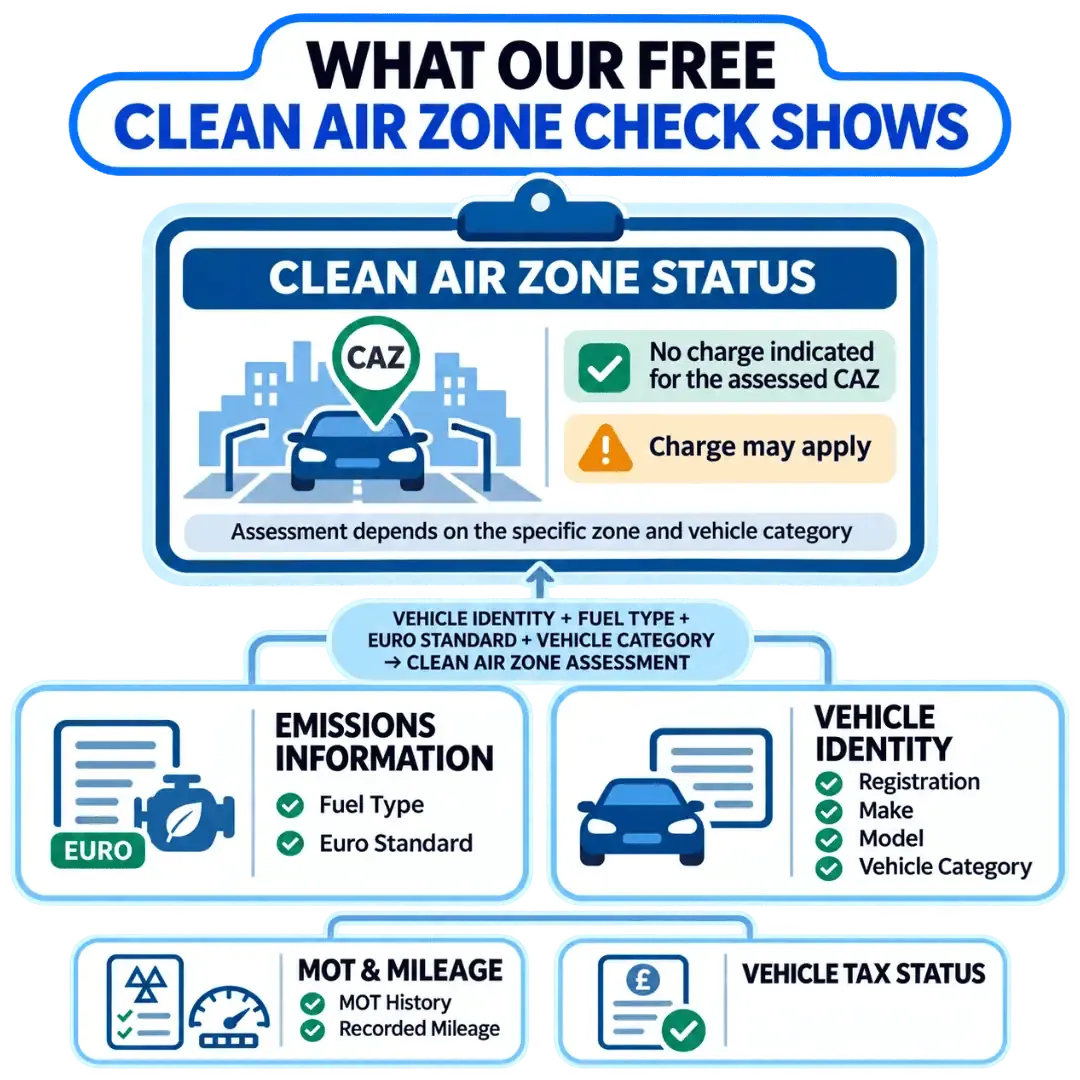
The free report contains five categories of vehicle, emissions and compliance information, explain below.
- Clean Air Zone Status: View your vehicle's CAZ assessment based on its emissions information. Whether a charge applies in a particular city depends on that zone's rules, vehicle category and any exemptions.
- Emissions Information: View your vehicle's fuel type and Euro emissions standard to help understand its CAZ assessment.
- ULEZ and Scottish LEZ Results: View separate compliance results for London's Ultra Low Emission Zone (ULEZ) and Scotland's Low Emission Zones (LEZs), which operate under different rules from England's CAZs.
- Verified Vehicle Identity: Confirm your vehicle's registration details, manufacturer and model against DVLA records.
- MOT, Mileage and Tax Information: Review available MOT history, recorded mileage and current road tax status.
Which Cities in England Have Clean Air Zones?
England has seven charging Clean Air Zone (CAZ) areas: Bath, Birmingham, Bradford, Bristol, Portsmouth, Sheffield and Tyneside (Newcastle and Gateshead).
Each zone has a classification that determines which vehicle categories may be charged.
The table shows whether ordinary private cars are included in those categories.
Clean Air Zone | CAZ Class | Are Ordinary Passenger Cars Covered? |
|---|---|---|
Bath | Class C | No |
Birmingham | Class D | Yes |
Bradford | Class C | No |
Bristol | Class D | Yes |
Portsmouth | Class B | No |
Sheffield | Class C | No |
Tyneside (Newcastle and Gateshead) | Class C | No |
Birmingham and Bristol are the only listed Class D zones where ordinary private cars may be charged.
Whether a particular car must pay depends on its emissions and any applicable exemptions.
You can check whether your vehicle needs to pay a Clean Air Zone charge using the official GOV.UK service.
What Do Clean Air Zone Classes A, B, C and D Mean?
Clean Air Zone classes A, B, C and D determine which vehicle categories are subject to charging rules.
Each successive class covers additional vehicle types.
CAZ Class | Vehicle categories covered |
Class A | Buses, coaches, taxis and private hire vehicles |
Class B | Class A vehicles, plus heavy goods vehicles |
Class C | Class B vehicles, plus vans and minibuses |
Class D | Class C vehicles, plus cars |
Local authorities can also include motorcycles in Class D zones.
For further details, see the official Clean Air Zone classification framework.
Which Vehicle Emissions Standards Apply to Clean Air Zones?
Petrol cars, vans and minibuses generally need to meet Euro 4 emissions standards, while diesel equivalents need Euro 6.
Buses, coaches and heavy goods vehicles must meet Euro VI.
The table below explains how the minimum standards apply only when the vehicle category is covered by the relevant Clean Air Zone (CAZ).
Vehicle category | Minimum emissions standard |
Petrol cars, vans and minibuses | Euro 4 |
Diesel cars, vans and minibuses | Euro 6 |
Buses, coaches and heavy goods vehicles | Euro VI |
Motorcycles, where included | Euro 3 |
Taxis and private hire vehicles generally follow the applicable petrol or diesel standards, although local authorities may set different requirements.
Euro 6 applies to light vehicles, while Euro VI applies to heavy vehicles.
These standards concern exhaust pollutants, not a vehicle's CO₂ emissions figure.
Are Electric and Hybrid Cars Subject to CAZ Charges?
Fully electric cars are not charged for driving in England's Clean Air Zones because they produce no tailpipe emissions.
Hybrid cars are not automatically charge-free.
Their eligibility depends on the vehicle's fuel type, Euro emissions classification and the rules of the relevant zone.
When Does a Clean Air Zone Charge Apply?
A Clean Air Zone (CAZ) charge applies when a vehicle is driven within a zone that covers its vehicle category, fails the required emissions standard and has no applicable exemption.
Any available discount may reduce the amount payable.
Private cars may be charged in Class D zones, such as Birmingham and Bristol, but are not normally charged in Class C zones.
You can check whether your vehicle needs to pay a Clean Air Zone charge using the official GOV.UK service.
Do All Diesel Cars Have to Pay a Clean Air Zone Charge?
No. Diesel cars are not automatically charged in every Clean Air Zone.
For example, a Euro 5 diesel private car may incur a charge in Birmingham or Bristol because it does not meet the Euro 6 requirement.
The same car would not normally be charged in a Class C zone, where ordinary private cars are excluded from charging.
Which Vehicles Are Exempt from Clean Air Zone Charges?
Certain vehicles are automatically exempt from Clean Air Zone (CAZ) charges under national rules.
Local authorities may also offer additional exemptions or discounts.
National CAZ exemptions apply to vehicles in the following qualifying categories.
- Disabled tax class vehicles: Vehicles registered in the disabled or disabled passenger tax classes.
- Historic and military vehicles: Vehicles qualifying for historic status and military vehicles.
- Ultra-low-emission vehicles: Vehicles that meet the requirements for the national ultra-low-emission exemption.
- Retrofitted and agricultural vehicles: Vehicles retrofitted with technology accredited by the Clean Vehicle Retrofit Accreditation Scheme (CVRAS), plus certain agricultural vehicles.
Meeting a zone's emissions standard or being outside its chargeable vehicle categories is not the same as qualifying for an exemption.
Local exemptions depend on the authority and may require approval.
Check the official GOV.UK Clean Air Zone guidance and the relevant council's rules before relying on one.
How Much Are Clean Air Zone Charges and When Must You Pay?
Clean Air Zone (CAZ) charges vary by city and vehicle category.
Non-compliant private cars pay £8 per day in Birmingham and £9 in Bristol.
Charges can be paid up to six days before travel, on the day of travel, or by 11:59 pm on the sixth day after driving in the zone.
The table compares daily charges across England's seven Clean Air Zones.
Clean Air Zone | Non-compliant private cars | Examples of other daily charges |
Bath | Not charged | Taxis, vans and minibuses £9; HGVs, buses and coaches £100 |
Birmingham | £8 | Taxis and vans £8; HGVs and coaches £50 |
Bradford | Not charged | Taxis and private hire £7; vans and minibuses £9; HGVs, buses and coaches £50 |
Bristol | £9 | Taxis and vans £9; HGVs, buses and coaches £100 |
Portsmouth | Not charged | Taxis and private hire £10; HGVs, buses and coaches £50 |
Sheffield | Not charged | Taxis and vans £10; HGVs, buses and coaches £50 |
Tyneside (Newcastle and Gateshead) | Not charged | Taxis and vans £12.50; HGVs, buses and coaches £50 |
Charges apply to relevant non-compliant vehicles, subject to exemptions and discounts.
Vehicle classification can affect the amount payable.
Clean Air Zones operate 24 hours a day, every day of the year.
Each charging day runs from midnight to midnight, and driving across midnight may incur charges for two days.
Missing the deadline may result in a Penalty Charge Notice (PCN).
Use the official GOV.UK service to check and pay a Clean Air Zone charge.
Why Check Clean Air Zone Status Before Buying a Used Car?
Checking a used car's Clean Air Zone (CAZ) status before purchase helps you assess its suitability for regular journeys, potential driving costs and claims made by the seller.
Four purchase considerations connect a used car's CAZ status with its identity, potential driving costs, journey suitability and seller claims.
- Verify the Advertised Vehicle: Compare the registration, make, model and fuel type with the seller's description.
- Assess Driving Costs: Account for potential daily CAZ charges when estimating ownership costs, particularly if you regularly drive in chargeable zones.
- Check Suitability for Regular Journeys: Check whether the vehicle could be charged in the cities you frequently visit, as CAZ rules vary by location and vehicle category.
- Compare the Result with Seller Claims: Check statements about CAZ compliance against the vehicle's recorded information and confirm any claimed exemptions with the relevant authority.
For a broader assessment, use CarVeto's Vehicle Reg Check to review available registration and vehicle records before buying.
How Are Clean Air Zones Different from ULEZ and Scottish LEZs?
English Clean Air Zones (CAZs) and London's Ultra Low Emission Zone (ULEZ) charge applicable non-compliant vehicles, while Scottish Low Emission Zones (LEZs) enforce vehicle restrictions through penalties rather than daily access charges.
The three schemes differ in their locations, vehicle requirements and consequences for non-compliance.
Scheme | Where it operates | Consequence for non-compliant vehicles |
Clean Air Zones (CAZs) | Designated charging areas in England | A daily charge applies to vehicles covered by the zone's rules, unless exempt. |
London ULEZ | Across London's boroughs and the City of London | A daily charge applies to vehicles that do not meet ULEZ requirements, unless exempt or discounted. |
Scottish LEZs | Aberdeen, Dundee, Edinburgh and Glasgow | Entering a zone in a non-compliant vehicle results in a penalty, subject to exemptions and enforcement rules. |
London also has a separate Low Emission Zone (LEZ), primarily covering heavier vehicles. It is distinct from Scotland's LEZs.
Check London's requirements using CarVeto's ULEZ Checker, or check Scottish vehicle eligibility using the official Scottish LEZ vehicle checker.
Frequently Asked Questions (FAQ)
No. A Clean Air Zone check assesses a vehicle's charging status; it does not record previous journeys or provide access to Automatic Number Plate Recognition (ANPR) enforcement records.
No. A vehicle parked within a Clean Air Zone for an entire day without being driven does not incur a charge.
If a chargeable vehicle is driven in the zone that day, parking it afterwards does not remove the daily charge.
No. CarVeto's CAZ checker accepts UK registration numbers only.
The government checker also cannot assess foreign registrations, but CAZ charges may still apply.
Consult the official GOV.UK Clean Air Zone guidance or contact Clean Air Zone support.
Compare your vehicle details and charging status with the official GOV.UK Clean Air Zone checker.
If the official result also appears incorrect, contact Clean Air Zone support or DVLA, as appropriate, to investigate the underlying records.
CarVeto cannot amend government vehicle records.