

What Is an Electric Vehicle Check?
An electric vehicle check is a UK registration-based lookup that identifies electric and hybrid vehicles and retrieves their available technical specifications and history records.
Buyers and owners use an EV check to verify vehicle details, review recorded history and examine original battery, range and charging specifications.
CarVeto's free check provides available MOT history, recorded mileage, road tax status and registration details.
Gold, Platinum and Complete reports provide additional EV specifications and vehicle history information, with available data varying by vehicle and report type.
An online EV check does not measure a battery's current State of Health (SoH) or replace a physical vehicle inspection.
CarVeto provides EV-specific data for supported battery-electric vehicles (BEVs) and plug-in hybrids (PHEVs).
Conventional hybrids (HEVs) and mild hybrids (MHEVs) are separate powertrain categories and may not be included in this EV-specific data coverage.
Which Types of Electric and Hybrid Cars Can You Check?
CarVeto provides EV-specific data for supported battery electric vehicles (BEVs) and plug-in hybrid electric vehicles (PHEVs) through its enhanced reports.
Hybrid electric vehicles (HEVs) and mild hybrids (MHEVs) can also be checked for available registration and vehicle history information.
The four electric and hybrid powertrain types differ in how they use battery power, whether they support external charging and which specifications apply.
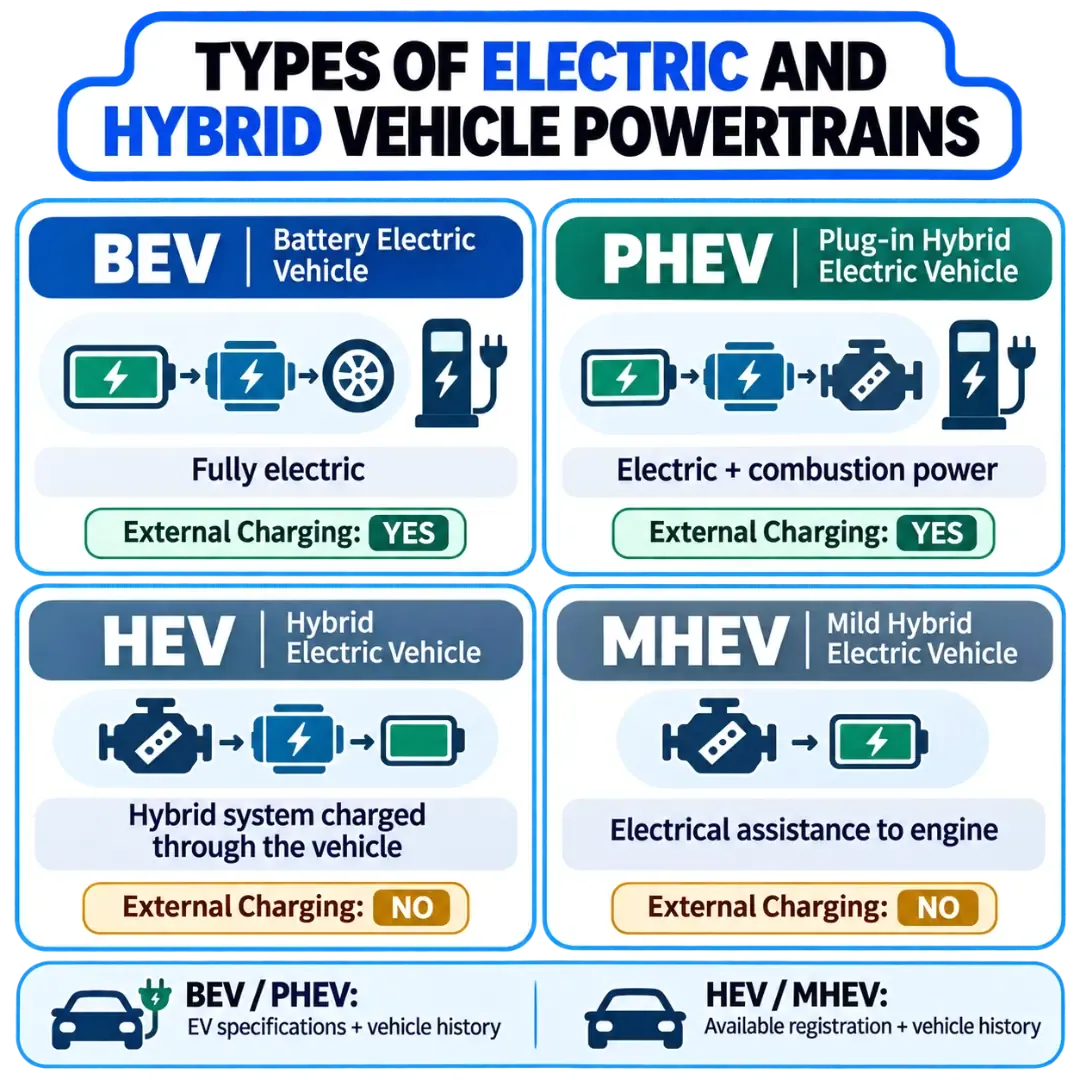
The four types of EV powertrain are given below.
Vehicle Type | Definition | External Charging | CarVeto Check Data |
|---|---|---|---|
Battery Electric (BEV) | Fully electric vehicle powered by a rechargeable battery and electric motor, without a combustion engine. | Yes | Available battery capacity (kWh), manufacturer-rated range, charging information, available manufacturer battery warranty terms and vehicle history. |
Plug-in Hybrid (PHEV) | Combines a rechargeable battery and electric motor with a petrol or diesel engine. | Yes | Available battery capacity, electric-only range, charging information, available manufacturer battery warranty terms and vehicle check history. |
Hybrid Electric (HEV) | Combines a combustion engine with an electric motor and a battery charged through the vehicle's own systems. | No | Available registration details, MOT history, mileage and tax status. |
Mild Hybrid (MHEV) | Uses an electrical system to assist a combustion engine without providing conventional electric-only driving. | No | Available registration details, MOT history, mileage and tax status. |
EV specification availability depends on the vehicle's make, model, registration year and derivative.
Battery capacity, driving range and charging capabilities can differ between variants of the same model.
The identified powertrain and available vehicle records determine which specifications and history information CarVeto can show.
What Information Does Our Electric Vehicle Check Show?
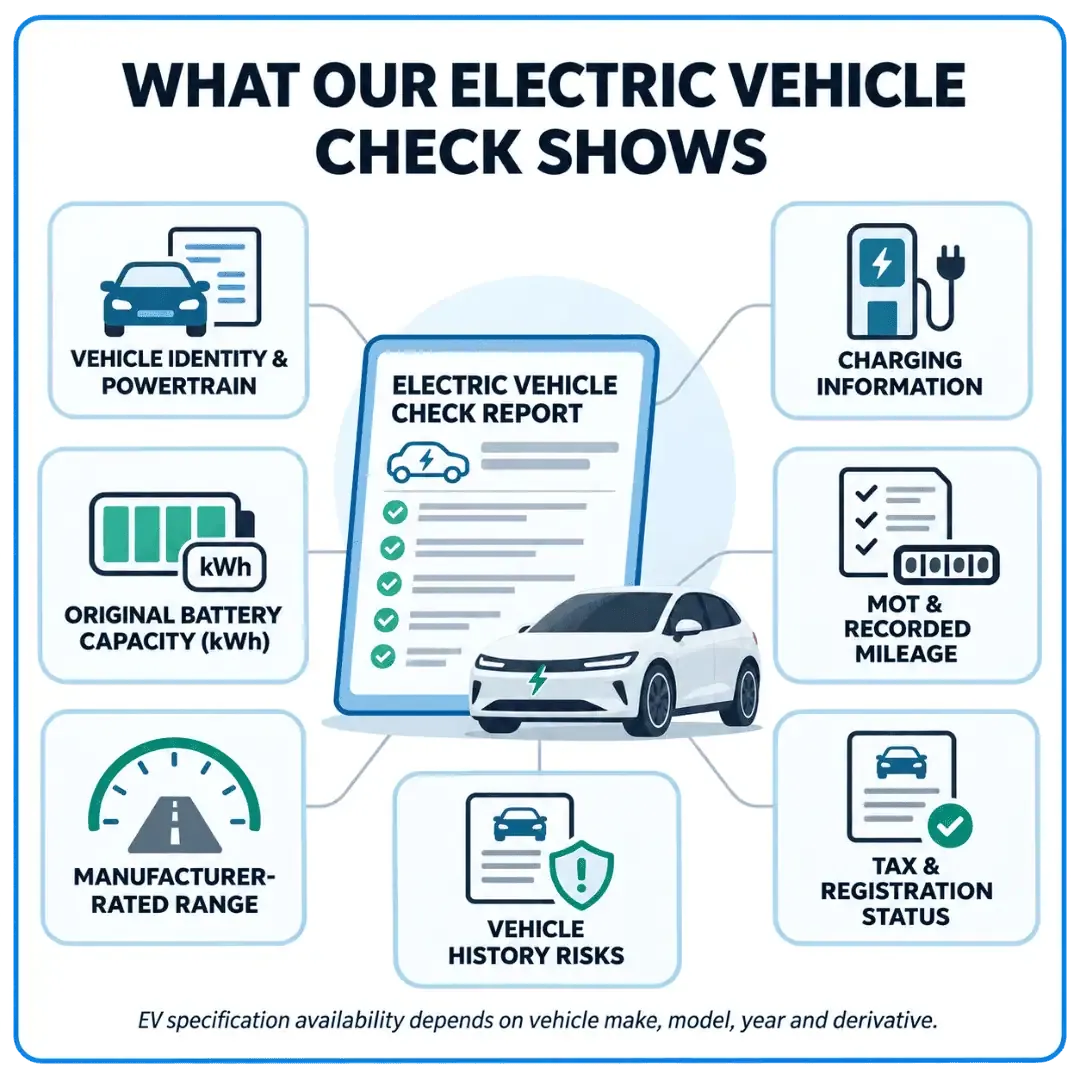
CarVeto's electric vehicle check covers six categories of information: vehicle identity and powertrain, original battery capacity, electric range and charging specifications, MOT and recorded mileage, vehicle tax and registration status, and recorded vehicle history risks.
Gold, Platinum and Complete reports provide additional EV-specific information depending on the vehicle and report type.
Vehicle Identity and Electric Powertrain
An electric vehicle identity check retrieves the car's recorded make, model, registration year and available powertrain details using its UK registration number.
Vehicle identification distinguishes battery electric vehicles (BEVs) from plug-in hybrids (PHEVs).
The exact model and derivative determine which battery, range and charging specifications apply, as these can differ between versions of the same electric car.
Original Battery Capacity in kWh
Electric vehicle battery capacity indicates the amount of electrical energy a battery is designed to store, measured in kilowatt-hours (kWh).
Reports provide available original battery specifications for supported BEVs and PHEVs, including:
- Gross battery capacity: The battery's total rated energy capacity in kWh.
- Usable battery capacity: The portion of rated battery energy available for driving, where recorded.
Original battery capacity describes the vehicle's published specification, not its current battery condition or State of Health (SoH).
Battery capacity establishes the vehicle's original energy-storage specification, while manufacturer-rated range describes its expected driving distance under standardised test conditions.
Manufacturer-Rated Electric Range
Electric vehicle battery capacity indicates the amount of electrical energy a battery is designed to store, measured in kilowatt-hours (kWh).
Reports provide available original battery specifications for supported BEVs and PHEVs, including:
- Gross battery capacity: The battery's total rated energy capacity in kWh.
- Usable battery capacity: The portion of rated battery energy available for driving, where recorded.
Original battery capacity describes the Vehicle's Published Specification, not its current battery condition or State of Health (SoH).
Battery capacity establishes the vehicle's original energy-storage specification, while manufacturer-rated range describes its expected driving distance under standardised test conditions.
Manufacturer-Rated Electric Range
Manufacturer-rated electric range is the distance an EV is rated to travel on battery power under standardised test conditions, measured in miles.
The rating may follow the WLTP test cycle or the older NEDC standard.
CarVeto reports provide available published range specifications for supported BEVs and PHEVs.
- BEV driving range: The published distance a battery electric vehicle can travel on a full charge under the specified test cycle.
- PHEV electric-only range: The published distance a plug-in hybrid can travel using electric power under the specified test cycle.
Real-world range estimates indicate how far an EV may travel under typical driving conditions, rather than standardised laboratory tests.
Seasonal estimates for winter, mild and warm conditions account for differences in temperature and energy consumption.
These estimates are distinct from manufacturer-rated WLTP figures.
Actual driving range also depends on driving speed, terrain, vehicle load and battery condition.
Available EV charging specifications include AC charging connector types, maximum AC charging power (kW), DC rapid-charging connectors and maximum DC charging power (kW), where recorded.
Actual charging times depend on charger output, battery charge level and charging conditions.
MOT Status and Recorded Mileage
CarVeto's free electric vehicle check retrieves available MOT records and odometer readings associated with the vehicle’s registration and VIN number.
The report includes:
- MOT status: Whether the vehicle has a valid MOT certificate, where applicable.
- MOT expiry: The recorded expiry date of the current MOT certificate.
- MOT history: Previous test dates, results and recorded advisories.
- Recorded mileage: Odometer readings documented during MOT tests.
Comparing historical mileage readings helps identify inconsistencies that may require investigation.
Vehicle Tax and Registration Status
CarVeto's free vehicle check provides available UK registration details and Vehicle Excise Duty (VED) information, including:
- Vehicle tax status: The vehicle's recorded taxation status.
- SORN status: Whether a Statutory Off Road Notification is recorded.
- Registration details: Available information about the vehicle's registration date and identity.
Electric cars are subject to applicable UK Vehicle Excise Duty rules, with tax liabilities depending on registration date and relevant vehicle characteristics.
Recorded Vehicle History and Purchase Risks
CarVeto's paid reports can check the following vehicle history and purchase risks, depending on the report selected.
An outstanding finance check is also available as an optional Gold upgrade:
- Outstanding finance: Records of finance agreements associated with the vehicle.
- Stolen vehicle markers: Records indicating whether a vehicle has been reported stolen.
- Insurance write-off history: Recorded insurance total-loss classifications.
- Salvage history: Available salvage records and associated vehicle information.
- Extended mileage history: Additional odometer records used to identify mileage inconsistencies.
These checks complement electric vehicle specifications by revealing financial and historical risks before purchasing a used EV.
How Does Our Electric Vehicle Check Work?
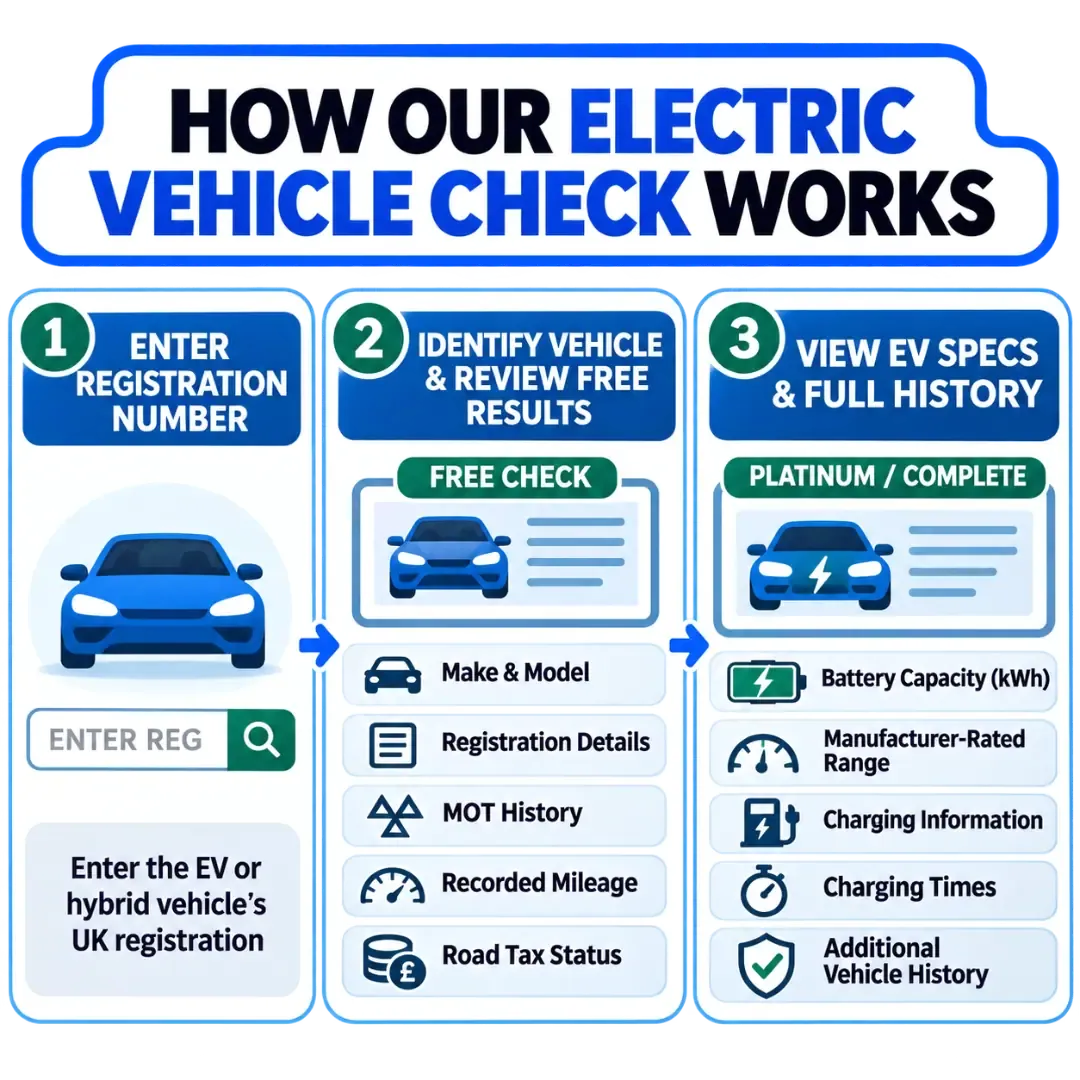
To perform an EV Vehicle Check, follow the steps given below:
- Enter Your Registration Number
Enter the electric or hybrid vehicle's UK registration number into the CarVeto checker. - Identify Your Vehicle and Review Free Results
Confirm the vehicle's make, model and registration details. Review available MOT history, recorded mileage and road tax status. - View EV Specifications and Full Vehicle History
Choose a Gold, Platinum or Complete report to review additional EV specifications and vehicle history information. Available fields depend on the vehicle and report selected.
Why Should You Check an Electric Vehicle Before Buying It?
An electric vehicle check helps buyers verify the car's identity and original specifications, assess recorded mileage and MOT history, and identify potential purchase risks.
The five reasons to check a used electric or hybrid car before buying are listed below:
- Verify the Vehicle Variant
Confirm the make, model and derivative to ensure the vehicle matches the advertised electric or hybrid version. - Compare Battery, Range and Charging Specifications
Review available original battery capacity (kWh), manufacturer-rated driving range and charging information to assess the vehicle's published capabilities. - Check MOT and Mileage History
Review previous MOT results, advisories and recorded odometer readings to identify mileage discrepancies or recurring test issues. - Investigate Vehicle History Risks
Check paid history records for outstanding finance, stolen vehicle markers and insurance write-offs before purchasing. - Compare the Report with Seller Claims
Cross-check the advertised specifications, mileage and vehicle history against the report to identify discrepancies before agreeing to buy.
Customer Testimonials for Our Electric Vehicle Report
CarVeto is rated 4.8 out of 5 on Trustpilot and Google Reviews, with customers praising its fast results, detailed vehicle history reports and helpful customer support.
Motorists say CarVeto's vehicle checks help them verify vehicle information, identify potential purchase risks and make informed decisions before buying a used car.
Thomas Addoah
I had a great experience with CarVeto
⭐⭐⭐⭐⭐
I had a great experience with CarVeto's customer support. I contacted them about a vehicle history report I had purchased nearly two years ago but could no longer access. Michelle was extremely helpful, responsive and professional throughout. She explained the situation clearly and kindly arranged a complimentary new Gold report, which provided the information I needed. It's refreshing to receive such excellent customer service. Many thanks to Michelle and the CarVeto team. Highly recommended!
Kelly
Excellent service, support and advice... thank you!
⭐⭐⭐⭐⭐
I am currently in the process of buying my son his first car. A friend recommended CarVeto and I'm so pleased they did! I purchased their Platinum Certificate and received it straight away. I was unsure about a couple of plate changes so I emailed CarVeto for advice. Michelle was extremely helpful and clear with her explanation.
What Else Should You Check Before Buying a Used Electric Car?
Before buying a used electric car, assess its physical condition alongside its vehicle history.
Check the tyres and brakes for wear, inspect the charging port, look for dashboard warning lights and examine any signs of previous damage or repairs.
CarVeto's Car Inspection service provides a separate route for assessing a used vehicle's physical condition.
Checking the traction battery's current State of Health (SoH) may require specialist EV diagnostics, as original battery specifications and driving-range figures do not measure its present condition.
Frequently Asked Questions (FAQ)
Yes, CarVeto can identify whether a UK-registered car is fully electric or hybrid using available vehicle identification records.
The make, model and derivative help distinguish battery electric vehicles (BEVs), plug-in hybrids (PHEVs) and other hybrid powertrains.
Yes, CarVeto can check a plug-in hybrid electric vehicle (PHEV) by its UK registration number.
Premium reports provide available PHEV battery capacity, electric-only range and charging specifications.
A PHEV's electric-only range measures driving on battery power rather than its total driving range using both electricity and fuel.
Yes, CarVeto provides a free electric vehicle check with available registration details, MOT history, recorded mileage and road tax status.
Gold, Platinum and Complete reports provide additional EV specifications, including original battery capacity, manufacturer-rated range and charging information.
You can find an electric car's original battery capacity in kilowatt-hours (kWh) through CarVeto's paid reports when the vehicle's exact specification is available.
The reported figure describes the battery's original energy-storage capacity, not its remaining capacity after years of use.
No, a registration-based EV check cannot measure the traction battery's current State of Health (SoH).
Battery SoH describes the battery's present condition relative to when it was new, including capacity degradation.
Assessing it requires appropriate EV diagnostic testing rather than a vehicle specifications report.
Yes. CarVeto's Gold reports can show EV charging connector types and maximum AC and DC charging power in kilowatts (kW).
For example, a vehicle may support Type 2 AC charging and CCS rapid charging.
The available specifications depend on the exact vehicle and report data.
CarVeto reports may show the manufacturer's original EV battery warranty terms, including years and mileage limits.
These figures do not confirm the remaining warranty on a used vehicle.
Contact the manufacturer or warranty provider to confirm remaining coverage based on the vehicle's age, mileage and warranty conditions.
Yes, electric cars generally require an MOT under the same rules as petrol and diesel cars.
In England, Scotland and Wales, the first MOT Due Date is three years after first registration, followed by annual testing.
In Northern Ireland, private cars normally require their first MOT after four years.
Yes, electric cars have been subject to Vehicle Excise Duty (VED) since 1 April 2025.
The amount payable depends on the vehicle's registration date and applicable tax rules, including any additional rate for qualifying higher-value vehicles.
EV battery capacity or driving-range data may be missing when the exact vehicle derivative cannot be identified or a verified technical specification is unavailable.
Different battery options, model years and vehicle variants can have different published specifications, so a general model match is not always sufficient.
No. CarVeto's electric vehicle check starts with a UK registration number, which is matched to the vehicle's VIN (Vehicle Identification Number) to support identity verification.
Our VIN Lookup explains how this identifier is used to verify vehicle details.