
Can You Buy a Car with a Credit Card? How It Works and Benefits
Yes, you can buy a car with a credit card in the UK if your credit card has enough available credit, your card provider allows the transaction and the seller accepts credit card payments.
You can purchase the full car price with a credit card or pay only part of the price by card.
You will have to cover the remaining balance with savings, a bank transfer, a personal loan or car finance.
Buying a car with a credit card can provide Section 75 protection, spread repayments and earn rewards or cashback when the card and transaction meet the relevant requirements.
A 0% purchase card can also reduce the cost of borrowing during its promotional period, if you clear the balance before the interest-free period ends.
Many buyers choose to purchase a car with credit card financing when they want added purchase protection and flexible repayment terms.
Credit card car purchases also have risks like interest charges after a promotional period, limited credit limits, restricted dealer acceptance and the need to manage repayments carefully.
You should compare the total cost of credit with other car finance options and check the vehicle’s history before completing the purchase.
Our Free Vehicle History Check provides important vehicle information that you should review before committing to the transaction.
How to Buy a Car with a Credit Card?
To buy a car with a credit card, check your available credit, confirm that the dealer accepts card payments, agree on the purchase terms, and decide how much of the price to charge to the card.
You can pay any remaining balance by another method and complete the transaction once the dealership confirms the payment arrangement.
The steps to use a credit card to buy a car in the UK are explained below.
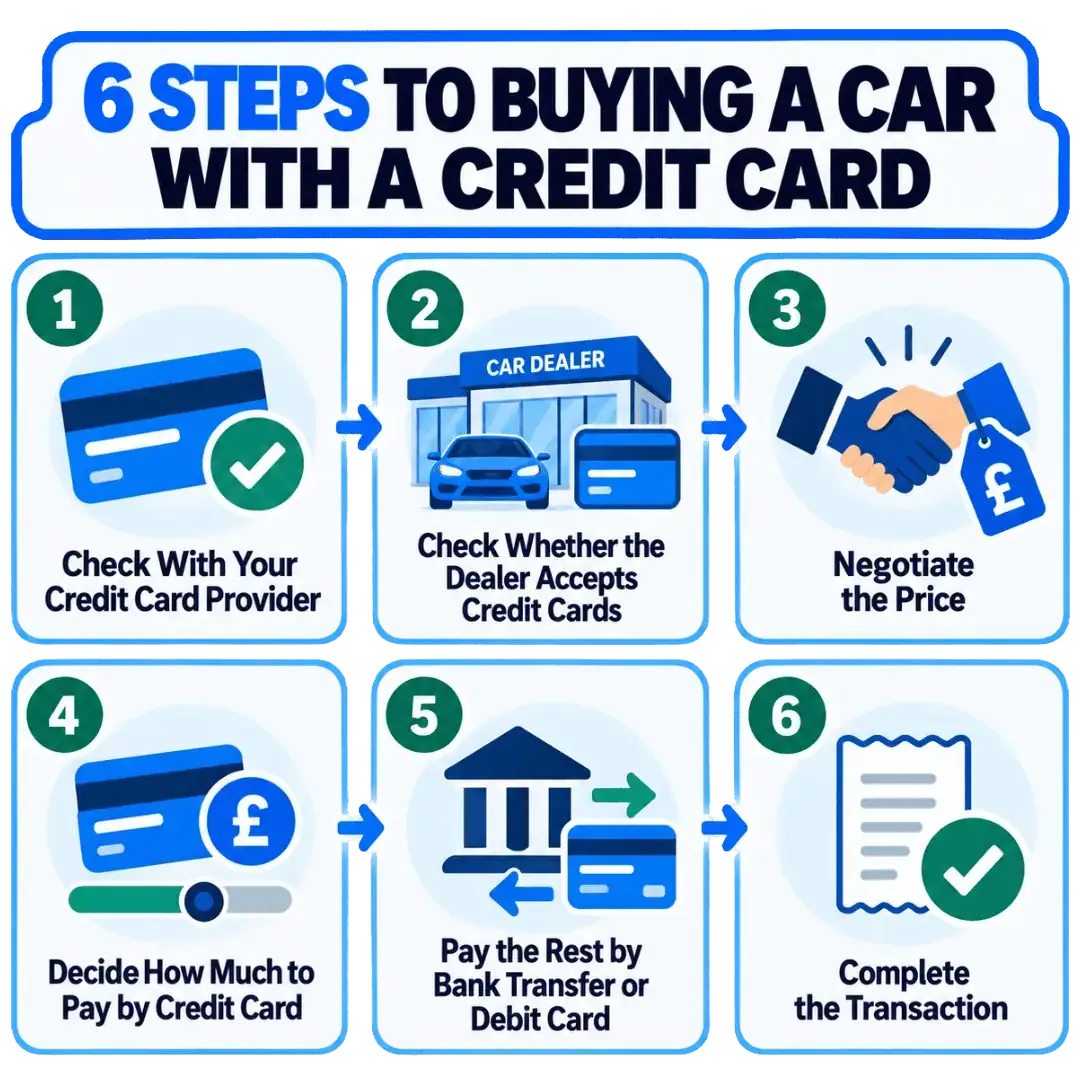
1. Check With Your Credit Card Provider
You need to check with your credit card provider first to confirm your available credit limit and any restrictions that apply to large transactions.
The dealer's payment policy determines if you can buy a car on a credit card in full or in part.
The card’s interest rate and fees also affect the cost of borrowing.
A 0% purchase card can allow the buyer to spread the cost without interest for a fixed period.
Standard credit card borrowing can become expensive if the balance remains unpaid after the promotional period.
The answer to “can I buy a car with a credit card?” depends on your available credit limit and the dealer's acceptance policy.
2. Check Whether the Dealer Accepts Credit Cards
You should check whether the car dealer accepts credit card payments and how much of the purchase price can be paid by card after you have confirmed that your credit card is suitable.
Some dealerships accept the full vehicle price, while others restrict credit card payments to a deposit or a fixed amount.
The dealer may charge a credit card fee to cover part of the card-processing cost.
Some dealers charge around 2% to 3% of the amount paid by credit card, although the actual fee varies between dealerships. However, even a £100 deposit can potentially trigger Consumer Credit Protection.
You should confirm the accepted card types, maximum payment and any additional charges before agreeing to the purchase.
3. Negotiate the Price
Negotiate the car price and payment arrangement with the dealer once you know how much the dealer will accept by credit card.
Credit card acceptance may affect the negotiation because the dealer incurs a cost when processing a card transaction.
You can also use our Car Valuation guide to establish a reasonable price before negotiating.
The agreed vehicle price, credit card amount, and any card payment fee should be clear before the transaction is completed.
4. Decide How Much to Pay by Credit Card
You need to decide how much of the purchase price to pay by credit card after agreeing on the price and payment arrangement.
You can pay the full purchase price, the deposit, or part of the balance by credit card.
The amount should stay within the card’s available credit limit and match the payment arrangement agreed with the dealer.
Paying only part of the price of the car by credit card is appropriate when your available credit limit is lower than the vehicle price.
A partial credit card payment also provides Section 75 consumer protection for qualifying purchases, even when the card does not cover the entire vehicle price.
Section 75 of the UK Consumer Credit Act 1974 makes the credit card provider jointly liable with the supplier for qualifying purchases between £100 and £30,000.
This act allows you to claim a refund from the card provider when the supplier breaches the contract or misrepresents the purchase.
5. Pay the rest by bank transfer or debit card.
Pay the remaining balance by bank transfer or debit card if the credit card does not cover the full purchase price.
The dealer should confirm the accepted payment method and the amount due before the transaction.
A money transfer credit card is a type of credit card that allows you to transfer money directly to a bank account.
This type of credit card provides an alternative to a standard credit card when a dealer does not accept credit cards directly.
This payment method involves different fees and does not provide the same Section 75 protection as a direct credit card purchase.
6. Complete the Transaction
Complete the transaction by making the agreed payments to the dealer once all payment amounts and methods have been confirmed.
You should retain the payment confirmation, invoice and other purchase documents as evidence of the transaction.
You can complete the purchase after the dealer confirms receipt of the required payment.
The final paperwork should show the agreed vehicle price and any separate amounts charged for credit card payments or other transaction costs.
Can You Buy a Car from a Private Seller with a Credit Card?
No, you cannot buy a car on a credit card in the UK from a private seller, since they generally do not have a card-processing facility.
A private seller would need a suitable payment terminal or online payment service to accept a card transaction.
Credit card payments also create additional costs and fraud concerns for private sellers.
Card-processing fees reduce the amount the seller receives, while chargebacks and disputed transactions can create additional payment risks.
Buyers should know that private car sales typically use bank transfers or other direct payment methods, not credit cards.
A money transfer credit card provides an alternative car payment method by transferring funds from the credit card to the buyer’s bank account.
You can use the money transfer credit card to pay the private seller.
Money transfers typically charge a fee, with some providers charging around 3% to 4% of the price paid.
A money transfer credit card does not provide the Section 75 protection available when you pay the seller directly by credit card.
You should consider the additional cost and reduced protection before using this payment method.
What Are the Benefits of Buying a Car with a Credit Card?
The benefits of buying a car with a credit card include Section 75 protection, repayment flexibility, rewards or cashback, and 0% interest periods.
These benefits depend on the card terms, the amount charged and the buyer’s ability to meet the repayment conditions.
The main benefits of buying a car on credit card are the following.
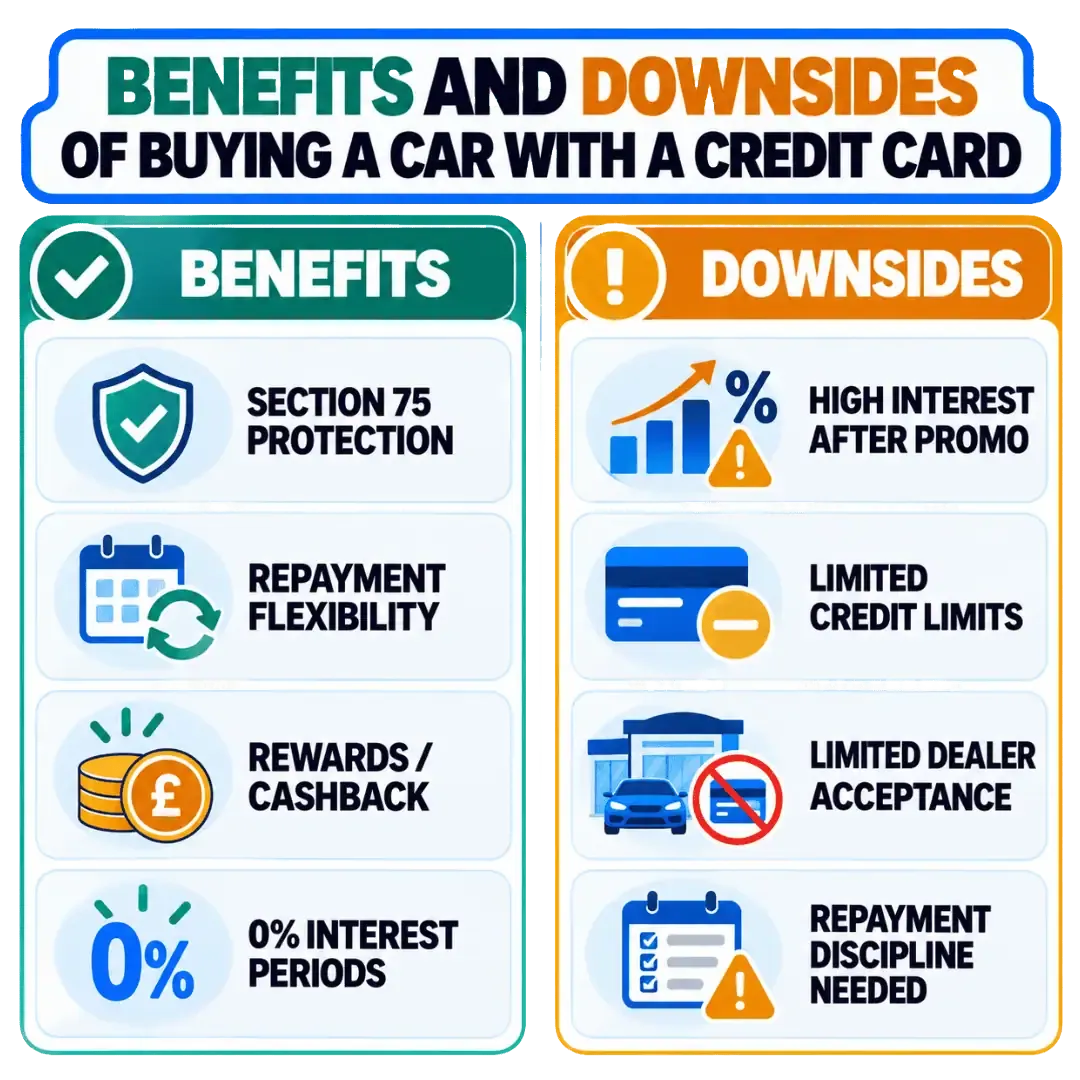
- Get Section 75 Protection: Section 75 of the Consumer Credit Act makes the credit card provider jointly liable with the dealer for qualifying purchases between £100 and £30,000. The protection applies even when the buyer pays only part of the purchase price by credit card.
- Spread Your Repayments: A credit card allows the buyer to spread the cost of the car through monthly repayments rather than paying the full amount immediately. The repayment period and total cost depend on the card’s interest rate and terms.
- Earn Rewards and Cashback: A rewards or cashback credit card may give the buyer points, miles or cashback on eligible spending. The value of the rewards depends on the card’s terms and the amount charged to the card.
- Use 0% Interest Periods: A 0% purchase credit card allows the buyer to borrow without paying interest for a fixed promotional period. The buyer must repay the balance before the 0% period ends to avoid the card’s standard interest rate on the remaining balance.
What Should You Remember When Buying a Car with a Credit Card?
You should remember to check your credit limit, plan your repayments, clear the balance before interest starts and consider a balance transfer when you are buying a car with a credit card.
These steps help you control the cost of borrowing, avoid paying interest, or prevent it from becoming an expensive long-term credit.
The main points to remember when buying a car with a credit card are given below.
- Check Your Credit Card Limit: You must make sure that the available credit card limit covers the amount you plan to charge to the card. Buyers should also leave enough available credit for other essential spending rather than using the entire limit for the car.
- Plan to Repay the Borrowed Amount: The plan to repay your borrowed amount should cover the full balance within the agreed interest-free period. The monthly amount depends on the balance and the number of months available to repay it.
- Clear the Balance Before Interest Starts: You must clear the full balance on your credit card before the promotional period ends. This helps you avoid the card's standard interest rate being applied to the remaining debt. A 0% credit card only remains interest-free during the promotional period.
- Consider a Balance Transfer: You can use a balance transfer to move existing credit card debt to another card with a new promotional interest rate. You must remember to check the transfer fee and promotional period before using this option.
The vehicle itself also requires separate checks before the purchase is completed.
Buyers should verify the car’s identity, history and documentation rather than relying on the payment method alone.
You can also read our guide to Buying Car Without V5C to learn about the checks you must remember when a seller does not have the vehicle’s logbook.
When Do I Buy a Car with a Credit Card?
You should buy a car with a credit card when it offers a competitive interest rate, the amount borrowed is manageable, and the balance can be repaid within the agreed period.
Your choice depends on how much you need to borrow, why you need the credit and the total cost of borrowing compared with other forms of car finance.
A personal loan may be a better alternative when you need predictable monthly payments and a fixed repayment period.
The total cost of borrowing is easier to estimate because the interest rate and repayment term are set in advance.
A credit card may cost less when it offers a 0% promotional period or a competitive interest rate, and you can repay the balance within the applicable timeframe.
The amount you need to borrow also affects whether a credit card is suitable.
A credit card with a sufficient limit is practical for a lower-cost vehicle or for covering part of the purchase price.
A personal loan is more suitable for a higher borrowing amount because it provides structured repayments over a fixed term.
When Is a Loan Better Than a Credit Card for Buying a Car?
A loan is better than a credit card for buying a car when the loan costs more than your available credit limit, or you need a larger amount over a longer period.
The average UK credit card limit was £5,985 in June 2026, as reported by FICO, although individual limits vary between borrowers.
Buyers should compare the total borrowing cost, including interest, fees, monthly repayments and repayment terms, with alternatives such as a personal loan, Hire Purchase (HP) or Personal Contract Purchase (PCP).
Which Type of Credit Card Should I Use to Buy a Car With?
The types of credit cards you should use for buying a car are given below.
- 0% purchase credit card: A 0% purchase card charges no interest on eligible purchases for a fixed promotional period. Current UK deals offer instalments of up to 26 months at 0%, making this option suitable when you can repay the car balance before the promotional period ends.
- Low-interest purchase card: A low-interest card provides a lower ongoing rate than a standard credit card, making it more suitable when you need longer to repay the balance. You should compare the representative APR (Annual Percentage Rate) and total interest with a personal loan before choosing this option.
- Rewards credit card: Rewards credit cards provide benefits like cashback, points, or other rewards on eligible spending like buying a car or paying a portion of its price. These rewards are valuable when the balance is repaid without incurring interest, as interest charges can outweigh the value of the rewards.
How Can You Plan Your Credit Card Repayments?
You can plan your credit card repayments by dividing the borrowed amount across the interest-free period and making regular payments that clear the balance before interest starts.
Borrowing £5,000 or less may provide an interest-free period of up to around 21 months, depending on the card and the applicant.
You should not rely only on the minimum monthly payment, as it may leave a balance when the 0% period expires.
You should either clear the remaining balance before the promotional period ends or consider transferring it to another suitable 0% credit card before interest starts.
What Other Ways Can You Pay for a Car Besides Using a Credit Card?
Other ways you can pay for a car besides using a credit card are the following.
- Personal loan: A personal loan provides a fixed amount that you can use to pay for a car, which you then repay through regular monthly payments over an agreed term. You should compare the loan’s total cost with the cost of using a credit card to buy the car. The interest rate, fees, and repayment period determine how much you ultimately pay for the vehicle.
- Car finance: Car finance options such as Hire Purchase (HP) and Personal Contract Purchase (PCP) allow you to spread the cost of a vehicle through scheduled payments. The finance agreement determines when you own the car and may require a deposit or final payment.
- Save up and buy outright: Saving the full purchase price allows you to buy the car without borrowing or paying interest. The buyer owns the vehicle outright after completing the purchase and avoids monthly credit repayments.
How Does Buying a Car with a Credit Card Compare to Other Finance Options?
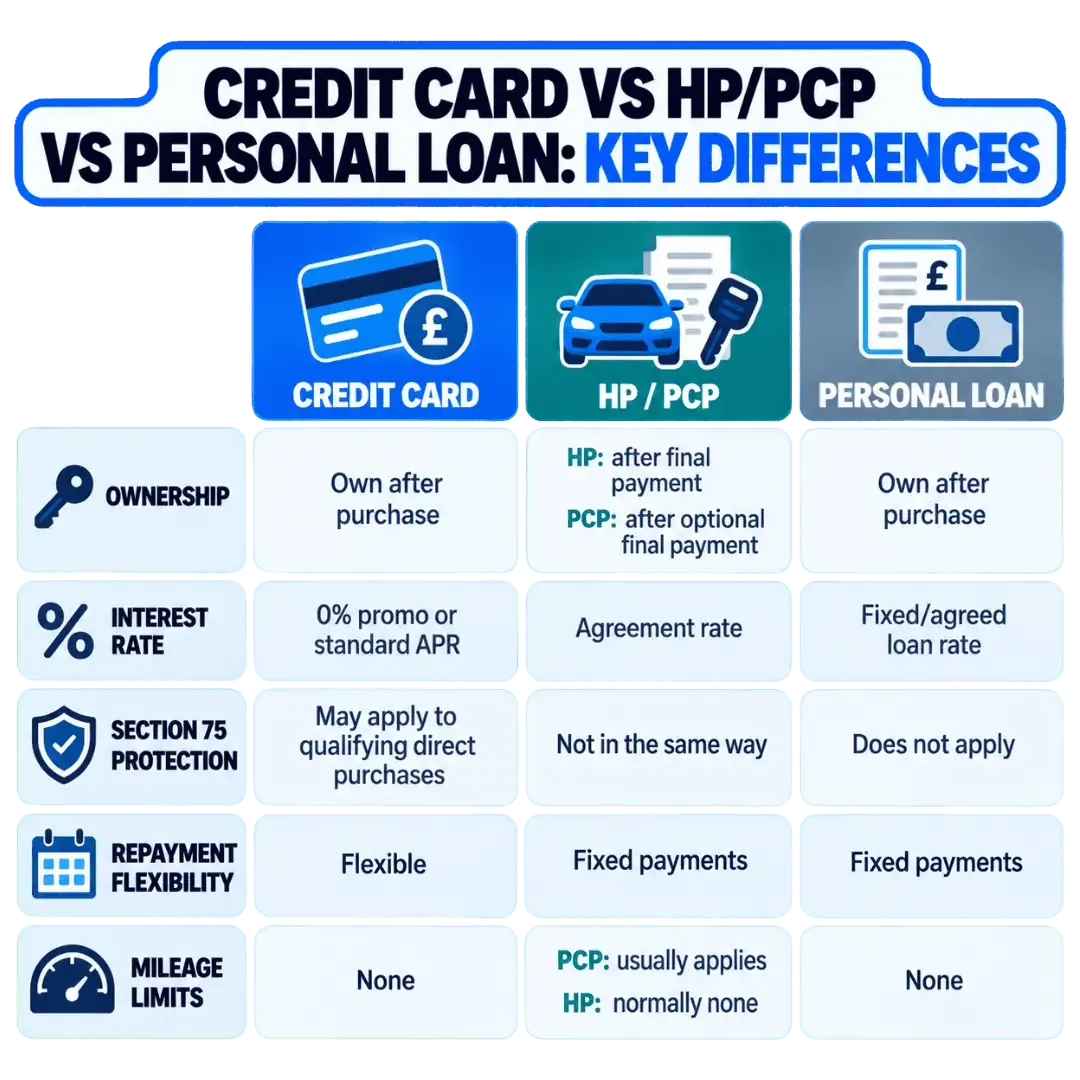
The comparison between a credit card and other finance options for a car purchase is given in the table below.
Factor | Credit Card | HP / PCP Finance | Personal Loan |
|---|---|---|---|
Ownership | You own the car after purchase. | HP transfers ownership after the final payment. PCP transfers ownership after the optional final payment is paid. | You normally own the car after purchase. |
Interest Rate | Ranges from 0% during a promotional period to a higher standard APR. | Interest is charged according to the finance agreement. | Interest is charged at a fixed or agreed rate over the loan term. |
Section 75 Protection | Direct credit card purchases between £100 and £30,000 may qualify for Section 75 protection. | Section 75 generally does not apply to the finance agreement in the same way as a direct credit card purchase. | Section 75 does not apply to a standard personal loan used to buy the car. |
Repayment Flexibility | Flexible monthly repayments, subject to the card terms and minimum payment. | Fixed payments over an agreed finance term. | Fixed monthly payments over an agreed loan term. |
Mileage Limits | No finance-imposed mileage limit. | PCP includes an agreed mileage limit, and HP normally does not. | No finance-imposed mileage limit. |
Acceptance | The dealer must accept credit card payments and may restrict the amount. | Available through dealers and finance providers subject to approval. | Available from banks and other lenders subject to approval. |
Best For | Buyers who have sufficient credit and can repay the balance affordably, particularly during a 0% period. | Buyers who want structured car finance and, with PCP, the option to return, keep or replace the car at the end of the agreement. | Buyers who want a fixed borrowing amount, predictable repayments and ownership of the car from purchase. |
What Are the Downsides of Buying a Car with a Credit Card?
The drawbacks of buying a car with a credit card are given below.
- High Credit Card Interest Rates: Credit card interest rates make the car more expensive when the balance remains unpaid after a 0% promotional period. Car buyers should clear the balance before the offer ends or compare the cost with other borrowing options.
- Limited Credit Card Limits: Credit card limits may not be high enough to cover the full price of a car. You will have to combine the card payment with another payment method or choose a different form of finance to pay for the car.
- Limited Dealer Acceptance: Car dealers do not always accept credit cards for vehicle purchases and may restrict card payments to a deposit or fixed amount. Some dealers may also charge a fee for accepting a credit card, which increases the overall cost of the vehicle purchase.
- Need for Repayment Discipline: Credit card borrowing requires the buyer to manage repayments carefully, particularly when using a 0% card with a fixed promotional period. Minimum payments may leave a balance that starts attracting interest when the offer expires.
- Higher Credit Utilisation: A large credit card balance increases credit utilisation and uses a greater proportion of the available credit limit. High utilisation may affect how lenders assess future credit applications, particularly while the balance remains outstanding.
Can I Use More Than One Payment Method to Buy a Car?
Yes, you can use more than one payment method when buying a car.
A buyer can pay a deposit by credit card and cover the remaining balance with savings, a bank transfer, a personal loan or car finance.
Using multiple payment methods lets you divide the upfront payment and remaining cost according to your available funds and borrowing options.
Does Buying a Car with a Credit Card Affect My Credit Score?
Yes, buying a car with a credit card can affect your credit score, as a large card payment increases your credit utilisation, which lowers your credit score temporarily.
Making repayments on time and reducing the balance can support your credit profile.
Missed payments or a high balance maintained over a long period can have a negative effect on it.
Can I Buy a Car Online with a Credit Card?
Yes, you can buy a car online with a credit card if the retailer accepts credit card payments for vehicle purchases.
Some online car retailers accept the full or partial purchase price by card, while others restrict card payments to a deposit or a specific amount.
You should check the retailer’s payment terms before ordering.
Section 75 protection can also apply to qualifying online car purchases when the statutory requirements are met, in the same way as qualifying purchases made from a dealership.