
How to Check if a Car is Cloned in the UK (Vehicle Identity Fraud Explained)
A cloned car is a vehicle whose registration identity has been illegally duplicated and applied to another vehicle. This duplication conceals the vehicle’s true history or legal status.
You check if a car is cloned by verifying its registration number, Vehicle Identification Number (VIN), and official vehicle records before buying or transferring ownership.
Vehicle identity fraud affects legal ownership, financial liability, insurance validity, and enforcement exposure.
Regulatory oversight in the United Kingdom includes the Driver and Vehicle Licensing Agency (DVLA), enforcement powers exercised by UK police forces, and statutory frameworks such as the Fraud Act 2006 and vehicle registration regulations.
Vehicle identity fraud involves registration duplication, VIN manipulation, or falsified documentation used to construct a false identity. Legal ownership remains tied to the authentic VIN and the official DVLA record.
Criminals use cloned identities to conceal theft, prior damage, outstanding finance, export status, or enforcement activity.
Buyers face seizure risk, financial loss, insurance invalidation, and lender enforcement rights if inconsistencies are not identified before purchase.
Effective verification requires structural and documentary alignment with official records.
If cloning is discovered after purchase, formal reporting to police and the DVLA is required to protect your position and correct the vehicle record.
In summary, a cloned car involves registration duplication or VIN manipulation that separates a vehicle’s physical identity from its official record. This creates legal, financial, and insurance risk. Checking a car for cloning requires confirming registration data, VIN consistency, documented history, and DVLA record alignment before payment.
CarVeto is an independent vehicle history check provider. We are not affiliated with or endorsed by the DVLA, UK police forces, HPI Ltd, or any government body. Our reports compile data from third-party data sources and do not constitute a legal determination of vehicle identity or title.
- What Is a Cloned Car?
- How Is a Car Cloned? (Registration Plates, VIN and Logbook Manipulation)
- Are Cloned Cars and Cloned Number Plates the Same Thing?
- Why Do Criminals Clone Cars?
- What Are the Risks of Buying or Owning a Cloned Car?
- What Happens If You Buy a Cloned Car in Good Faith?
- How Do You Check if a Car Has Been Cloned Before Buying It?
- What Signs Should You Look for When Inspecting a Car for Cloning?
- How Do You Verify a Car’s VIN Properly?
- Advanced Identity Checks Most Buyers Overlook
- What Should You Do If Your Car Has Been Cloned?
- Can a Cloned Car Have Outstanding Finance or Insurance Risks?
- Are All Cloned Cars Stolen or Written Off?
- Frequently Asked Questions
What Is a Cloned Car?
A cloned car is a vehicle whose registration identity has been stolen or duplicated and applied to another vehicle without legal authority.
In the United Kingdom, a vehicle’s legal identity is defined by its registration number and its Vehicle Identification Number (VIN). The registration number links the vehicle to the registered keeper recorded by the DVLA. The VIN is a 17-character manufacturer-assigned code that uniquely identifies the vehicle’s structural identity.
When a registration number or VIN is copied or altered so that two vehicles appear to share the same identity, vehicle identity fraud occurs.
Car cloning goes beyond simple number plate theft. It can involve duplicated plates, altered VIN markings, forged V5C documentation, or manipulated registration records.
The purpose is concealment. A cloned identity may hide theft, prior damage, unpaid finance, export status, or criminal use.
Under UK law, misuse of registration marks and false vehicle identity representation may trigger enforcement under the Fraud Act 2006, vehicle registration regulations, and police vehicle crime powers.
Legal ownership remains tied to the authentic VIN and the official DVLA record. A duplicated identity does not transfer lawful title or remove existing liabilities.
A cloned car is therefore a vehicle whose physical identity does not match its official record. That mismatch creates legal exposure, financial risk, and potential enforcement consequences for buyers and registered keepers.
How Is a Car Cloned? (Registration Plates, VIN and Logbook Manipulation)
Car cloning occurs when a legitimate vehicle’s registration identity is duplicated and applied to another vehicle to conceal that vehicle’s true status.
Criminals select a vehicle that matches the make, model, and colour of the legitimate car to avoid suspicion.
The aim is to create two vehicles that appear to share one lawful identity.
Cloning involves manipulation of one or more identity elements:
Number Plate Duplication
Number plate duplication occurs when a legitimate registration number is copied and displayed on another vehicle.
Plates may be stolen or obtained through illicit suppliers, including misuse of “show plates” that do not meet British Standard requirements. Once fitted, the duplicated registration links the second vehicle’s activity to the innocent registered keeper recorded by the DVLA.
Automatic Number Plate Recognition (ANPR) systems read the registration mark rather than the VIN. Duplicated plates can therefore evade congestion charges, toll systems, and automated enforcement until further checks are carried out.
VIN Tampering
VIN tampering occurs when the Vehicle Identification Number is altered, replaced, or obscured to match a cloned registration identity.
The VIN is permanently stamped into structural components and displayed in manufacturer-defined locations. Criminals may grind, restamp, weld, overlay VIN plates, or replace structural sections containing stamped identifiers to align the vehicle with forged documentation.
Because the VIN defines the vehicle’s structural identity, tampering constitutes serious fraud and may trigger liability under the Fraud Act 2006 and vehicle crime enforcement powers.
Synthetic Identity Bundling (VIN + Plates + V5C)
Synthetic identity bundling occurs when duplicated registration plates, a manipulated VIN, and falsified documentation are combined to create a fabricated vehicle identity.
Criminals attach cloned plates, alter or disguise the VIN, and present a forged or fraudulently obtained V5C logbook.
The V5C records the registered keeper on the DVLA database. It does not prove legal ownership.
When these elements appear consistent, the vehicle may pass superficial checks.
This method is commonly used to sell stolen, written-off, or otherwise encumbered vehicles as legitimate. The greater the identity manipulation, the greater the legal and financial risk to an uninformed buyer.
Are Cloned Cars and Cloned Number Plates the Same Thing?
No, cloned cars and cloned number plates are not the same.
Number plate duplication is one method used in car cloning, but it does not always involve full vehicle identity fraud.
A cloned number plate is the unauthorised copying of a registration mark and displaying it on another vehicle.
Use a Number Plate Checker to verify whether a registration matches the correct make, model, colour, and tax status recorded on the DVLA register.
The fraud is limited to the physical plate.
The VIN and documentation of the second vehicle remain unchanged. The usual objective is to evade enforcement cameras, toll systems, or penalty notices.
A cloned car involves broader vehicle identity theft.
It may include duplicated plates, altered VIN markings, falsified V5C documentation, or a combination of these elements. The objective is broader identity concealment beyond plate duplication.
The distinction determines risk. Plate duplication can result in penalty notices being issued to the innocent registered keeper. Full vehicle cloning exposes a buyer to seizure, defective title, insurance invalidation, and financial loss.
The level of identity manipulation determines the scale of legal and financial consequences.
Why Do Criminals Clone Cars?
Criminals clone cars to conceal a vehicle’s true identity and shift legal and financial liability onto an innocent registered keeper.
The primary motive is enforcement evasion. A cloned identity allows a vehicle to pass roadside observation, automated cameras, toll systems, and routine registration checks without immediate detection.
Common objectives include:
Avoiding enforcement charges
Cloned registration plates allow criminals to avoid speeding penalties, congestion charges, toll payments, and parking fines. Enforcement notices are redirected to the legitimate registered keeper.
Concealing stolen vehicles
A stolen vehicle fitted with a cloned identity can appear lawful in basic registration checks, reducing the likelihood of recovery.
Disguising written-off or salvage vehicles
Vehicles declared total losses may be assigned the identity of a clean vehicle to increase resale value and reduce scrutiny.
Selling vehicles with concealed financial or cross-border issues
A cloned identity can hide outstanding finance, mileage discrepancies, or import/export irregularities that would otherwise reduce value or prevent lawful sale.
Facilitating further criminal activity
A vehicle operating under a cloned identity may be used in additional offences because registration tracing leads to an unrelated party.
All objectives rely on one principle: registration identity functions as proof of legitimacy. When falsified, enforcement exposure and financial liability are transferred to the innocent registered keeper.
What Are the Risks of Buying or Owning a Cloned Car?
Buying or owning a cloned car exposes the purchaser or registered keeper to legal liability, financial loss, insurance invalidation, and enforcement action.
Risk severity depends on the level of identity manipulation.
Plate-only duplication creates enforcement exposure.
Full identity cloning creates defective title and ownership disputes.
UK police forces and the DVLA treat cloned identity activity as vehicle crime and fraud.
Legal identity remains tied to the authentic VIN and the official DVLA registration record.
The main risk categories are:
Legal Risk
Legal risk arises when the vehicle’s recorded identity does not match its true structural identity.
Police may seize a vehicle identified as stolen or fraudulently re-identified under vehicle crime enforcement powers and common law property recovery principles. A purchaser does not acquire lawful title to stolen property, even if acting in good faith. Under UK property law, stolen goods remain the property of the original owner or their insurer if a claim has been settled.
If cloned plates are linked to offences, enforcement notices and investigation may be directed to the innocent registered keeper until the identity issue is formally resolved.
Financial Loss
Financial loss occurs when a buyer pays for a vehicle they cannot lawfully retain.
If the vehicle is seized and returned to its lawful owner or insurer, the buyer loses both possession and purchase funds unless the seller can be identified and held liable. Recovery requires civil action, and fraudulent sellers are often untraceable.
Cloned vehicles are also associated with concealed damage, mileage discrepancies, or prior insurance total-loss classification. Buyers can Check if a Car is Written Off before purchase to confirm whether it has been declared a Category A, B, S, or N insurance total loss.
Insurance Complications
Insurance risk arises because insurers rely on accurate vehicle identity and declared history.
If a vehicle’s identity is misrepresented, the insurer may treat the policy as void for material non-disclosure under UK insurance contract principles. Fraud investigation may follow if cloned plates are linked to criminal activity. The legitimate owner may be required to demonstrate non-involvement.
The Motor Insurance Database (MID) links policies to registration numbers. A duplicated registration can create administrative conflict until corrected.
Outstanding Finance Exposure
Outstanding finance exposure arises when a cloned identity conceals a secured lending agreement.
If unpaid finance exists, the lender retains a legal interest in the vehicle. A buyer does not obtain clear title while the agreement remains active. Finance agreements grant enforcement rights, including repossession under the Consumer Credit Act 1974 and related consumer credit regulation.
Before completing a purchase, Check for Outstanding Car Finance to confirm the vehicle is not subject to enforceable lender rights.
Without verification, a buyer may unknowingly purchase a vehicle that remains legally secured against a finance agreement.
What Happens If You Buy a Cloned Car in Good Faith?
Buying a cloned car in good faith does not grant lawful ownership if the vehicle is stolen or fraudulently re-identified.
Under UK property law, a person cannot transfer better title than they possess.
If the vehicle was stolen, legal ownership remains with the original owner or their insurer where a theft claim has been settled. Police have authority to seize stolen property once identified. The buyer must surrender the vehicle regardless of knowledge or intent at the time of purchase.
The V5C logbook does not prove ownership. It records the registered keeper on the DVLA database.
A forged or fraudulently obtained V5C does not change the legal ownership position.
Financial recovery depends on identifying the seller. If the seller can be traced, the buyer may pursue civil action for misrepresentation or fraud.
Where payment was made by credit card, statutory consumer credit protection may provide limited recourse, subject to legal conditions. Debit card payments do not provide equivalent statutory protection.
Good faith reduces criminal exposure but does not secure legal title. Verification before purchase remains the only reliable safeguard.
This section provides general information and does not constitute legal advice.
How Do You Check if a Car Has Been Cloned Before Buying It?
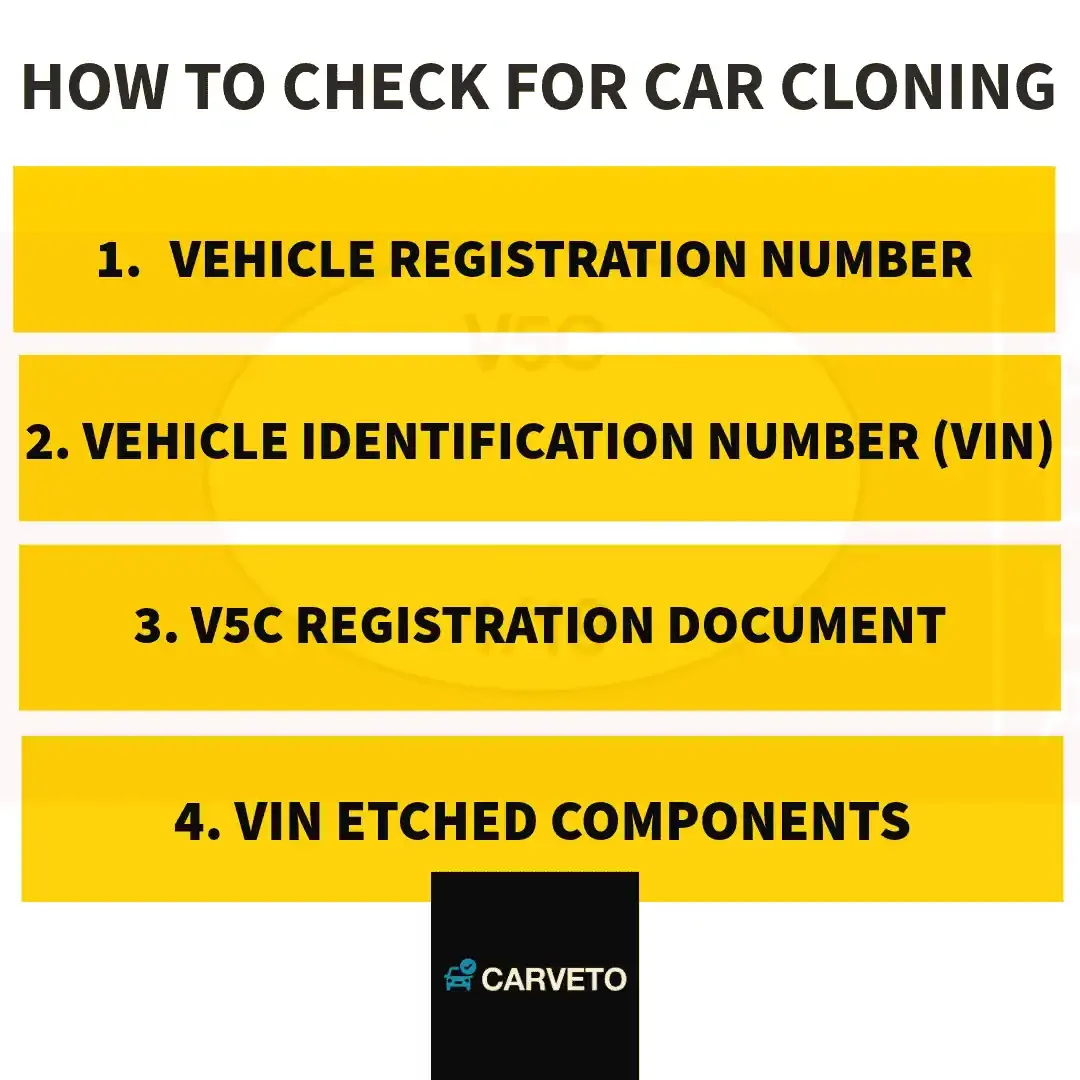
You check if a car has been cloned by verifying its registration record, VIN consistency, and official history data before completing the purchase.
Verification confirms that the vehicle’s physical identity matches its recorded identity. It requires cross-checking registration data, structural identifiers, and continuity records.
Surface inspection alone is insufficient because identity fraud often relies on partial document consistency.
The process requires five sequential checks:
Run a Car History Check
A car history check can identify recorded risk indicators, including theft status, write-off classification, scrapped or exported markers, finance records, plate changes, and mileage discrepancies. It does not independently confirm physical VIN authenticity or rule out structural manipulation.
A structured Car History Check should support, not replace, manual identity verification.
Cross-Check VIN Across the Vehicle and V5C
Inspect the Vehicle Identification Number on the vehicle and confirm it matches the VIN printed on the V5C logbook. The VIN must appear in manufacturer-designated locations, including the chassis, lower windscreen area, interior door pillar or bootwell. Character spacing, alignment, and surrounding metal must show no grinding, welding, or restamping. Any inconsistency indicates identity tampering.
Verify Registration with DVLA
Confirm that the vehicle’s registration details match DVLA records, which form the official statutory vehicle register in the United Kingdom. Verify make, model, colour, engine size, and tax status. Any discrepancy between the physical vehicle and the official record indicates identity manipulation.
Review MOT and Mileage Continuity
Review MOT history and mileage progression for logical continuity. Mileage must increase consistently across recorded test dates. Sudden reversals, unexplained gaps, or inconsistent test locations indicate possible cloning or record substitution. Check the vehicle’s MOT Records to confirm recorded usage patterns.
Validate Seller Identity and Sale Context
Confirm that the seller’s name and address match the V5C registered keeper details. View the vehicle at the address recorded on the logbook where possible. Avoid transactions in temporary or anonymous locations.
Use traceable payment methods to establish a documented transaction record.
These steps confirm whether registration identity, structural identity, and documented history align. If any inconsistency appears, halt the transaction and investigate further.
Verification before payment remains the only reliable safeguard against vehicle identity fraud.
What Signs Should You Look for When Inspecting a Car for Cloning?
Physical, documentary, and behavioural inconsistencies indicate cloning risk.
Cloning relies on partial identity alignment. A vehicle can appear legitimate while underlying records or identifiers conflict. Inspection must focus on anomaly detection rather than surface condition.
Key warning indicators include:
Suspicious Pricing Patterns
A significantly under-market asking price signals elevated fraud risk.
Cloned vehicles are often priced to secure rapid sale and reduce scrutiny. A price that materially undercuts comparable listings for the same make, model, year, and specification requires verification before proceeding.
Seller Behaviour Red Flags
Avoidance behaviour increases identity fraud risk.
Reluctance to provide identification, refusal to meet at the registered address, pressure for immediate payment, or insistence on cash transactions indicate evasion. Legitimate sellers comply with reasonable verification steps.
Documentation Inconsistencies
Mismatch between documentation and vehicle characteristics indicates identity manipulation.
The V5C must reflect the correct make, model, colour, and engine specification. Differences between the physical vehicle and the registration record require formal explanation.
Ensure you Verify Recorded Mileage and ensure it aligns with MOT and service history entries.
Altered paperwork, inconsistent fonts, or missing security features require scrutiny.
Inspection does not replace structured verification. It supports formal checks by identifying inconsistencies that automated records may not immediately expose.
How Do You Verify a Car’s VIN Properly?
You verify a car’s VIN by confirming that its 17-character Vehicle Identification Number is authentic, structurally intact, and identical across all official records.
The VIN is the vehicle’s permanent structural identifier. It is assigned by the manufacturer and embedded in multiple locations.
Proper verification requires physical inspection and documentary comparison.
A single glance at the windscreen plate is insufficient.
You can run a Car VIN Check to support record-based verification, but it does not replace physical inspection.
Verification involves the following checks:
Where the VIN Should Appear
The VIN must appear in multiple manufacturer-designated locations and match exactly in every instance.
Common locations include:
- Lower windscreen dashboard plate
- Chassis or structural frame stamping
- Driver’s door pillar or frame label
- Engine bay or bulkhead plate
- Bootwell
- V5C registration document
Every instance must display identical characters in the same sequence. Differences in spacing, alignment, depth, or formatting indicate alteration.
The VIN stamped on the vehicle must match the VIN printed on the V5C and related service records.
Signs of VIN Stamp Alteration
VIN tampering leaves visible disruption to surrounding material.
Warning signs include:
- Grinding marks near stamped areas
- Uneven or inconsistent character depth
- Misaligned digits
- Weld seams or filler near identifier sections
- Clean metal within otherwise aged components
Because the VIN is stamped into structural metal, alteration disturbs the surrounding surface. Visible interference indicates identity manipulation and should immediately halt the transaction.
Matching VIN to Recall and Specification Records
VIN verification also requires confirming alignment with manufacturer specification data.
The VIN encodes manufacturer, model series, production year, and plant origin. These attributes must correspond with the physical vehicle.
If the VIN decodes to a different model or specification than presented, identity substitution is likely.
If the VIN fails authenticity, consistency, or specification alignment checks, the vehicle’s legal identity cannot be relied upon.
Advanced Identity Checks Most Buyers Overlook
Advanced identity checks identify cloning risks that standard registration and history checks may not detect.
These checks focus on structural consistency, cross-record alignment, and data coherence.
They supplement formal verification but do not replace registration or history checks.
Key advanced checks include:
Manufacturer VIN-Etched Components
Some manufacturers mark additional components with partial or full VIN references. These may include windows, structural panels, chassis sections, catalytic converters, or body parts.
All etched identifiers must correspond with the primary VIN. Any mismatch indicates part substitution or identity manipulation. Consistency across multiple components strengthens structural authenticity.
Temporal or Geographic Registration Anomalies
Registration records must reflect physically possible vehicle movement.
If enforcement records, toll data, or camera notices show the same registration in distant locations within an impossible timeframe, identity duplication is likely. A vehicle cannot appear in two places simultaneously.
Mileage progression must align with MOT and service records. Large unexplained gaps or conflicting location data indicate cloning or record substitution.
Cross-Border Identity Mirroring
A legitimate vehicle identity should not appear inconsistently across jurisdictions.
If a vehicle is recorded as exported and later reappears domestically without lawful re-registration, identity inconsistency is indicated. Import or export discrepancies between physical presence and registration history require investigation.
You can Check if a Car is Imported to confirm whether the vehicle’s recorded import status aligns with its current UK registration.
When jurisdictional records conflict, the vehicle’s legal identity cannot be relied upon without further verification.
Advanced checks strengthen identity confirmation by detecting inconsistencies that surface inspection and basic record checks may miss.
What Should You Do If Your Car Has Been Cloned?
If your car has been cloned, report the fraud, document the evidence, and formally correct the vehicle record with the relevant authorities.
Cloning creates enforcement exposure because the duplicated registration links offences to your DVLA record.
Prompt reporting limits liability escalation. Identity correction requires coordinated action involving the police, the DVLA, and any issuing enforcement authority.
Follow these steps:
Report to Police and Obtain Crime Reference
Report the cloning to the police immediately and obtain a crime reference number. Provide copies of penalty notices, location records, and evidence confirming your vehicle was elsewhere at the time of the alleged offence.
The crime reference number establishes formal documentation of identity fraud.
Notify DVLA
Inform the DVLA that your registration has been cloned. The DVLA can place a marker against the vehicle record and update enforcement flags where necessary. In verified cases, a replacement registration number may be issued to prevent continued misuse.
After notification, conduct a DVLA Registration Check to confirm that the official vehicle record reflects accurate and updated details.
Challenge Incorrect Fines or PCNs
Contact the issuing authority for each penalty charge notice. Provide the crime reference number and supporting evidence.
Once cloning is formally recorded, enforcement bodies must reassess liability. Failure to respond may result in escalation.
Inform Your Insurer
Notify your insurer that the vehicle has been cloned. This protects your policy record if cloned plates are linked to offences or accidents.
Insurers rely on accurate registration identity when assessing risk and claims.
These actions create a documented fraud record and separate your lawful vehicle identity from the cloned activity.
Can a Cloned Car Have Outstanding Finance or Insurance Risks?
Yes. A cloned car can carry outstanding finance and create insurance exposure if its identity conceals secured debt or misrepresents vehicle history.
Outstanding finance attaches to the vehicle as a lender’s secured interest. If the agreement remains unpaid, enforcement rights remain active and clear title does not transfer to the buyer.
Cloning can conceal this liability. A vehicle may appear under a clean registration record while the physical vehicle remains subject to finance.
Insurance risk arises from the same identity mismatch.
Insurers assess cover using the vehicle’s registration and declared history. If the insured vehicle does not match its true structural identity, the policy may be void for material misrepresentation.
Claims may be refused and investigation may follow.
Verification before purchase remains the most effective safeguard.
Are All Cloned Cars Stolen or Written Off?
No. Not all cloned cars are stolen or written off, but many involve a stolen, written-off, exported, or otherwise fraudulently re-identified vehicle.
Car cloning is identity duplication. The underlying vehicle may carry a concealed status such as theft, total loss, export record, finance encumbrance, or enforcement use.
The fraud concerns the falsified identity rather than the vehicle’s prior condition alone.
Stolen vehicles are often assigned the identity of a legitimate vehicle to reduce detection.
Written-off vehicles may be reintroduced under a clean identity to increase resale value.
Some cases involve plate-only duplication without altering the physical vehicle. In those instances, the vehicle itself may not be stolen or written off, but the registration identity remains fraudulent.
Identity integrity is decisive.
A vehicle may appear mechanically sound and legally taxed while carrying a falsified identity.
Verification must focus on structural and documentary alignment rather than assumptions about damage or theft history.
Frequently Asked Questions About Cloned Cars
No. An HPI Check Report can reveal indicators of cloning by identifying inconsistencies in registration, VIN, theft, write-off, finance, or DVLA records.
However, it cannot independently confirm physical VIN tampering or guarantee detection of identity substitution.
Yes. ANPR cameras can detect cloned number plates when the same registration appears in multiple locations within an impossible timeframe.
Yes. Cloning a number plate is illegal in the UK and constitutes a criminal offence under vehicle registration and fraud legislation.
No. Personalised number plates are not inherently more likely to be cloned, but any publicly visible registration can be copied and misused.
Yes. You can apply to change your registration number if your car has been cloned, and the DVLA may issue a replacement registration after the fraud is formally reported and verified.
Important Legal Notice
This guide is for general informational purposes only. Vehicle identity fraud assessment requires physical inspection and official authority verification. CarVeto provides vehicle history information compiled from third-party data sources. We do not conduct forensic vehicle examinations and cannot guarantee detection of all cloned or fraudulently re-identified vehicles.