
Find Car History When Your Service Records Are Missing
When drivers search “find car history,” they often mean something very different.
In reality, it’s not stolen status or finance checks they need, but missing service history.
This guide helps you trace past maintenance, rebuild servicing records from physical clues, and understand what’s still possible to recover.
We cover everything from dealership visits and MOT advisories to CarVeto’s digital service history (DSH) service, which may be available through some manufacturers.
Whether the service book was lost, never stamped, or completely missing, we’ll help you piece together what matters.
- What ‘Car History’ Actually Means in the UK
- Car History vs Service History: Two Different Records
- Finding Car History: What Drivers Are Really Looking For
- Ways to Trace a Car’s Past Servicing (Without a Service Book)
- Recovering Lost or Incomplete Service History
- Why Service History Affects Risk, Reliability & Resale
- Places You Can Look for Historic Service Information
- Using CarVeto to Find Car History
What ‘Car History’ Actually Means in the UK
When people refer to “car history,” they’re often talking about the vehicle’s background, such as whether it was written off, stolen, or subject to finance agreements.
In the UK, this data comes from sources like the DVLA, police records, and insurance databases.
Look at CarVeto Car History to view a formal report.
It helps uncover risk and identity concerns, but says nothing about how well the car was serviced.
The DVLA stores details about keeper changes, tax status, and SORN declarations.
MOT history, available via GOV.UK shows test outcomes and advisories, helpful for spotting usage patterns, but not maintenance work.
None of these systems records servicing like oil changes, timing belt replacements, or inspections.
This is not the same as service history.
You can have a completely clean background, but no evidence that the vehicle was ever properly maintained.
Car History vs Service History: Two Different Records
It’s easy to confuse a car’s background history with its service history, but they hold entirely different information.
One shows risk and registration signals; the other reveals how well the vehicle was looked after.
Dealers often hand over incomplete records: a V5C, an MOT printout, but no service book, no garage stamps, no receipts.
That’s where the mix-up starts.
Car History (Background) | Service History (Maintenance) |
|---|---|
Keeper history (DVLA) | Stamped service book or digital DSR record |
MOT pass/fail results | Invoices for oil changes, filter replacements |
Finance and insurance status | Scheduled servicing intervals (OEM) standards) |
Write-off and stolen status | Evidence of maintenance work, such as inspections, brake fluid changes, or timing belt replacement (if recorded) |
Tax/SORN from DVLA records | Advisory work and long-term maintenance pattern |
Many vehicles show complete MOT records but no evidence of Full Service History (FSH), or even partial (PSH) maintenance data.
A dedicated Car Service History Check uncovers maintenance, not background risk.
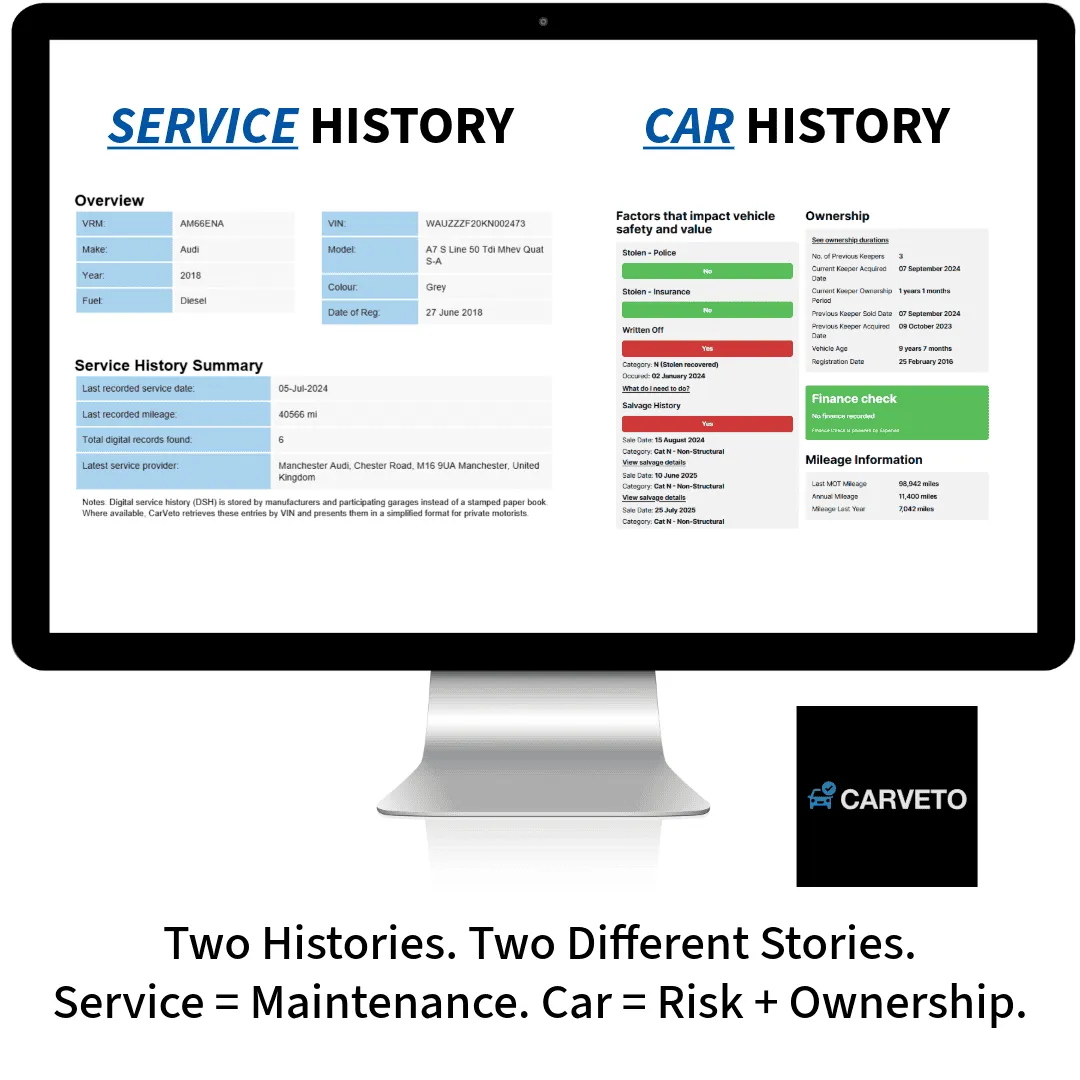
What Car History Shows vs What Service History Shows
- Car history shows: keeper and registration data, finance markers, write-off status, and MOT pass/fail outcomes.
- Service history shows: oil and filter changes, brake fluid intervals, inspections, timing belt replacement, garage stamps, and adherence to OEM servicing schedules.
Why Drivers Mix These Terms When Searching
Used cars often change hands with paperwork missing or incomplete.
A V5C might be present, but the service book is unstamped or absent.
Some garages don’t issue receipts or maintain stamps.
Others use digital-only systems that the seller never accessed.
The result? Most drivers who search for “find car history” are really trying to recover lost service history, not check a vehicle’s background.
Finding Car History: What Drivers Are Really Looking For
Drivers who are buying a car want to know it’s been well-maintained and has a regular maintenance and repair history.
Digital records exist only in some cases and require dealership access.
And many vehicles pass through long ownership chains with no consistent paperwork.
The result is the same: uncertainty about how well the car was maintained.
That’s why this page focuses on helping you recover service records, not background checks.
Why service records matter:
- Confirm whether essential servicing was carried out on schedule
- Reveal gaps that affect future reliability and maintenance planning
- Support resale value and give clarity to future garages
Ways to Trace a Car’s Past Servicing (Without a Service Book)
Even without a service book, you can often recover fragments of a car’s servicing record.
Many vehicles change hands with missing paperwork, but traces remain in invoices, garage stickers, MOT patterns, or manufacturer systems.
This section shows how to identify these clues and assemble a partial record of past maintenance.
While no single source provides a complete view, combining several can help confirm what work was done and what may now be overdue.
Step-by-step:
- Search through any paperwork.
Check folders, envelopes, and handover packs for invoices, job sheets, or reminders. - Inspect glovebox and boot compartments.
Many receipts, garage cards, or branded booklets are stored here. - Look for stickers on the windscreen or engine bay.
These often show last oil change or timing belt dates. - Use GOV.UK to review the MOT history.
Advisory notes can indicate neglect or recurring faults. This does not show servicing. - Assemble what you find into a dated timeline.
A partial history, even if incomplete, helps with servicing decisions and future resale. This reconstruction is for your knowledge only and is not an official replacement for a service book.
Start with Physical Paperwork and Receipts
Begin with any documents you have access to. Look for:
- Invoices detailing parts and labour
- Job sheets with technician notes
- Service stamps, even on loose pages
- Warranty letters or service due reminders
- Garage business cards or service desk receipts
- Dealer inspection reports or PDI forms
Each document helps confirm servicing intervals and garage involvement.
Use MOT History to Infer Maintenance
MOT records don’t show servicing, but they can offer clues.
Frequent advisories for tyres, brakes, or suspension may point to poor maintenance.
Consistent passes without advisories could suggest regular upkeep.
MOT records do NOT count as full service history.
Always use them to support, not replace, servicing evidence.
When Digital Records May Exist (DSR)
Digital Service Records (DSR) are maintained by some manufacturers and record work performed at authorised dealers.
If the car was maintained by a main dealership, a digital log may exist, even if no physical book was provided.
Digital Service Records vary by manufacturer and may not include historic independent-garage work.
What DVLA Can and Cannot Provide
The DVLA does not hold any records about servicing. It only stores:
- Registered keeper history
- Tax and SORN status
- Basic vehicle identity information
MOT history is available via GOV.UK, but it reflects test results, not garage servicing.
Timing belts, oil changes, and brake fluid do not appear in DVLA or MOT data.
Recovering Lost or Incomplete Service History
When a vehicle’s service record is missing or fragmented, it’s still possible to rebuild part of its maintenance history.
Using dated invoices, MOT patterns, and garage confirmations, you can create a usable overview of what work was done and when.
Some garages will reissue stamps or duplicate invoices if you can show past bookings.
Main dealers may access digital records (DSR). See CarVeto's Digital Service History Tool.
MOT timelines help estimate when servicing likely occurred.
Though not complete, this reconstruction can guide your next maintenance steps.
However, records from closed garages or undocumented private work usually can’t be recovered.
What you can realistically restore:
- Service stamps reissued from verified invoices
- Duplicate invoices or job sheets from garages
- Dealer-confirmed work logged in digital systems
- A basic timeline inferred from MOT + garage data
- Confirmation of major maintenance (e.g. timing belt)
This process is often enough to understand the car’s maintenance health, even without an official stamped book.
Rebuilding from Partial Data
Gather every trace of servicing, invoices, garage name and MOT entries.
Use these to create a dated outline of past work.
Contact known garages to confirm service types, then link those events to MOT mileage for interval clues.
This triangulated view helps map out oil changes, inspections, and key servicing milestones.
Contact Garages and Dealerships
If you can identify a garage from invoices or stickers, reach out directly.
Many retain internal databases or workshop logs for customer vehicles.
Under GDPR, you may need to provide proof of ownership and vehicle details.
Garages typically keep:
- Invoice archives
- Booking histories
- Workshop notes from inspections
They won’t release previous owner details, but may confirm past work done.
What Can Realistically Be Recovered
- Reissued service stamps backed by documentation
- Copies of invoices or job sheets
- Confirmation of specific servicing (e.g. brake fluid, filters)
- Digital Service Records (DSR) from dealer platforms
- Estimated intervals based on mileage and MOT patterns
Records from independent garages without logs, DIY work, or long-ago owner maintenance often can’t be recovered.
Why Service History Affects Risk, Reliability, and Resale
Mechanical reliability
When service history is missing, it’s harder to know whether essential maintenance, such as oil changes, timing belt replacements, or brake fluid flushes, has been performed.
Those are the jobs that keep an engine healthy over the long term.
Without proof, many owners choose to “reset the clock” with a major service, simply because the risk of unknown neglect is too high.
Resale and buyer confidence
Buyers look at service history as a shortcut to understanding how a car was treated.
A full service history (FSH) reassures people that the car was maintained on schedule, while a complete absence of records usually triggers caution or lower offers.
Background checks and MOT records can show that a car is legal and correctly registered, but only service records show how well it’s actually been cared for.
Places You Can Look for Historic Service Information
If your service history is incomplete or missing, there are still reliable places to search for fragments of the vehicle’s maintenance past.
These sources won’t offer a full picture, but they can help confirm if, and when, key servicing took place.
By checking public records and contacting previous garages or dealerships, you can assemble a useful partial history.
Where to look:
- GOV.UK MOT records and V5C replacement services
- Main dealerships that serviced the vehicle under warranty
- Independent garages the car previously visited
- OEM digital platforms that store service logs (DSR)
- Original paperwork including invoices and reminder letters
GOV.UK Sources (MOT, V5C Replacement)
MOT history is available from GOV.UK using the vehicle’s registration.
It shows test dates, mileage, and advisory notes, which can help infer usage and potential service timing. GOV.UK also lets you request a replacement V5C logbook if it was lost.
However, these services do not include any servicing information: they are strictly background identity records.
Dealerships and Manufacturer Platforms
Main dealerships may hold servicing data if the car was previously under warranty or regularly maintained there.
Many brands now log each visit digitally using a Digital Service Record (DSR) system.
Access usually requires proof of ownership and a direct request to the dealership.
These logs can help confirm work such as oil changes, brake fluid replacement, or scheduled inspections.
Using CarVeto to Understand the Car’s Background
CarVeto can help you understand ownership patterns, MOT history, and other background signals.
We can also provide Digital Service Records that backfill the vehicle’s maintenance journey, especially when formal records are missing or incomplete.