
What Documents Do You Need for a Car in the UK?
Car documents in the UK are official records that establish a vehicle’s legal identity, ownership, and compliance with road safety and taxation laws. These documents are essential when driving, taxing, insuring, or selling a car.
They may be requested at any time by police officers, insurance providers, prospective buyers, or DVLA representatives.
🗂️ Core Car Documents (Required):
- V5C Registration Certificate (Logbook)
Confirms the registered keeper and contains vehicle-specific details like make, model, and VIN. Managed by the DVLA. - MOT Certificate
Required for vehicles over three years old, this proves the car is roadworthy and meets environmental standards. - Vehicle Tax Status
You must show the car is taxed or has a valid Statutory Off Road Notification (SORN). - Motor Insurance Certificate
Mandatory for driving on public roads and used to prove valid insurance coverage.
📁 Helpful Additional Documents (Optional):
- Service History Records – for evidence of maintenance and added resale value
- Car Finance or Warranty Agreements – confirming financial obligations or coverage
- Breakdown Cover Details – useful in roadside emergencies
- Proof of Purchase – such as a vehicle invoice or bill of sale
🔎 Check Your Car’s Documentation Digitally
Platforms like CarVeto enable buyers and sellers to conduct quick vehicle history checks using the car’s Vehicle Registration Mark (VRM). These tools can reveal critical issues, such as outstanding finance, whether the car has been written off, or if it has been reported stolen.
Examine Car History with a Free Report
Enter your registration number below

Vehicle Registration Document (V5C Logbook)
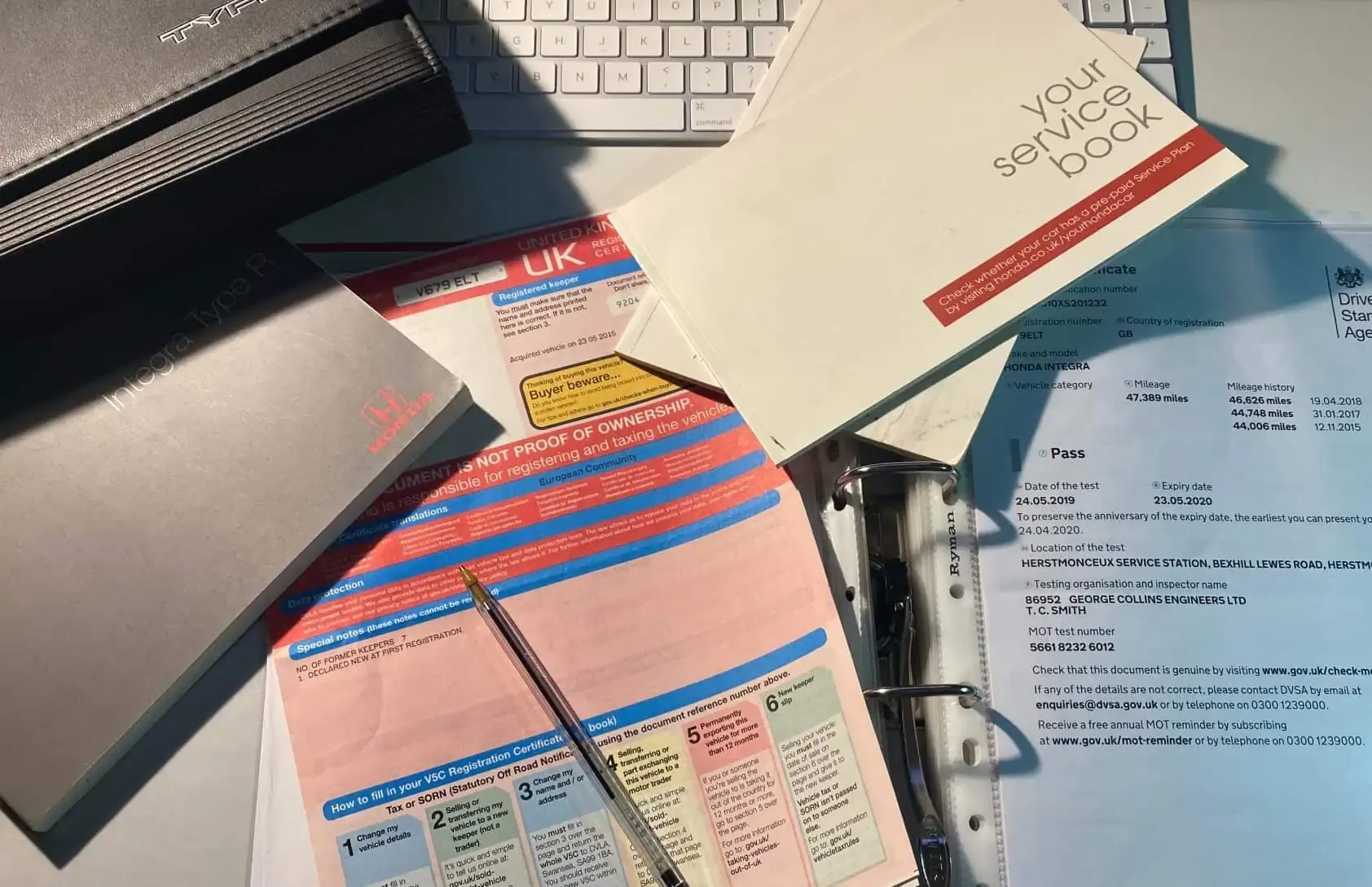
The V5C logbook, officially known as the Vehicle Registration Certificate, is one of the most important car documents in the UK.
Issued by the DVLA (Driver and Vehicle Licensing Agency), it records the vehicle’s registration history, technical details, and registered keeper.
However, it’s important to note that the V5C does not prove legal ownership. It identifies the person responsible for taxing, insuring, and maintaining the vehicle.
You’ll need a valid V5C when taxing a car, transferring ownership, exporting or scrapping a vehicle, or declaring it off the road (SORN).
What Is a V5C Logbook?
The V5C is a red A4 certificate issued to the registered keeper by the DVLA. It includes:
- The name and address of the registered keeper
- Unique DVLA reference numbers
- Vehicle identification data, such as the registration number and VIN
It is essential when buying or selling a car privately, updating keeper details, or proving responsibility for the vehicle to insurers or authorities.
What Information Does the V5C Contain?
A valid V5C will display:
- Vehicle registration mark (VRM)
- Vehicle Identification Number (VIN)
- Make, model, engine size, fuel type, and colour
- Date of first UK registration
- Total number of previous keepers
- Name and address of the current keeper
- 11-digit document reference number and its issue date
All listed details should match the car’s physical identifiers and align with any Vehicle History Check to confirm the car’s identity and legality.
How to Check if a V5C Is Genuine
To verify a V5C’s authenticity:
- Look for the red certificate design (blue versions were phased out in 2009)
- Ensure Section 1 contains the 11-digit reference number
- Check for DVLA watermarks and anti-fraud microtext
- Match the VIN and registration number against the car itself
Any mismatch or sign of tampering should be treated as a serious red flag. Always investigate further before continuing with a purchase.
What to Do if Your V5C Logbook Is Lost or Stolen
If your logbook is lost, stolen, or damaged:
- Apply for a replacement at GOV.UK or complete DVLA form V62
- Pay a £25 replacement fee
- Expect delivery within 5 working days (online) or up to 6 weeks by post
If theft is suspected, report it to the DVLA immediately to prevent fraud under your vehicle’s registration.
Driving Licence Requirements
A UK driving licence is a legal requirement for operating a motor vehicle. It confirms that the driver is qualified and authorised to drive a specific vehicle category after passing the relevant theory and practical tests.
Driving without a valid licence is a criminal offence and can result in fines, points, or disqualification.
Alongside your V5C logbook and motor insurance certificate, your driving licence is one of the core documents that proves your legal authority to use a car in the UK.
Types of UK Driving Licences
The most common types of UK driving licences for private motorists include:
- Provisional Licence (Category B)
Issued to learner drivers. It allows supervised driving and is required before booking a test. - Full UK Driving Licence (Category B)
Granted, after passing both theory and practical tests. Allows unsupervised driving of manual or automatic vehicles. - Automatic-Only Licence
For drivers who passed their test in an automatic vehicle. It does not allow the use of manual transmission vehicles. - Extended or Special Licences
For vocational drivers (e.g. HGV, bus) or individuals regaining their licence after a ban.
Photocard licences are the standard format in the UK and must be renewed every 10 years. The paper counterpart was abolished in 2015 and is no longer valid.
When Do I Need to Show My UK Driving Licence?
You must be able to present your licence:
- When stopped by police, either immediately or within 7 days at a police station
- To verify your identity during legal processes, driving tests, or insurance claims
Do I Need My Licence When Buying or Selling a Car?
While not legally required, buyers may be asked to show a valid driving licence to confirm they are eligible to drive the vehicle legally and safely.
Can Insurers Check Your Licence?
Yes. Insurance companies often request your driving licence number to validate your entitlements, check for driving convictions, or assess your no-claims bonus.
Is a UK Licence Valid for Driving Abroad?
A UK driving licence is accepted in many countries, particularly in Europe. However, some destinations require an International Driving Permit (IDP) and your licence.
Check the destination’s driving rules before travelling.
📌 Tip: Avoid storing your driving licence in the car. It’s a valuable identity document and vulnerable to theft or misuse.
Car Insurance Certificate & Cover Notes
A car insurance certificate is an official document that proves your vehicle is legally insured. In the UK, all drivers must have at least third-party cover to use public roads.
The certificate outlines your policy terms, level of cover, and who may legally drive the car.
Alongside your V5C logbook and driving licence, it is one of the core documents required for lawful vehicle ownership and use.
What Does a Car Insurance Certificate Include?
A valid certificate includes important policy details such as:
- Policyholder name and address
- Vehicle registration number (VRM) and description
- Insurer’s name and policy number
- Cover level: Third Party, Fire & Theft, or Comprehensive
- Start and expiry dates of the policy
- Driving restrictions (e.g. named drivers or business use clauses)
Most UK insurers now issue these documents digitally, but you can request a paper copy.
Do I Need to Keep a Printed Copy?
No, you do not need to keep a physical insurance certificate in your car.
However:
- You must produce it if requested by police, either at the roadside or within 7 days at a police station
- A printed version may be useful to store at home or securely in the car
- Avoid keeping it openly in the glovebox, as insurance data can be exploited if your car is stolen
When Is Your Insurance Certificate Needed?
Your certificate may be required when:
- Stopped by police to confirm your vehicle is insured
- Selling or buying a car, especially in private transactions
- Applying for vehicle finance or loans
- Taxing your vehicle online or at the post office (in some cases)
It serves as legal proof of cover and helps you avoid serious penalties such as fines, points, or even vehicle impoundment.
MOT Certificate & Roadworthiness Proof
An MOT certificate confirms that a vehicle meets the UK’s minimum legal standards for road safety and environmental performance.
All cars over three years old must pass an MOT test annually to remain road legal.
Driving without a valid MOT can lead to fines, penalty points, and invalid insurance.
While a printed certificate isn’t legally required, the vehicle’s MOT status must always be valid and electronically recorded.
The MOT is a core part of your vehicle’s legal documentation, alongside your V5C logbook, driving licence, and insurance certificate.
Where Can I Check MOT History?
You can check any UK vehicle’s MOT record online using the registration number (VRM):
- Through the official DVLA MOT check service
- On car history platforms like CarVeto, which display detailed test results
These tools can help you verify:
- MOT test dates and expiry status
- Pass/fail outcomes
- Advisories and reasons for failure
- Recorded mileage and mileage patterns
- Gaps in testing, which may indicate missed or delayed MOTs
Checking MOT history is especially important when buying a used car, as repeated test failures, tampered mileage, or skipped MOTs could reveal mechanical issues or prior neglect.
Use our Free MOT Check & Vehicle History Report With Tax, Mileage & Advisories
What If Your MOT Certificate Is Lost?
You do not need a paper MOT certificate to prove MOT compliance, the test result is digitally linked to the vehicle’s VRM and accessible by:
- Police and enforcement officers
- Insurers
- Car dealers or buyers
If you’ve lost your MOT certificate:
- Check your MOT status online at GOV.UK
- Request a duplicate from the MOT test centre (a small fee may apply)
- Download a digital replacement directly from the DVLA service
📌 Tip: Although not mandatory, many drivers save a screenshot or printed copy of their MOT certificate in their glovebox or service folder for quick access.
Car Tax (Vehicle Excise Duty) – What You Need to Know
Vehicle Excise Duty (VED), commonly known as car tax, is a mandatory charge for any vehicle used or kept on UK public roads.
It must be paid annually and is calculated based on the car’s CO₂ emissions, fuel type, and first registration date.
Use our free Road Tax Calculator by Reg Tool for annual costs.
Driving without valid car tax, or failing to declare a vehicle off-road via a Statutory Off Road Notification (SORN), is a criminal offence.
Offenders may face fines, vehicle clamping, or enforcement action from the DVLA.
Along with your MOT certificate, insurance policy, and V5C logbook, car tax status forms part of the documentation confirming your legal right to drive in the UK
How Can I Check If a Car Is Taxed?
To check a vehicle’s tax status using only its registration number (VRM):
- Visit the official DVLA vehicle enquiry service
- Use car history check tools like CarVeto, which show tax and SORN status in their free reports
These checks reveal:
- Whether the vehicle is currently taxed
- Tax expiry date
- VED band and CO₂ emissions
- Fuel type and environmental classification
- SORN status or if the car has been exported
Verifying this information is especially important when buying a used car to avoid vehicles flagged for off-road or illegal use.
Do I Need to Show Proof of Car Tax When Selling a Vehicle?
No, physical proof of tax is not required during the sale or purchase of a car. However, both parties must meet key obligations:
- Sellers must notify the DVLA of the sale; any unused tax will be refunded automatically
- Buyers must re-tax the vehicle immediately, as car tax does not transfer between owners
- Driving a car with expired or missing tax is illegal, even if the previous owner had paid
📌 Reminder: You can tax your vehicle instantly online at GOV.UK uses either the 11-digit number from the V5C logbook or the green slip (V5C/2) provided by the seller.
Vehicle Service History & Maintenance Records
A vehicle’s service history is one of the best indicators of its mechanical health, maintenance standards, and long-term reliability.
While not legally required like the V5C logbook or MOT certificate, service records are highly valued, especially when buying or selling a used car.
A well-documented service history can boost resale value and provide confidence that the car has been properly cared for over time.
What Counts as Vehicle Service History?
Service history refers to any documented record of maintenance, repairs, or inspections carried out during the life of the vehicle. This may include:
- Routine servicing such as oil changes, filter replacements, and brake checks
- Major mechanical work, including clutch or timing belt replacement
- Records showing that MOT advisories were fixed
- Stamps or entries from franchised or independent garages
Service records are typically kept in a stamped booklet, a series of garage invoices, or a digital record managed by the manufacturer, prevalent for newer vehicles.
Cars with a full service history (FSH) often command higher resale values and are viewed as lower-risk purchases.
What If the Service Book Is Missing?
If the original service booklet is unavailable, there are still ways to verify service history:
- Request digital maintenance records from the car’s manufacturer or dealership
- Ask for past repair invoices or bills from the seller
- Use vehicle history check platforms like CarVeto, which may include service-related data from sources such as the Retail Motor Industry Federation (RMI), British Vehicle Rental & Leasing Association (BVRLA), or DVLA MOT logs
These sources can help confirm whether mileage trends match expected service intervals and may reveal signs of odometer tampering or skipped maintenance.
📌 Tip: Always keep a copy of every future service invoice or garage receipt. It protects the car’s resale value and supports any future warranty claims.
Read our comprehensive guide: How to Find Service History on My Car.
Warranty, Proof of Purchase & Ownership
Although not legally required like the V5C logbook, MOT certificate, or insurance documentation, both proof of purchase and warranty papers play a critical role in protecting your legal rights and financial interests.
These documents are especially important when buying from private sellers or smaller independent dealers.
Together, they help confirm ownership status, resolve potential disputes, support warranty claims, and provide a paper trail for resale, tax inquiries, or legal matters.
What Qualifies as Proof of Purchase?
Proof of purchase refers to any documentation confirming a vehicle transaction's details.
Acceptable formats include:
- A sales invoice or bill of sale, signed by both buyer and seller
- A bank payment confirmation or transfer receipt
- Written correspondence (e.g. email or signed letter) confirming the sale and terms
A complete proof of purchase should ideally include:
- Full names and addresses of the buyer and seller
- Vehicle registration number (VRM), make, model, and mileage
- Sale price and date of transaction
- A statement confirming the car is sold free from finance or legal claims
While not mandatory for DVLA processes, this document is highly useful in ownership disputes, HMRC checks, or police investigations.
Do I Need to Keep Warranty Documents?
Yes, if the vehicle is still under manufacturer warranty or has a valid extended or dealer-backed warranty, retain all related documents.
These should include:
- The warranty certificate or policy number
- The vehicle’s registration date (which impacts warranty eligibility)
- Any warranty transfer paperwork if the vehicle changed owners
- Information about approved garages or repair networks
For used vehicles bought from a dealer, a statutory warranty of 3–12 months may apply by default.
Always request written confirmation of the coverage period, included components, and exclusions.
📌 Tip: Keep warranty and purchase documentation stored securely and accessible. It can save money on repairs, validate your ownership, and protect your rights in case of post-sale problems.
What Documents to Keep in the Car
Knowing which car documents to keep in your vehicle helps you stay prepared, confident, and protected on the road.
While some records are best stored at home for security, others can make unexpected situations, such as breakdowns or police stops, easier to handle.
Carrying the right items gives you peace of mind for both everyday driving and longer journeys.
What Should I Keep in My Glovebox?
These documents are practical to have readily available:
- Breakdown or emergency contact numbers, including recovery, insurer, and a trusted family member
- A copy of your insurance certificate, either printed or saved digitally
- A MOT certificate, helpful during resale or if questioned by roadside authorities
- Your car’s user manual and garage service contact details
📱 Pro tip: Save digital versions in apps like Google Drive or Apple Notes, and ensure they’re accessible offline in areas with limited signal.
What Should Be Stored at Home for Security?
To protect your personal and vehicle-related information, it’s best to keep these documents stored securely at home:
- Your driving licence, to guard against identity misuse
- The V5C logbook, which proves registered keeper status
- Proof of purchase, bank statements, and passports, which contain sensitive information
- Warranty or finance agreements, which may expose confidential contract details
📌 Positive reminder: Keeping essential documents secure at home helps protect your identity and supports a smooth, safe driving experience.
What to Do if Car Documents Are Lost or Damaged
Losing important car documents can be inconvenient, especially when you're trying to tax, sell, or insure a vehicle.
The good news is that most UK vehicle paperwork can be replaced quickly and easily through the DVLA, your insurer, or other authorised services.
By understanding the replacement process for each document, you can stay compliant, avoid legal issues, and minimise disruption.
Replacing Lost or Damaged Documents
Here’s how to replace the most commonly lost vehicle documents in the UK:
- V5C Logbook (Vehicle Registration Certificate)
Apply online at GOV.UK using your vehicle registration and personal details, or submit form V62 by post.
Fee: £25
Processing time: 5 working days online, up to 6 weeks by post - MOT Certificate
Check your MOT status online at GOV.UK MOT history. If you need a printed copy, contact the MOT test centre that performed your last test.
Fee: Up to £10 (optional reprint charge)
Read our guide to Replacement MOT Certificates.
- Insurance Certificate
Contact your insurer directly. Most providers offer free replacements, including instant digital copies via email or mobile app. - Driving Licence (Photocard)
Apply for a replacement licence at GOV.UK.
Fee: £20
Processing time: Usually within 1 week
📌 Tip: If your documents were stolen, report the incident to both the police and the DVLA. This helps prevent identity fraud or unauthorised use of your information.
How Long Does It Take to Get a Replacement V5C?
If ordered online, most replacement V5C logbooks arrive within five working days.
Postal applications using form V62 may take up to 6 weeks, especially if the DVLA requires extra verification.
How to get an Urgent V5 Replacement.
📌 To avoid delays when buying or selling a car, always confirm that the V5C logbook is available and up-to-date. A missing or delayed V5C can interrupt ownership transfers and prevent proper vehicle taxation or insurance.
Frequently Asked Questions About Car Docs
To drive legally in the UK, you need a valid driving licence, a current MOT certificate (if the car is over three years old), up-to-date vehicle tax (or a valid SORN), and a car insurance certificate. These documents confirm that the vehicle is roadworthy, taxed, insured, and that you are legally authorised to drive it.
No, you do not need to keep your V5C logbook in the car. The V5C, also known as the vehicle registration certificate, should be stored securely at home. It contains personal details and vehicle information that could be misused if stolen.
Yes, you can apply for a replacement V5C logbook online through GOV.UK. You’ll need the vehicle registration and your details. The fee is £25 and delivery takes about 5 working days. If your V5C has been stolen, also notify the DVLA to prevent misuse.
Yes, driving a car without a valid MOT certificate is illegal in the UK if the vehicle is over three years old. You may face fines, penalty points, and your insurance could be invalidated. The only exception is driving to a pre-booked MOT test.
You can check a car’s tax and MOT status by entering the registration number on the DVLA website or using tools like CarVeto. These services reveal expiry dates, test outcomes, and SORN status to confirm roadworthiness and legality.
Number plate documents, often called car reg docs or vehicle registration paperwork, are the documents you need to legally get number plates made in the UK.
You must provide proof of identity, such as a valid driving licence or passport, and proof of entitlement to the registration number. Accepted proof includes the V5C logbook, the V5C/2 new keeper slip, a V750 certificate of entitlement, or a V778 retention document.
These checks are required by all registered number plate suppliers to help prevent fraud and vehicle cloning.
Read our guide to British License Plates: Formats, Types & What UK Number Plates Mean.
It’s not mandatory to keep a printed insurance certificate in your glovebox, but it’s helpful in emergencies. A digital version on your phone is usually sufficient, but having a printed backup can speed up roadside checks or claims.
You should never leave personal or sensitive documents in your car, such as your driving licence, V5C logbook, passport, bank statements, or proof of purchase. These could be stolen and used for identity fraud or to illegally sell your vehicle.
Yes, a full and documented service history can significantly increase a car’s resale value. Buyers are more confident in vehicles with proof of regular maintenance, as it suggests reliability and lowers the risk of hidden mechanical issues.
Proof of purchase typically includes a signed invoice or receipt showing the buyer’s and seller’s details, the vehicle registration number, sale date, and agreed price. This document can help resolve ownership disputes or warranty claims.
Yes, digital documents are generally acceptable when selling a used car. However, buyers may prefer physical copies for items like the service book or proof of purchase. Key documents like the V5C must be transferred through the DVLA.
You can check if a car has been written off or stolen by running a full vehicle history report with CarVeto. It uses MIAFTR and PNC databases to show write-off categories, theft records, salvage history, and VIN anomalies.
Conduct a Free Stolen Car Check
No, the UK does not currently accept digital driving licences. If requested by police, you must present your physical photocard licence immediately or within 7 days at a police station. Keeping it secure at home is advised.
To replace lost car documents, use GOV.UK services for the V5C logbook and driving licence, contact your MOT garage for a duplicate certificate, and request a reissue from your insurer for the insurance certificate. Fees and times vary.
When buying a used car, bring your driving licence for identification and ensure the seller provides the V5C logbook, service history, MOT certificate, and a proof of purchase. These documents help confirm the car’s identity and condition.