
Car Ownership in the UK: Legal Meaning, Proof, and Responsibilities
In the UK, car ownership refers to having the legal right to possess, control, and transfer a vehicle, a role that differs from the registered keeper listed with the DVLA.
While the V5C logbook records the keeper for administrative purposes, ownership is established through supporting evidence such as a purchase invoice, finance agreement, sales contract and vehicle history check.
This guide outlines what legal ownership means, how it can be demonstrated, and which responsibilities apply, including tax, insurance, and fines.
It also explains how finance and lease agreements affect ownership and keeper status.
Whether managing day-to-day use or resolving a dispute, understanding these distinctions is essential for anyone involved with a vehicle.
- What Car Ownership Legally Means in the UK
- Registered Keeper vs Owner: What’s the Difference?
- What Is a V5C Logbook — And What It Does Not Prove
- How to Prove Car Ownership in the UK
- When Car Ownership Starts and Ends
- Who Is Responsible for Tax, Fines, and Insurance?
- Who Owns a Car on Finance, Lease, or PCP?
- Changing, Losing, or Disputing Car Ownership
- Frequently Asked Questions
What Car Ownership Legally Means in the UK
Ownership of a vehicle in the UK is a legal status.
It refers to the individual or organisation with the lawful right to possess, control, and dispose of the car.
This legal state is entirely separate from any single document, including the V5C registration certificate.
Unlike countries that use title documents to record ownership, UK law treats ownership as a matter of factual evidence and context, not as something granted or defined solely by registration.
In day-to-day use, three distinct roles often overlap: the legal owner, the registered keeper, and the main user or driver.
While the owner holds the legal rights to the vehicle, the registered keeper is the person recorded with the DVLA for administrative purposes, such as vehicle tax and enforcement contact.
The primary user may be a third party, such as a family member or an employee.
The DVLA’s role is to maintain a database of registered keepers to support the enforcement of road laws and tax obligations.
However, the DVLA does not determine, verify, or hold records of legal ownership.
As a result, the V5C logbook is an administrative document, not a legal title.
Ownership exists independently of the V5C and is proven by documentation related to purchase, financing, or other lawful acquisition retrieved through an online CarVeto Vehicle History Report.
Understanding this distinction is essential when buying, selling, or insuring a car or when resolving disputes.
Legal ownership carries rights to the asset, while the registered keeper is responsible for ensuring the vehicle complies with legal and tax obligations.
Ownership vs Registration vs Use
- Ownership: The legal right to possess and control a car, usually backed by a purchase record or finance agreement.
- Registration: The DVLA record of the person responsible for the vehicle’s legal and tax obligations.
- Use: The day-to-day driver, who may or may not be the owner or keeper.
These roles are often assumed to mean the same thing, but they don’t. These differences matter because proof of ownership and liability rest on the role a person holds.
Why DVLA Does Not Record Legal Ownership
The DVLA’s system records who is legally responsible for managing the vehicle, not who legally owns it.
Its role is administrative, helping enforce tax laws and ensure compliance.
The V5C logbook shows the registered keeper, not the legal owner.
As a result, it is not suitable for proving ownership and should not be treated as a title document.
Registered Keeper vs Owner: What’s the Difference?
The registered keeper and the legal owner of a car in the UK are distinct roles.
The keeper is listed with the DVLA and handles administrative responsibilities, while the legal owner holds the right to sell, transfer, or control the vehicle as an asset.
The table below outlines the core differences:
Role | Recorded by | Legal Ownership | Responsibilities | Example |
|---|---|---|---|---|
Registered Keeper | DVLA | No | Notify DVLA of changes, respond to enforcement, ensure tax is up to date | Employee driving a company car |
Legal Owner | Not recorded by DVLA | Yes | Sell or transfer vehicle, settle finance, provide proof of purchase | Company hold a lease agreement |
In routine cases, one person may hold both roles.
But when cars are leased, financed, or shared, ownership and keeper status often diverge, with legal and practical consequences.
Responsibilities of the Registered Keeper
The registered keeper is responsible for maintaining the vehicle’s administrative status.
This includes:
- Notifying the DVLA of address or keeper changes
- Responding to enforcement or penalty notices
- Ensuring the vehicle’s tax is correctly registered and paid
- Handling DVLA-related tasks and updates
These duties support law enforcement and compliance but do not imply ownership of the vehicle.
Rights of the Legal Owner
The legal owner controls the vehicle as property.
Typical rights include:
- Selling or transferring the vehicle
- Settling any outstanding finance
- Making asset-related decisions
- Providing documentation as ownership evidence
Legal ownership may exist without keeper status, as in leases or third-party use cases.
Example Scenarios (Company Car, Family Car)
Company Lease Car
An employee drives a leased vehicle. The leasing company or employer is the legal owner, while the employee is the registered keeper and handles DVLA-related matters.
Family-Owned Car
A parent buys a car and remains the owner. Their adult child becomes the registered keeper, uses the vehicle daily, and manages insurance and tax.
What Is a V5C Logbook — And What It Does Not Prove
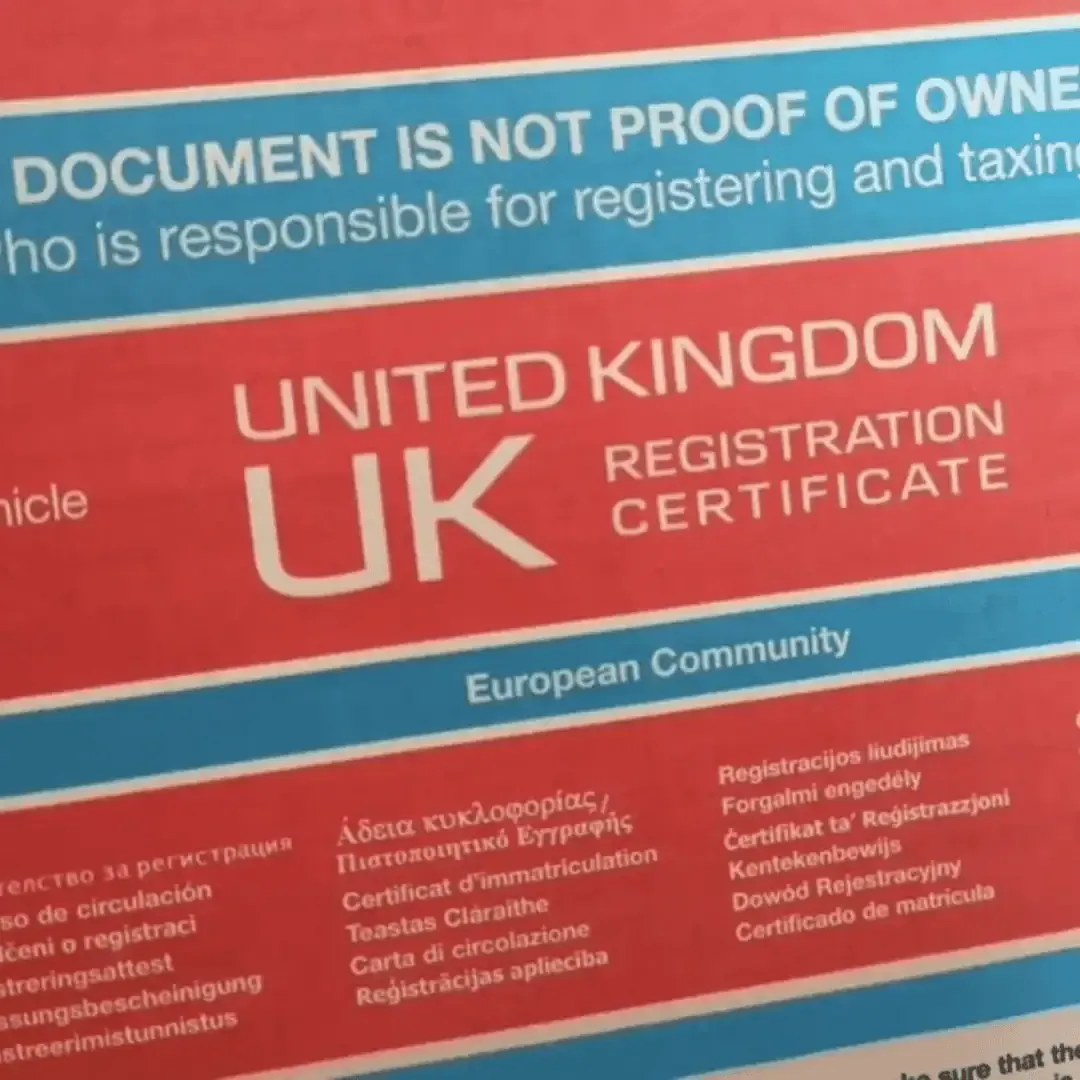
The V5C, or V5 Logbook, is a vehicle registration certificate issued by the DVLA.
It shows who is recorded as the registered keeper of a vehicle, the individual responsible for its legal and tax-related status.
While the V5C is widely used and often requested during transactions, it does not confirm legal ownership of the vehicle.
Its primary role is administrative.
The V5 ensures that the DVLA maintains an accurate record of the registered keeper for enforcement, taxation, and compliance purposes.
The common misconception that it proves ownership often leads to disputes, but legal title depends on other evidence, such as a purchase invoice or finance settlement letter.
Understanding what the logbook does and does not contain is essential before relying on it in a legal or financial context.
Read our complete guide on a DVLA-issued V5 Logbook.
What a V5C Shows
- Registered keeper’s name and address
- Vehicle make, model, colour, and VIN (Vehicle Identification Number)
- V5C issue date and document reference number
- Number of previous registered keepers (if recorded)
The logbook gives a high-level summary of who is responsible for the vehicle according to DVLA records, along with key identifying information used for compliance and record-keeping.
What a V5C Does Not Show
- Legal ownership of the vehicle
- Proof of purchase, finance settlement, or control of the asset
- Transaction history or sale records
- Confirmation of who holds legal rights to the car
Why the V5C Is Often Misunderstood
It’s common to assume that the name listed on the V5C equals legal ownership.
This belief is reinforced by the document’s role in buying and selling, but it misrepresents its purpose.
The DVLA makes it clear that the V5C does not confirm ownership.
This confusion is partly due to differences between UK law and systems used elsewhere.
Some countries issue title certificates that do confirm legal ownership, but in the UK, ownership must be proven through other forms of evidence.
For those, see how car ownership is verified using a combination of documents and records.
How to Prove Car Ownership in the UK
Car ownership in the UK is verified through a combination of documents.
No single piece of evidence is definitive in all cases.
Ownership refers to who has the legal right to control, sell, or transfer the vehicle, and this must be shown through appropriate records.
The V5 Logbook identifies the registered keeper, but it does not verify ownership.
Evidence is evaluated based on strength and context.
This may include invoices, finance settlement letters, or contracts, depending on how the vehicle was acquired.
In more complex cases, professionals compare DVLA records, financial status, and car history to establish a clear picture of ownership.
Learn more about a DVLA Car Details Check.
Below is the standard hierarchy used when verifying vehicle ownership.
Strongest Evidence of Ownership
- Purchase invoice or receipt
A dated document showing the buyer’s name and vehicle details provides direct evidence of transfer. - Bill of sale or sales contract
A signed agreement between buyer and seller establishes intent and transaction terms. - Finance settlement letter
Confirms full repayment and title transfer if the car was purchased under a finance plan.
These documents are ranked by legal clarity and traceability, offering the most weight when ownership is questioned.
Supporting Evidence Used in Disputes
- Insurance policy or certificate
Suggests control and responsibility, but not ownership. - Service and repair records
Indicates long-term possession and engagement with the vehicle. - Correspondence about the vehicle
Includes emails, letters, or transaction confirmations. - Ongoing possession context
Evidence like regular use, location records, or access is helpful but weak on its own.
Supporting documents help reinforce an ownership claim but cannot substitute for strong evidence. They become more persuasive when used in combination.
How Professionals Verify Ownership
Ownership is typically verified through a three-part process:
- Check DVLA registration data
Match keeper records with the documents provided. - Check for outstanding finance or title issues
Determine if a lender still holds legal rights. - Check vehicle history
Cross-reference VIN with history databases to rule out theft, write-offs, or inconsistencies.
This process ensures that ownership claims align across administrative, financial, and historical data points, protecting both parties in a transaction.
Read our guide on Car History Explained.
When Car Ownership Starts and Ends
Car ownership isn't always tied to a single event. Responsibility and control over a vehicle can shift at different points, when money changes hands, when possession begins, or when the DVLA updates its records.
Timing matters: delays between sale and registration update can lead to confusion on lliability.
Understanding how and when this shift occurs helps protect both parties.
The timeline below outlines what changes before, during, and after a DVLA Transfer of Ownership.
Before DVLA Is Updated
After a vehicle is sold or transferred, the new owner may take possession before the DVLA database reflects the change.
In this window, the previous registered keeper can still receive fines or legal notices.
Keeping dated, signed sale documentation is critical.
It serves as proof of the shift in responsibility during the update delay.
If both parties use the DVLA’s online system and provide the 11-digit reference from the V5C, the record can be updated instantly.
If sent by post, delays may occur, increasing the risk of misdirected notices.
During the Transfer
Once both parties initiate the update, the ownership transition begins.
Although the online system is usually fast, there can still be a brief lag before enforcement systems reflect the change.
In this phase, supporting documents, such as sale contracts or receipts, remain key to resolving any ambiguity.
After DVLA Confirms the Change
When the update completes, the DVLA’s records show the new keeper.
This point marks the end of the previous keeper's liability over the vehicle.
Insurance and vehicle tax responsibilities now match the updated record.
For additional detail, see the DVLA ownership check.
Who Is Responsible for Tax, Fines, and Insurance?
Legal and administrative responsibilities usually follow the registered keeper, not the legal owner.
Ownership defines control of the vehicle as property, but obligations such as tax, fines, and insurance are assigned based on DVLA records.
Read our detailed guide to find out If My Car is Legal.
Clear alignment between keeper status and real-world use is essential to avoid enforcement actions or invalid insurance cover.
The breakdown below maps these responsibilities by type.
To verify tax status, see the Free Car Tax Check.
Car Tax Responsibility
Vehicle tax is linked directly to the registered keeper.
This person is responsible for ensuring the vehicle is either taxed or formally declared off-road (SORN).
- Tax enforcement begins with the keeper, not the owner.
- Unresolved ownership disputes do not remove tax liability.
Fines and Enforcement Notices
Fines, such as speeding penalties or parking charges, are initially directed to the registered keeper, based on DVLA records.
- If the keeper wasn’t driving, they may be required to identify the responsible driver.
- Liability starts with the keeper unless DVLA records have been updated to reflect a new status.
Insurance Obligations
Insurance cover must reflect how the vehicle is used and by whom. Insurers generally require the main driver or named user to match the registered keeper, or have a direct link to them.
- A person who is not the legal owner can insure a vehicle, depending on provider's rules.
- The keeper is usually expected to be on the policy to validate cover.
Who Owns a Car on Finance, Lease, or PCP?
Legal ownership of a vehicle can remain with a finance company or leasing provider until the agreement ends.
The type of finance, whether Hire Purchase, PCP, Lease, or Personal Loan, determines who owns the car at each stage.
The user, typically the driver and sometimes the registered keeper, may not hold legal title.
Each arrangement has different implications for control, sale rights, and verification.
See CarVeto’s process to Check if a Car has Outstanding Finance.
Hire Purchase (HP)
In a Hire Purchase agreement, the finance company remains the legal owner until all payments are completed.
The user may be listed as the registered keeper, but cannot sell or transfer the vehicle during the term.
Ownership transfers only after the final payment is made.
PCP Agreements
With a Personal Contract Purchase (PCP), the finance provider holds legal ownership throughout the agreement.
The user may be the keeper, but doesn’t gain ownership unless they pay a final “balloon” sum at the end.
Until then, the right to sell or dispose of the car remains with the finance company.
Leasing and PCH
In a Lease or Personal Contract Hire (PCH) agreement, the vehicle remains the property of the leasing company at all times.
The user is the registered keeper and main driver, but does not acquire ownership.
Plate registration and insurance often reflect the leasing structure but do not affect the title.
Personal Loans
When a personal loan is used to fund a vehicle purchase, the buyer typically becomes the legal owner immediately, as the loan is not tied to the vehicle itself.
Even so, it’s important to check for encumbrances, especially if the lender has applied a security interest.
Changing, Losing, or Disputing Car Ownership
Ownership issues typically occur when DVLA records, transaction evidence, and actual control of the vehicle don’t match.
These mismatches can lead to liability problems, enforcement notices, or disputes over legal title.
Most cases are resolved by reviewing the available documents and verifying what the records show.
Below are the most common scenarios, with the types of evidence that help resolve them. For more, visit the Lost V5 page.
Lost or Missing V5C
If the V5C (logbook) is lost, a replacement can be requested from the DVLA.
The V5C is not proof of legal ownership, it identifies the registered keeper only.
The absence of a V5C doesn’t affect ownership rights, as long as other evidence (such as a receipt or contract) is available.
Ownership Disputes After Sale
Disputes after a vehicle sale usually happen when the DVLA record isn’t updated, finance remains unpaid, or proof of sale is missing.
In such cases, fines or penalties may still be directed at the seller.
Resolution depends on clear evidence: a dated sale receipt, payment records, or written communication showing transfer of control.
Frequently Asked Questions About Car Ownership
No. The registered keeper is recorded for administrative purposes, while legal ownership depends on who bought the vehicle or holds the legal title.
These roles may belong to different people.
No. A V5C shows who is the registered keeper, not the legal owner.
The DVLA states it should not be used to prove ownership.
No. The DVLA does not provide an online tool for the public to view the registered keeper of a vehicle.
For data protection purposes, you can only access this information by applying with a valid reason, using DVLA’s V888 request process.
Ownership is proven using documents like a purchase invoice, bill of sale, or finance settlement letter.
Supporting evidence includes insurance records and correspondence, but no single document is definitive in all cases.
Yes. Legal ownership can be demonstrated by other evidence, such as a receipt, contract, or financial documentation.
The V5C is not required to establish ownership.
It depends on the finance type.
With HP or PCP, the finance provider owns the vehicle until the agreement ends.
With a personal loan, the buyer typically retains ownership of the car. Leasing companies retain ownership under PCH.
The registered keeper is usually responsible for vehicle tax and receiving enforcement notices.
These obligations are linked to DVLA records, not ownership.
Ownership transfers when the buyer gains control and payment is made.
The DVLA update assigns administrative responsibility but does not define legal ownership.
Yes. Joint ownership is possible if supported by documentation.
However, the DVLA can only record one registered keeper.