
Used Car Buying Checklist: What to Look for Before Buying
Car buyers should check a used vehicle’s details, history, documents, physical condition and performance before buying it.
A thorough pre-purchase used car check helps you verify the car’s identity, condition, maintenance history and potential costs.
You should start with the registration number, VIN (Vehicle Identification Number), V5C (vehicle registration certificate), ownership details and supporting documents.
Then you need to check the vehicle’s history, MOT (Ministry of Transport) and service records.
CarVeto allows you to Check Car History for Free, providing useful information before you arrange a viewing or test drive.
Car buyers wondering what to look for when buying a used car need to research the make and model.
You also need to research typical market price, running costs, reliability and common maintenance issues.
A physical inspection should cover the exterior, interior, engine, tyres, brakes, steering, suspension and electrical systems.
A test drive helps identify problems that may not appear when the car is stationary.
You should also consider a professional inspection for expensive, older or higher-mileage vehicles.
Also ask the seller specific questions about the car’s history and condition.
You need to understand the available payment methods, recognise common red flags and compare the different legal protections and return rights that apply when buying from a private seller or used car dealer.
What to Check Before Buying a Used Car?
You should check the car’s registration and vehicle details, history, finance status, stolen status, and write-off records.
Things to check when buying a used car also include mileage, number plate changes, MOT history and service records in the UK.
These used car checks help you verify the vehicle’s identity, legal and financial status, recorded history, and condition.
A used car should pass both online and document-based checks before you move on to a physical inspection and test drive.
This protects the buyer from unexpected repair costs in the near future.
37.3% of UK adults who had bought a second-hand car later discovered unexpected repair costs, as reported by a survey from Blackcircles in September 2026.
The checks you should complete before buying a used car are given below.
Car Registration and Vehicle Details
Checking the car registration and vehicle details confirms that the car you are viewing matches the seller’s description.
You should check the registration number, make, model, engine size, fuel type, colour and transmission against the vehicle and its available records.
The registration number identifies the vehicle in UK records, while its make, model and specification provide additional identity markers.
A mismatch between the registration details, the vehicle itself, the V5C logbook or the seller’s listing indicates an incorrect listing, documentation problem or vehicle cloning.
Used Car History
A used car history check identifies hidden issues that may not be visible from the vehicle or its documents alone.
A history check can reveal outstanding finance, stolen status, previous write-offs, mileage discrepancies, and earlier number plate changes.
CarVeto’s premium used vehicle check combines verified data from several sources.
These sources include Experian, the Police National Computer (PNC), the Driver and Vehicle Licensing Agency (DVLA), and the Motor Insurance Anti-Fraud and Theft Register (MIAFTR).
Reviewing these records alongside the car’s physical condition gives you a more complete view of the vehicle before purchase.
Outstanding Finance
Outstanding finance means a finance agreement remains associated with the vehicle.
The finance company may retain ownership or rights over the car until the agreement is settled.
Personal Contract Purchase (PCP) agreements, hire purchase arrangements, and logbook loans are examples of financial arrangements that require careful checking.
Dealer vehicles may also have unit stocking loans, which allow dealers to finance vehicles held for sale.
Buyers should ask the dealer to confirm that any stocking finance has been settled before completing the purchase.
A vehicle history check identifies recorded finance against the car before you pay a deposit or purchase price.
A finance record should be resolved with the seller and finance provider before the transaction proceeds.
Buyers should contact the lender using the finance agreement reference and vehicle registration details when further confirmation is required.
A settlement letter from the finance provider can provide evidence that the outstanding agreement has been paid.
Buying a car with unsettled finance creates a risk of an ownership dispute or action by the finance provider to recover the vehicle.
A private seller also needs to have the right to sell the vehicle, so buyers should resolve any outstanding finance and obtain appropriate settlement evidence before completing the purchase.
Finance agreements such as hire purchase can give the lender rights over the vehicle until the agreement is settled.
Stolen Vehicle History
Checking a used car for stolen vehicle history helps you establish whether the vehicle has been reported as stolen.
CarVeto checks data from the PNC and other trusted sources like DVLA, MOT, and MIAFTR to identify records associated with stolen vehicles.
A stolen vehicle may be seized by the police even after an innocent buyer has paid for it.
The buyer may then face the loss of both the vehicle and the money paid for it.
Previous Write-Offs
A previous write-off means an insurer has already assessed the vehicle as a total loss after damage or another insured event.
A vehicle history check can reveal whether the car has been recorded as a write-off and provide an important warning before purchase.
The main UK write-off categories are Category A (Cat A), Category B (Cat B), Category S (Cat S), and Category N (Cat N).
Cat A vehicles are designated for disposal, and Cat B vehicles can be salvaged for parts only. Cat S indicates structural damage, and Cat N indicates non-structural damage.
A repaired Cat S or Cat N vehicle needs closer assessment of its repair quality and current condition.
Cat S and Cat N vehicles are safe to return to the road, and the vehicle is valued at least 50% lower than market price.
These write-off statuses stay on the vehicle history for life.
Previous write-off history may affect a vehicle’s safety assessment, market value, insurance options, and future resale prospects.
Car buyers should review the available history and repair evidence rather than relying only on the car’s current appearance.
CarVeto helps you Check Write-Off Categories to learn about the car’s classification and how it affects a vehicle.
Mileage History
Checking mileage history establishes whether the current odometer reading is consistent with the vehicle’s recorded mileage.
You need to compare the mileage displayed on the dashboard with historical MOT readings, service records, and other available vehicle-history data.
Mileage discrepancies may result from clocking, where the recorded mileage is deliberately reduced to make a vehicle appear less used.
The discrepancies also include a legitimate odometer replacement or MOT data input errors.
Vehicle documents should explain a genuine odometer replacement with its invoice, while unexplained differences need further investigation.
Accurate mileage affects how buyers assess a car’s age, condition, maintenance requirements, and value.
A significant unexplained discrepancy also affects the vehicle’s future resale prospects and should be resolved before purchase.
Previous Number Plate Changes
Checking previous number plate changes tells whether the vehicle has been registered under other numbers during its history.
A vehicle history check can show previous and current registration numbers associated with the car.
These numbers include legitimate changes such as personalised registration transfers, with the month and year of each transfer.
Registration history provides another way to cross-check the vehicle’s identity and documentation.
Car buyers should compare previous registration details with DVLA records, the V5C and the registration displayed on the vehicle to identify inconsistencies that require clarification.
You can use CarVeto’s number plate check to identify all previous registration numbers along with the month and year of transfer.
CarVeto displays a warning alert if the vehicle you are checking has a genuine number plate change.
The number plate warning alerts you to act cautiously and ask the seller questions before buying the vehicle.
MOT History
Checking MOT history lets you review the vehicle’s previous test results, failures, advisories, recorded mileage, and next MOT due date.
Car buyers can use CarVeto’s MOT History Check to review these records before viewing or purchasing the car.
MOT history provides evidence of how the vehicle has performed during previous roadworthiness tests.
Most cars require a valid MOT once every 3 years, although some vehicles are MOT-exempt.
A vehicle with a SORN (Statutory Off Road Notification) declaration should not be used on public roads.
It can be used in limited circumstances, like travelling to a pre-booked MOT test.
Service History
Checking the service history lets you know whether the vehicle has received regular maintenance.
You ought to review service intervals, repair records, invoices, receipts, service-book entries, and dealer stamps.
You should then compare these records with the car’s mileage and MOT history.
You need to pay particular attention to major maintenance items such as timing belt or cam belt replacement and clutch work.
Service paperwork should contain consistent dates, mileage readings, vehicle details and garage information that correspond with the car’s history.
Our Service History Check gives you evidence of the vehicle’s maintenance record and helps you predicting upcoming maintenance costs before you buy.
What Documents Should You Check When Buying a Used Car?
You should check the V5C logbook, proof of ownership, VIN and registration details, service records, MOT records, owner’s manual, and spare keys before buying a used car.
These documents and records help you verify the vehicle’s identity, maintenance history, roadworthiness, and the seller’s connection to the car.
Your buying a second-hand car checklist should cover these documents alongside any recent changes or unexplained inconsistencies.
The information should support your vehicle history check and match the car you are viewing before you proceed with the purchase.
The documents you should check when buying a used car are explained below.
V5C Logbook
The V5C logbook is the DVLA registration document that records a vehicle’s registered keeper and key vehicle details.
You should check the V5C logbook, as it records the vehicle’s registration and registered keeper details.
You need to compare the registration number, make, model, colour, engine details, registered keeper information, and document issue date with the seller’s information.
The V5C information should also correspond with the vehicle’s DVLA records and the details shown in your vehicle history checks.
A recently issued V5C or inconsistencies between the document, vehicle and seller will need further checks before purchase.
The V5C identifies the vehicle’s registered keeper rather than proving legal ownership.
You also need to check additional evidence showing the seller’s legitimate connection to the vehicle instead of treating the V5C alone as proof of ownership.
Proof of Ownership
Proof of ownership establishes the seller’s legitimate connection to the vehicle before completing the purchase.
A purchase receipt, sales order or invoice from when the seller acquired the car can provide supporting evidence of the transaction history.
The seller’s details should make sense alongside the V5C, vehicle records, and other available documents.
A seller who cannot provide reasonable evidence of their connection to the vehicle requires additional verification before you proceed.
VIN and Registration Number
Checking both the VIN and registration number gives you two important identifiers for confirming a used car’s identity.
The registration number links the vehicle to UK records and VIN, while the vehicle identification number provides a unique identifier for the individual vehicle.
MOT records are associated with the vehicle and its registration details.
Registration transfers or re-registration may result in historical records appearing under different numbers.
CarVeto reconnects relevant vehicle records across different registration numbers to provide a more complete vehicle history.
The VIN provides a more precise identity check when a vehicle has had multiple registration numbers.
You should compare the VIN displayed on the vehicle with the available documents.
You can also use our Vehicle Identification Number check to verify that the vehicle identity matches the available MOT data.
Service Records and Receipts
Service records and receipts are needed to confirm that the vehicle has received routine maintenance.
You should review service dates, mileage, service intervals, garage details, invoices, receipts, and recorded maintenance work.
The service records should follow a logical sequence when compared with the vehicle’s current mileage and MOT history.
Consistent records provide stronger evidence of regular maintenance, while unexplained gaps or missing receipts make it harder to establish what work has been completed.
MOT Records
MOT records provide a complete history of the vehicle’s previous test results, failures, advisories, mileage readings, and test dates.
Buyers should review these records before purchase and compare them with the vehicle’s current condition, service history and odometer reading.
A useful MOT history should show a clear progression of test dates and recorded mileage, with advisories helping you identify items that have previously required attention.
You can Check Vehicle's MOT Status on CarVeto to review the available MOT information before committing to the purchase.
Owner’s Manual and Spare Keys
The owner’s manual provides manufacturer guidance on the vehicle’s controls, equipment, maintenance requirements and operating procedures.
You should check that the manual relates to the vehicle and includes the information relevant to its specification and equipment.
A spare key provides a useful backup and avoids the inconvenience of arranging a replacement after purchase.
Replacement key costs vary by vehicle and key type, with a missing spare key potentially costing around £100 to £300 to replace.
What to Check When Inspecting a Used Car?
You should inspect the bodywork, paint, rust, doors, windows, boot, tyres, wheels, lights, electrical systems, interior, controls, and engine bay before buying a used car.
This second-hand car purchase checklist helps you identify accident repairs, corrosion, mechanical faults, electrical problems, and signs of wear that vehicle records may not reveal.
You need to inspect the car in daylight on level ground and compare its physical condition with the vehicle’s age, mileage, history, and seller description.
A thorough inspection also gives you specific issues to investigate during the test drive or with an independent mechanic.
The checks when inspecting a used car are explained below.
Bodywork and Paint
Bodywork and paint provide useful clues about the car’s current condition and previous repairs.
You should check the panel gaps, paint colour and finish, dents, scratches, and areas that appear newer than the surrounding bodywork.
Uneven panel alignment, mismatched paint shades, overspray, or an inconsistent finish may indicate previous accident repairs or repainting.
You need to check the body from different angles and look for rippled surfaces that may indicate filler or repaired panels.
Rust and Corrosion
Rust and corrosion can weaken body components and create repair costs after purchase.
You should check the wheel arches, door edges, sills, underbody areas, and around the boot for visible corrosion.
Bubbling paint, flaking metal, and discoloured areas can have rust developing beneath the surface.
You need to pay particular attention to areas where water collects or where damaged paint has exposed the underlying metal.
Doors, Windows and Boot
Doors, windows and the boot should open, close and lock correctly without unusual resistance.
You should test every door, the boot, central locking, electric windows and window seals to confirm that the related mechanisms operate properly.
Uneven gaps, doors that do not close cleanly or difficulty operating the boot may have previous bodywork or mechanical problems.
Damp carpets, wet boot areas or damaged seals can also point to water ingress.
Tyres and Wheels
Tyres and wheels affect road safety, handling, MOT compliance, and the cost of bringing a used car into good condition.
You should carefully check the tread depth, sidewalls, and overall condition of all tyres for uneven wear, cracks, bulges, or other damage.
The UK legal minimum tread depth for most car tyres is 1.6 mm across the central three-quarters and around the entire circumference.
Tyres approaching 3 mm may also require replacement soon, creating an additional ownership cost.
Uneven tyre wear can mean incorrect wheel alignment, worn suspension components, or previous accident damage.
You need to check the wheels for cracks, bends, or significant kerb damage.
You also need to confirm that the car has a spare wheel or puncture repair kit and a locking wheel nut key where applicable.
Lights and Electrical Systems
Lights and electrical systems should operate correctly before you buy the car.
You need to test the headlights, brake lights, indicators, hazard lights, fog lights and reverse lights, then check the dashboard for persistent warning lights.
You should test electric windows, mirrors, central locking, dashboard controls, infotainment systems, and other electrical equipment fitted to the vehicle.
A warning light that remains illuminated after the engine starts or an electrical function that fails needs further investigation.
Interior and Controls
The interior condition should broadly match the vehicle’s age, mileage and recorded use.
You should check the seats, upholstery, dashboard, carpets, trim, and other surfaces for excessive wear, damage or repairs.
You also need to test the air conditioning, heating, wipers, mirrors, windows, infotainment system, and dashboard controls.
Unusual smells, dampness, stains or water damage may indicate leaks, poor maintenance, or previous water ingress.
Excessive wear on the steering wheel, pedals, or seats can also provide useful context when compared with a vehicle advertised as having low mileage.
Under the Bonnet
The engine bay can reveal leaks, worn components, and maintenance issues that are not obvious from the outside.
You need to inspect around the engine and connected components for oil or coolant leaks, damaged wiring, deteriorated hoses and worn belts.
You should check the oil, coolant, and brake fluid levels where accessible and look for contamination or unusual fluid conditions.
Low fluid levels, visible leaks, damaged components, or contaminated fluids mean maintenance requirements or underlying mechanical problems.
Signs of Accident Damage
Signs of accident damage often appear through inconsistent bodywork, repaired components, or alignment problems.
You need to check for mismatched paint, overspray, distorted panels, and differences in the finish between adjacent body panels.
Doors and the boot should open and close without sticking or misalignment.
You should also look under the bonnet and inside the boot for welding marks, bends, non-original bolts, or hinges and other signs of structural repair.
Uneven tyre wear also shows alignment or suspension problems following previous damage.
You should compare these physical signs with the vehicle history report and write-off records before deciding whether the car is suitable for purchase.
What to Check During a Used Car Test Drive?
You should check the engine, temperature, clutch, gearbox, brakes, steering, suspension, and acceleration during a used car test drive.
Many people ask should I be buying a used car through a checklist!
You should use a checklist, as it lets you assess how the vehicle performs under normal driving conditions and identify mechanical issues that may not appear during a stationary inspection.
A test drive provides useful evidence about the car’s starting behaviour, operating temperature, transmission, braking, handling, ride quality, and performance.
You should pay attention to unusual noises, vibrations, resistance, hesitation, and warning signs throughout the drive.
Key checks to make during a used car test drive are given below.
Engine and Temperature
The engine should start smoothly and run consistently from a cold start and after reaching normal operating temperature.
Unusual rattling, knocking, tapping, or grinding noises during startup mean engine or mechanical problems.
The engine should continue running smoothly as it warms up without excessive vibration, smoke or unusual sounds.
You need to monitor the temperature gauge throughout the drive.
It is also better to check that the thermostat allows the engine to reach and maintain its normal operating temperature.
Rapid temperature increases, overheating, or abnormal temperature changes show cooling-system, thermostat or other maintenance issues.
Clutch and Gearbox
The clutch and gearbox should engage smoothly throughout the test drive without stiffness, slipping or sticking.
A manual gearbox should allow each gear to engage without excessive resistance, grinding or unusual noise.
An automatic transmission should shift smoothly and quietly according to the vehicle’s speed and engine load.
Delayed engagement, jerky gear changes, slipping, or unusual transmission noises may indicate gearbox problems.
You should check the transmission behaviour since clutch and gearbox faults are very expensive to repair or replace.
Brakes
The brakes should provide smooth, controlled stopping without excessive pedal effort during the test drive.
You need to test braking progressively in a safe location and check whether the vehicle remains stable during normal stops.
Unusual squealing, grinding, vibrations, or pulling to one side means worn or faulty brake components.
The handbrake should also engage securely and hold the vehicle properly when stationary.
Poor braking performance or unusual brake behaviour warrants further investigation before purchase because brake faults affect both safety and repair costs.
Steering
The steering should feel smooth, controlled, and appropriately assisted throughout the test drive.
Excessive heaviness, resistance, or looseness indicate steering, suspension, or assistance-system problems.
The vehicle should track straight on a suitable and safe road without pulling noticeably to either side.
Vibrations or inconsistent resistance mean alignment, suspension, or steering issues that need further inspection.
Suspension
The suspension should absorb normal road bumps while maintaining a controlled and comfortable ride.
You should pay attention to how the vehicle responds when driving over suitable uneven surfaces at an appropriate speed.
Excessive bouncing, knocking sounds, or harsh movement may indicate worn shock absorbers, springs, or other suspension components.
Poor ride quality reveals suspension faults that are difficult to identify during a stationary inspection.
Acceleration and Performance
The car should accelerate smoothly and keep pace with normal traffic without hesitation or excessive sluggishness.
You need to test acceleration progressively through the gears where safe and legal, while observing how the engine responds to throttle input.
Hesitation, loss of power, unusual engine behaviour or poor throttle response means mechanical or fuel-system issues.
Acceleration performance should also remain consistent as the engine reaches normal operating temperature.
Should You Get a Professional Used Car Inspection?
Yes, you should get a professional used car inspection when buying an expensive, older, or higher-mileage vehicle.
A used vehicle inspection provides an independent assessment of the car’s current condition beyond standard checks and a test drive.
A professional inspection is particularly useful when the vehicle has limited service records, previous damage, unusual test-drive symptoms, or a complex mechanical history.
A used car check before buying does not replace a vehicle history check, document checks, or your own physical inspection.
A professional inspection adds another layer of evidence by assessing the vehicle’s mechanical and structural condition before money changes hands.
Should You Buy a Car From a Private Seller or a Car Dealer?
You should buy a car from a private seller or a car dealer based on your budget, preferred level of protection and confidence in carrying out vehicle checks.
A privately owned vehicle may offer a lower purchase price, while a dealer purchase generally provides greater consumer protection and a more formal buying process.
The difference between private sales and dealer purchases lies in their prices, legal protection, returns, prep, paperwork, sales pressure, and trust factor.
These differences also help you decide which checks to prioritise before buying a second-hand car.
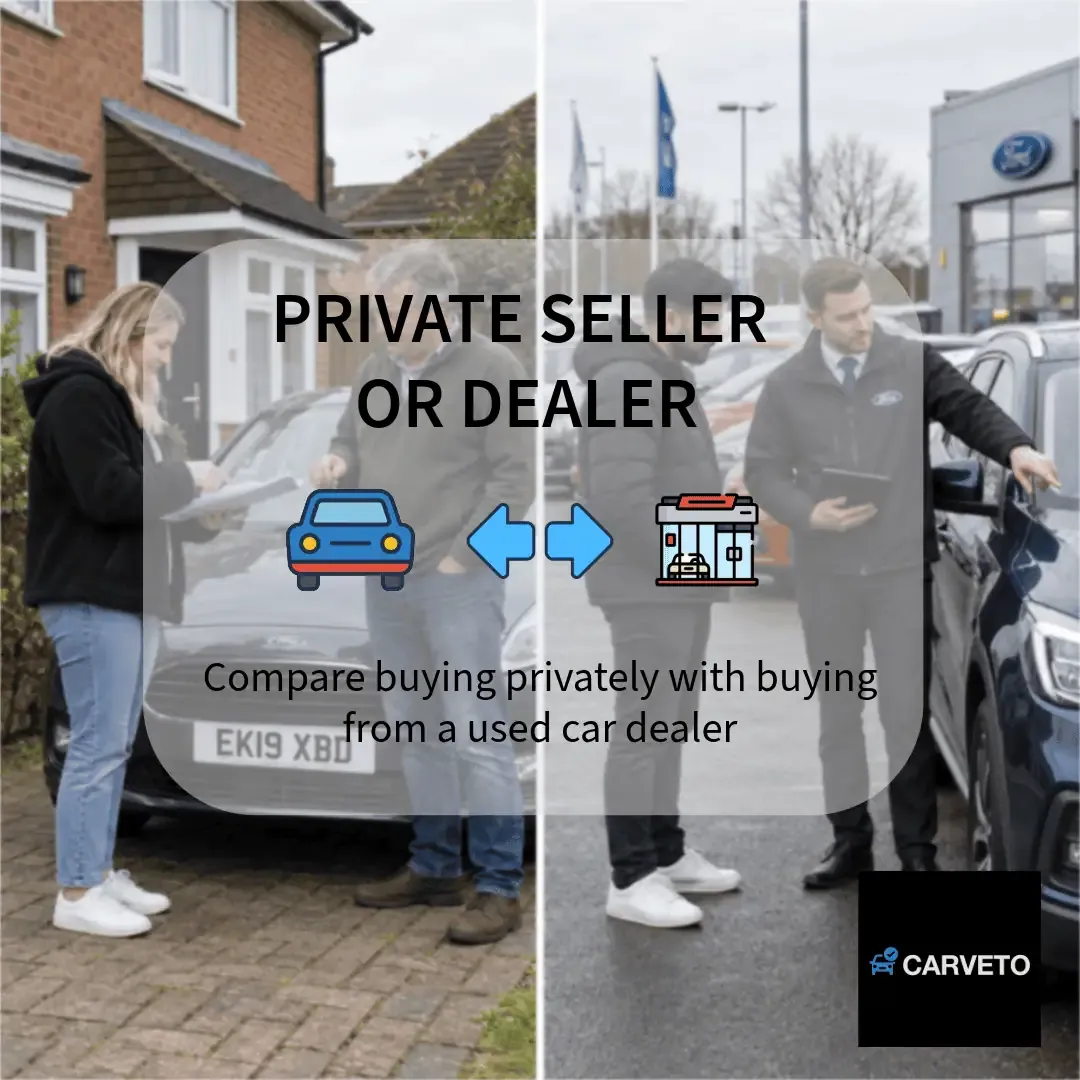
The key differences between buying a car from a private seller and a car dealer are given in the table below.
Feature | Private Seller | Dealer |
|---|---|---|
Price | Often lower | Usually higher (retail) |
Legal protection | Limited | Covered by the Consumer Rights Act |
Returns/refund | Rare to impossible | Possible if faults are found |
Vehicle prep | Sold "as is" | Usually serviced and celaned |
Paperwork support | Minimal | Usually well organised |
Sales pressure | Lower | Can be high |
Trust factor | Varies by seller | More predictable (regulated) |
Buying a Car From a Private Seller
Buying a used car from a private seller involves purchasing a privately owned vehicle directly from its current owner.
Private sales appeal to budget-focused buyers because privately sold cars may have lower asking prices.
These cars offer more options among lower-value vehicles.
Private sellers have fewer trader obligations than used car dealers. Buyers need to take greater responsibility for checking the vehicle before purchase.
A thorough history check, document review, physical inspection, and test drive help buyers identify problems before payment.
Buying a Car From a Dealer
Buying a used car from a dealer involves purchasing a vehicle from a business that sells cars as part of its trade.
Dealer purchases may appeal to first-time buyers because the buying process includes more structured paperwork and established procedures.
Used car dealers have legal responsibilities as traders under the Consumer Rights Act 2015.
It gives buyers additional consumer protections compared with a private sale.
Buyers should still complete their own vehicle history checks, document checks, physical inspection, and test drive before purchasing the car.
What Should You Research Before Viewing a Used Car?
You should research common model problems, typical market prices, fuel type and running costs, and reliability and maintenance issues before viewing a used car.
This research helps you understand whether the car suits your budget and identify questions to raise during the viewing.
Important areas to research before viewing a used car are written below.
- Common Problems With the Make and Model: You should research recurring faults, recalls, and known weaknesses associated with the specific make, model, and engine. These issues help you focus your physical inspection on areas that require closer attention.
- Typical Market Price: You need to compare prices for similar cars by considering the model year, mileage, specification, condition and service history. This comparison identifies whether the seller’s asking price appears reasonable for the vehicle.
- Fuel Type and Running Costs: You should research the fuel type, typical fuel economy, road tax, and insurance group for the specific model. These costs help you estimate the ongoing expense of owning the car.
- Reliability and Maintenance Issues: You ought to research the model’s reliability record and common maintenance requirements, including major components that need periodic replacement. You can use this information to identify potential future repair costs before buying used cars.
How Should You Pay for a Used Car?
You should pay for a used car with cash, card, credit card, or car finance.
Each payment method has different costs, protections and requirements that may affect the overall purchase.
The main payment options for a used car are given below.
- Cash: Cash payment avoids borrowing costs and provides a straightforward way to complete the purchase. Buyers should obtain a receipt and keep clear evidence of the transaction.
- Card: Paying by debit card provides a traceable payment record without creating credit borrowing. Buyers should confirm any applicable card payment limits before completing the transaction.
- Credit Card: A credit card provides a traceable payment record and additional protection under Section 75 of the Consumer Credit Act 1974 for qualifying purchases. Section 75 applies to credit card purchases costing more than £100 and up to £30,000, subject to the relevant conditions.
- Car Finance: Car finance allows buyers to spread the vehicle cost through an agreed finance arrangement rather than paying the full price upfront. You should compare the deposit, interest, repayment period and total amount payable before committing to finance.
What Are the Red Flags When Buying a Used Car?
The red flags when buying a used car include a seller avoiding the V5C address, a recently issued V5C, missing service history, pushy or evasive behaviour, and vehicle inconsistencies.
These signs do not automatically indicate a problem, but working through a checklist when buying a used car confirms whether further checks are needed.
Red flags you should look for when buying a used car are given below.
- The Seller Won’t Meet at the V5C Logbook Address: A seller who refuses to meet at the address recorded on the V5C needs to be analysed. The buyer should ask why the meeting location differs and check the seller’s connection to the vehicle before proceeding.
- The V5C Logbook Was Recently Issued: A recently issued V5C provides a reason to investigate the vehicle’s history further. UK car buyers need to compare the V5C issue date with the vehicle history, seller details and other available records.
- There Is No Service History: Missing service records make it harder to establish whether routine maintenance and major repairs were completed. The car buyer needs to ask the seller for available invoices, receipts, or digital records and compare them with the vehicle’s mileage and MOT history.
- The Seller Is Overly Pushy or Evasive: Pressure to make a quick payment or reluctance to answer reasonable questions can prevent proper checks. Sellers should provide consistent information and allow enough time to examine the vehicle, documents and history.
- The Car Doesn’t Match the Advertisement or Vehicle Checks: Differences in the advertised specification, mileage, registration details, condition, or vehicle history require clarification. Car buyers should compare the car with the advertisement, V5C, MOT records, and vehicle history report before completing the purchase.
Can I Buy a Used Car Without Seeing It in Person?
Yes, you can buy a used car without seeing it in person, but this approach carries additional risks because photos and listings cannot show every physical issue.
An in-person viewing lets you inspect the bodywork, interior, tyres, engine bay and other areas. Problems in these parts cannot be found online.
A physical viewing also lets you compare the vehicle with its paperwork and verify its registration, VIN, and other details.
The UK government recommends checking that the information provided by the seller matches DVLA records and the vehicle before purchase.
What Is the Most Common Hidden Issue When Buying a Used Car?
The most common hidden issue when buying a used car is outstanding finance.
The finance company may own the car under certain finance arrangements, creating a risk that the vehicle could be repossessed after you buy it.
A finance check helps identify agreements that remain associated with the vehicle before you pay the seller.
Mileage discrepancies are another important hidden issue because incorrect mileage records or odometer fraud can affect the car’s history, condition, and value.
Car buyers should compare the current odometer reading with MOT records, service documents, and other available vehicle-history data.
Is a CarVeto Vehicle History Check the Same as an HPI Check?
CarVeto's vehicle history check is similar to an HPI (Hire Purchase Information) check and also provides extra data about the car.
Both checks provide used car history information, including checks for outstanding finance, write-off records, and stolen vehicle records.
The exact information available depends on the specific report and data sources used.
CarVeto Complete History Check gives buyers a broader set of vehicle-history details to review alongside the car’s documents, MOT history and physical condition.
Can I Buy a Car Without the V5 Logbook?
Yes, you can buy a car without the V5 logbook, but you should be cautious.
The V5C logbook provides important registration and registered-keeper information.
The UK government advises buyers not to buy a vehicle without a V5C.
The government recommends checking that the vehicle details match the information held by DVLA.
A missing V5C makes it harder to verify the vehicle’s registration history.
It increases the risk of problems involving a stolen, cloned or incorrectly registered vehicle.
You need to check the vehicle’s DVLA car details, VIN, MOT history and available vehicle records before the purchase.
How Much Is Car Tax for My Vehicle?
The car tax for your vehicle is between £10 and £5,690.
It depends on its registration date, emissions and the tax rules that apply to its registration period.
The relevant DVLA vehicle information determines the applicable Vehicle Excise Duty (VED) rate for the car.
Car tax forms part of the ongoing cost of owning a used vehicle, so checking the applicable rate helps you estimate running costs before purchase.
You can Check Car Tax on CarVeto to verify the vehicle tax status before completing the transaction.
How Do I Notify DVLA of a Change of Ownership?
You should notify DVLA of a change of ownership when a used vehicle is sold by completing the relevant part of the V5C or using the GOV.UK online service.
The process changes the registered keeper details and gives DVLA the information needed to record the transfer.
You should confirm that the seller has completed the transfer and keep the new-keeper V5C/2 slip.
You should use our Change Car Ownership guide to complete the relevant process after buying a used car.
Do I Need Insurance to Test-Drive a Car?
Yes, you need valid insurance that covers you to test-drive a used car.
Your existing car insurance does not automatically mean you are covered to drive another vehicle.
You should check your insurance policy before driving the test-drive vehicle.
A dealership or private seller may provide suitable test-drive cover, but you should confirm the arrangement before driving.
Driving without the required insurance is illegal and may result in penalty points and liability for damage caused to the vehicle or other property.
What Questions Should I Ask When Buying a Car Privately?
The questions you should ask when buying a car privately are listed below.
- How long have you owned the car?
- Why are you selling the car?
- Does the car have any outstanding finance?
- Is the V5C in your name and available to view?
- Does the service history include recent maintenance and repairs?
- Has the car been involved in an accident or written off?
- Are there any known mechanical or electrical faults?
- When was the last MOT and what advisories were recorded?
- Does the mileage match the MOT and service records?
- Can I arrange a test drive and independent inspection?
The seller’s answers should match the vehicle’s documents, history and physical condition.
Any unexplained inconsistency in the answers to these used car checklist questions should be investigated before you pay.
What Questions Should I Ask When Buying a Car from a Dealership?
The questions you should ask when buying a car from a dealership are listed below.
- How long has the car been sitting on the forecourt?
- What is the total on-the-road price?
- What preparation or inspection has been carried out?
- Does the car have a complete service history?
- Has the vehicle been involved in an accident or written off?
- Does the vehicle have any outstanding finance?
- Are there any known faults or repairs required?
- What does the warranty cover?
- Can I arrange an independent inspection?
- What are the terms for returning or rejecting the vehicle if a fault appears?
How Old Should a Second-Hand Car Be?
A second-hand car should be around 3 to 5 years old because it balances lower price with safety and reliability.
The appropriate age when buying a 2nd hand car depends on the vehicle’s condition, history, mileage, and purchase budget.
Older second-hand vehicles in the UK have lower purchase prices, while newer car models cost more.
Depreciation is not linear, and newer vehicles often lose value during their early years.
Car buyers should compare each vehicle on its individual condition and history.
What Should I Do If the Information Given to Me by a Seller Does Not Match DVLA Records?
You should stop the purchase and investigate the discrepancy if the information given to you by the seller does not match DVLA records.
You need to check the registration, make, model, VIN, V5C and other available vehicle details against the official records.
You should contact the police straight away if the V5C information does not match DVLA records.
Can I Return the Car If I Am Not Satisfied?
No, you cannot return a car if you are unsatisfied with your purchase.
You can only return the car under different rights.
These rights depend on how you bought it, who sold it and whether the car has a fault.
A car bought from a dealer in person has a 30-day short-term right to reject if it is faulty, not of satisfactory quality, not fit for purpose or not as described.
This falls under the Consumer Rights Act 2015.
Faults discovered after 30 days may give you rights to a repair or replacement, with further rejection rights applying in certain circumstances.
Online or remote dealer purchases may also have a separate 14-day cancellation period under the Consumer Contracts Regulations 2013.
Private sales provide fewer consumer protections.
A buyer may have a remedy if the seller misrepresented the car, did not have the right to sell it or breached roadworthiness.
Evidence such as the advertisement, messages, vehicle history report and an independent inspection helps establish what was represented and what condition the vehicle was in.
Preserving this evidence becomes increasingly important as more time passes after the purchase, particularly if a fault or dispute arises later.